
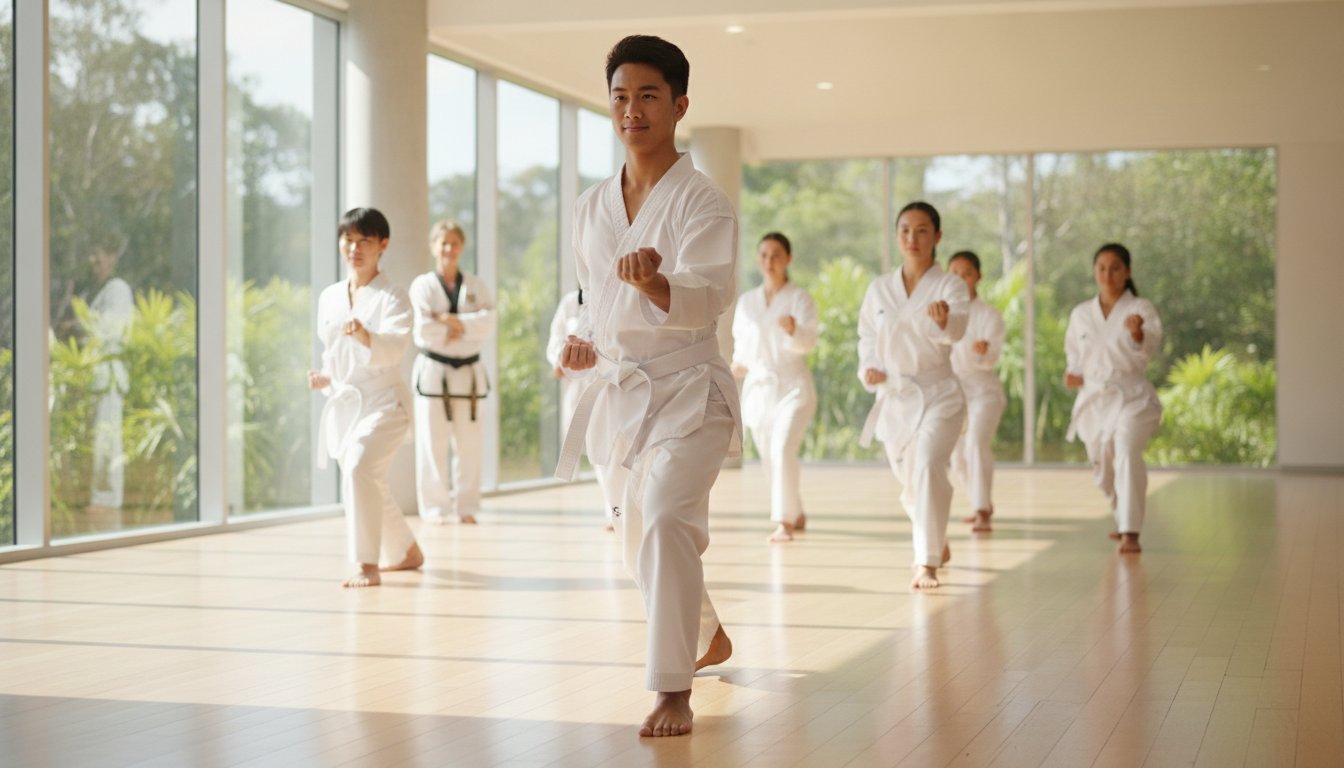
Imagine standing on the mat for your first class, heart racing as the instructor calls out a sharp command, but you have no idea whether to bow or stand still. It’s a common moment of hesitation for many new students who worry about mispronouncing words or confusing similar sounds like Joon-bi and Baro. Learning taekwondo terminology for beginners is about more than just memorizing a list; it’s your first step toward discipline and joining a global community of over 80 million practitioners.
We know that feeling like the only one “out of the loop” is intimidating, but you don’t have to navigate this journey alone. This 2026 guide provides the essential Korean commands you need to build your confidence from day one. You’ll master the vocabulary required for your first belt grading and learn to respond with precision to every instruction given by your coach. We’ll break down the most important terms used in the dojang so you can focus on your training and feel like a true part of our martial arts family.
Key Takeaways
- Understand how Korean language fosters a disciplined environment and connects you to a global community of practitioners.
- Master essential taekwondo terminology for beginners to handle every class interaction with confidence and precision.
- Learn to identify key technical terms for stances and blocks so your physical movement perfectly mirrors your instructor’s commands.
- Gain the skills to count from one to ten and use directional terms to navigate your Poomsae patterns without hesitation.
- Prepare for your first belt grading at Flinn Taekwondo Academy by knowing exactly which terms you need to master for your Yellow Belt.
Why We Use Korean Terminology in the Dojang
Stepping onto the mat for the first time is a powerful experience. It isn’t just about the physical workout; it’s about entering a space where tradition and discipline lead the way. We use Korean commands because they serve as a mental bridge. When you hear these terms, your brain switches into “training mode,” helping you leave the distractions of school or work at the door. This linguistic ritual helps create a focused environment where every student, from our Little Tigers to our Senior practitioners, understands the expectations of the session.
Using these traditional terms also connects you to a global community. Taekwondo is practiced in 213 countries, and whether you are training in our Brisbane academy or a dojang in Seoul, the commands remain the same. This universal language ensures that a student can travel anywhere in the world and feel immediately at home on the mats. Mastering taekwondo terminology for beginners is your passport to this international family. It honors a 2,000-year-old heritage, preserving the spirit of the martial art while you build your own modern success story. For a deeper look at the specific movements you’ll encounter, you can reference this Comprehensive List of Taekwondo Techniques to see how these terms apply to your physical training.
The Dojang and the Dobok: Your Training Space
Respect Through Language: Sabum-nim and Beyond
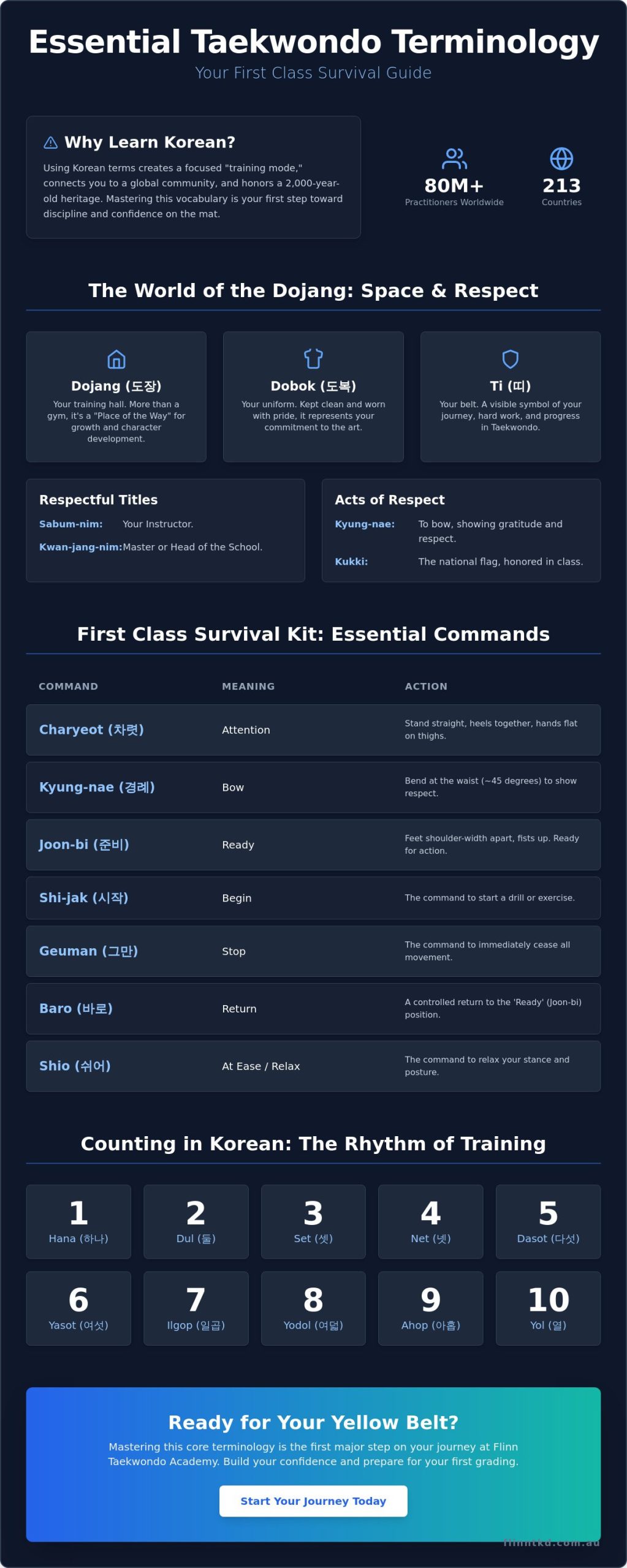
In our community, respect is the foundation of every interaction. We use specific titles to acknowledge the experience and dedication of our leaders. Your instructor is referred to as Sabum-nim, while a master or head of the school is called Kwan-jang-nim. We always perform a Kyung-nae (bow) when addressing them or entering the training area. This isn’t about hierarchy; it’s about showing gratitude for the knowledge being shared. You’ll also notice we show respect to the Kukki (national flag) at the start and end of class. This simple act acknowledges the roots of the discipline and reminds us of the high standards of living we strive for both inside and outside the academy.
The First Class Survival Kit: Essential Commands
Walking into your first session can feel like learning a new language on the fly. Don’t worry about being perfect right away. Focus on these core commands first. They are the building blocks of every class, helping you move in sync with your team. Mastering this basic taekwondo terminology for beginners will immediately lower your stress levels and help you focus on the movement rather than the translation.
Charyeot (Attention) is the foundation. When you hear this, bring your heels together and place your hands flat against your thighs. It signals that you are ready to listen. Kyung-nae (Bow) usually follows. Bend at the waist, about 45 degrees, and keep your eyes focused slightly downward. This is how we show respect to our instructors and peers. These commands are standardized globally. You can even hear them during elite international competitions, as noted in this guide to Olympic Taekwondo Terminology.
Before any drill starts, you’ll hear Joon-bi (Ready). You’ll move your feet shoulder-width apart and bring your fists up to your solar plexus. It’s a physical and mental transition that says you are prepared for action. When the instructor is ready for the class to move, they will call out Shi-jak (Begin). When it’s time to pause, listen for Geuman (Stop). Following this rhythm is the first step toward the discipline required for higher ranks. If you’re ready to put these commands into practice, our martial arts classes in Brisbane are the perfect place to start your journey.
The ‘Return’ Commands: Baro and Shio
After a technique is finished, the instructor will say Baro. This means you should return to your starting “ready” position with poise. It isn’t a rushed shuffle; it’s a controlled return to balance. If the instructor says Shio, you can relax your stance. In our dojang, relaxing doesn’t mean losing focus or slouching. It means taking a controlled breath while remaining alert. You might also hear Dwiro-dora, which means to turn around. We use this to switch directions during drills or to turn away from the flags and instructors to neatly adjust our uniforms.
The Power of the Kiap (Yell)
The Kiap is your spirit yell. It is mandatory because it serves a vital purpose. A sharp, loud Kiap helps you exhale forcefully, which tightens your core and protects you from impact while generating more power in your strikes. It also helps banish nerves. Many beginners start with a quiet, shy sound. We encourage you to find your voice. A strong Kiap shows your coach that you are training with 100% effort and helps you build the internal confidence that taekwondo terminology for beginners is designed to foster.
Taekwondo Technical Terms: Stances, Kicks, and Blocks
Precision in your movement starts with precision in your understanding. Once you have mastered the opening commands, the next step in your journey is learning the specific names for your physical techniques. Using the correct taekwondo terminology for beginners ensures that you and your instructor are speaking the same language during high-energy drills. It allows you to react instantly to feedback without needing a visual demonstration for every single move. This clarity builds your confidence and helps you feel like a true athlete from your very first week.
Your foundation always begins with Seogi (Stance). In our dojang, we teach that power doesn’t come from your arms or legs alone; it starts from the ground up. If your stance is weak, your technique will be unstable. By learning these terms, you develop the mental fortitude to hold your position even when your muscles are tired. This focus on the basics is what separates a dedicated martial artist from a casual participant.
Fundamental Stances for White Belts
- Ap-seogi (Walking Stance): A short, natural stance used for basic movements.
- Ap-kubi (Forward Stance): A long, deep stance that builds leg strength and stability.
- Naranhi-seogi (Parallel Stance): The neutral position used during the ‘Joon-bi’ command.
- Dwbi-kubi (Back Stance): A defensive posture where most of your weight is on the back leg.
Kicking is the heartbeat of our discipline. Known as Chagi, these movements are the signature of the art. Whether you are training for personal growth or looking toward high performance competition training, these kicks require balance and focus. You can find a detailed breakdown of these technical attacks in this guide to Olympic Taekwondo Terminology. Mastering the names of these kicks helps you visualize the movement before you even lift your leg.
The ‘Big Three’ Beginner Kicks
- Ap-chagi (Front Kick): The first kick every student learns, focusing on speed and the ball of the foot.
- Dollyo-chagi (Roundhouse Kick): The most common kick in sparring, involving a powerful hip rotation.
- Yeop-chagi (Side Kick): A technical strike that uses the edge of the foot and requires excellent balance.
Defense is just as critical as offense. Makki (Block) and Jireugi (Punch) work together to keep you safe and effective. A punch in Taekwondo isn’t a simple swing; it involves a specific rotation of the fist that adds snap and power. Learning to name your blocks helps you internalize the three levels of defense: high, middle, and low. This structured approach to taekwondo terminology for beginners transforms the way you perceive your own body’s potential.
Basic Blocking Techniques
- Arae-makki (Low Block): A downward motion to protect against low strikes.
- Momtong-makki (Middle Block): An inward or outward block to protect the solar plexus.
- Olgul-makki (High Block): An upward block designed for essential head protection.
Counting and Directions: Navigating the Poomsae
Mastering the rhythm of a class often comes down to understanding the count. In our dojang, we don’t just move; we move together. Whether you are performing a series of strikes or holding a difficult stretch, the count keeps the energy high and the focus sharp. Learning this specific taekwondo terminology for beginners transforms a group of individuals into a single, powerful team. It creates a shared heartbeat that drives every student to give their best effort.
Counting also plays a vital role in Poomsae (Forms). These are choreographed patterns of movements that simulate a fight against multiple imaginary opponents. In Poomsae, your timing is everything. We use Korean counts to ensure every block and kick lands with the correct power and poise. If you are ready to experience this focus firsthand, we invite you to join our community and start your journey with a trial class.
Mastering the Numbers 1-10
We use Native Korean numbers for counting repetitions and timing movements. For Brisbane speakers, getting the pronunciation right is easier than you might think. Try these phonetic guides during your next practice:
- Hana (Ha-na): One
- Dul (Dul): Two
- Set (Set): Three
- Net (Net): Four
- Dasot (Da-sot): Five
- Yasot (Ya-sot): Six
- Ilgop (Il-gop): Seven
- Yodol (Yo-dol): Eight
- Ahop (A-hop): Nine
- Yol (Yol): Ten
You will notice we count out loud during stretching and basic drills. This isn’t just for tradition. It forces you to breathe properly and helps the instructor gauge the energy of the room. It’s important to note that these numbers are different from the Sino-Korean numbers (Il, Ee, Sam) used to describe ‘Dan’ or ‘Gup’ ranks. Mastering this distinction is a key part of taekwondo terminology for beginners as you prepare for your first grading.
Directional and Level Commands
Understanding where to strike is just as important as knowing how to strike. Your instructor will use directional terms like Oen (Left) and Oreun (Right) to coordinate the class. If you hear “Oen Ap-chagi,” you know exactly which leg to lead with. This spatial awareness is essential for safety and precision in a crowded training environment.
We also divide the body into three distinct target zones. Arae refers to the area below the belt, while Momtong covers the torso from the belt to the neck. Targeting the Momtong is essential for maximum efficiency in sparring and technical drills. Olgul is the head and face area used in high-performance scoring. By learning these levels, you can refine your accuracy and ensure every technique is delivered exactly where it’s intended.
Learning Terminology at Flinn Taekwondo Academy
At Flinn Taekwondo Academy, we don’t treat language as a barrier. We treat it as a tool for personal growth. If this experience inspires you to broaden your linguistic skills even further, you can discover Future Chinese to develop practical Mandarin communication skills. Our Brisbane instructors weave Korean terms into the flow of every session, ensuring you hear them while your body is in motion. This method builds a strong connection between the command and the physical response. Mastering taekwondo terminology for beginners becomes a natural part of your training journey rather than a stressful memorization task. We believe that by using these traditional terms, we maintain a high standard of discipline that benefits our students in their daily lives. Our philosophy focuses on achieving excellence through a balance of ancient tradition and modern coaching techniques.
When the time comes for your first grading, you won’t feel overwhelmed or embarrassed. We explicitly teach the vocabulary required for your first Yellow Belt throughout your initial weeks of training. Our coaches ensure you’re comfortable with the commands, stances, and kicks mentioned earlier in this guide. This structured preparation means you can focus on your technique during the grading, knowing you have the terminology down pat. It’s about building the mental fortitude to perform under pressure while feeling like a valued member of our martial arts community. We want you to walk onto the mat feeling prepared and proud of how far you’ve come.
Tips for Parents: Helping Your Little Tiger at Home
Helping your child master their new vocabulary doesn’t require you to be a Korean linguist. You can turn the ‘Survival Kit’ commands into a fun game during the week. Try calling out “Charyeot” or “Joon-bi” during morning routines to see how quickly they can snap into focus. This playful reinforcement helps them internalize the language of the dojang while having fun with the family. These small moments at home directly support the developmental goals of our Little Tigers Taekwondo Brisbane program, fostering better listening skills and personal agency in young children. You don’t need to be an expert to make a huge difference in their progress.
Join the Flinn Academy Family in Brisbane North
Our academy is led by Master Jeff Flinn, whose 7th Dan expertise ensures you receive authentic instruction in both movement and language. We’ve created a supportive environment where it’s okay to stumble over a word or forget a command as you start out. Every black belt in our room was once a beginner who felt that same hesitation. We invite you to book a trial class to hear the language of Taekwondo in person and feel the energy of our training floor. For those who want to dive deeper into the heritage of our art, our guide on What is Taekwondo? offers a broader look at how this discipline transforms lives. Come and see how taekwondo terminology for beginners can be the key to unlocking your confidence.
Step Onto the Mat with Confidence
You’ve now moved beyond the initial hesitation of your first class. By understanding the core commands and technical terms, you’ve laid the foundation for a successful martial arts journey. Mastering taekwondo terminology for beginners isn’t just about learning a language; it’s about adopting the mindset of a dedicated student. You’ve learned how to respond to your instructor’s rhythm and how to identify the targets for your kicks and blocks with precision.
At Flinn Taekwondo Academy, we are proud to be a family-owned institution serving North Brisbane since 2013. Under the expert guidance of Master Jeff Flinn, a 7th Dan Black Belt, you’ll train using an internationally accredited World Taekwondo curriculum. We provide the mentorship you need to turn these technical terms into powerful, physical skills. Your journey toward discipline and achievement starts with a single step. We can’t wait to welcome you to our community and celebrate your successes on and off the mat.
Book Your Free Trial Class at Flinn Taekwondo Academy Today!
Frequently Asked Questions
Do I need to be fluent in Korean to do Taekwondo?
No, you don’t need to be fluent in Korean to excel in our classes. We focus exclusively on the specific technical terms and commands used during training. Most students find they pick up the vocabulary naturally through repetition and action. Our instructors are here to guide you, ensuring you feel comfortable and confident as you learn the language of the mats alongside your physical techniques.
What is the most important Korean word to know on my first day?
The most important word for your first day is “Charyeot,” which means “Attention.” This command tells you to bring your heels together and focus your mind on the instructor. It’s the foundation of all dojang etiquette and shows that you’re ready to learn. Mastering this single word will help you feel like an active part of the class from the moment you step onto the floor.
Why do instructors yell ‘Shi-jak’ so loudly?
Instructors use a loud, sharp “Shi-jak” to synchronize the group and instantly raise the energy in the room. This command means “Begin” and serves as a mental trigger for explosive movement. A loud call ensures every student hears the instruction over the sounds of training. It helps maintain the disciplined, energetic rhythm that makes our martial arts classes so effective for building focus and power.
Is there a difference between Taekwondo terms and Karate terms?
Yes, there is a clear difference because Taekwondo uses Korean while Karate uses Japanese. For example, we train in a “Dojang,” whereas Karate practitioners use a “Dojo.” While some movements might look similar, the terminology reflects the unique cultural heritage of each art. Learning these specific Korean terms connects you directly to the 2,000-year-old history of Taekwondo and its specific global community.
How do I pronounce ‘Sabum-nim’ correctly?
You pronounce it as “Sah-bum-nim.” The “Sah” sounds like the start of “safari,” and the “bum” rhymes with “hum.” It’s the respectful title for your instructor. Don’t worry about getting the accent perfect right away; the most important thing is the intent and respect behind the word. Our Brisbane coaches will help you refine your pronunciation during your first few weeks of training.
What does ‘Poomsae’ actually mean?
“Poomsae” literally translates to “pattern” or “form.” It refers to a choreographed sequence of movements that represent a fight against imaginary opponents. Each Poomsae is designed to teach you specific balance, timing, and technical skills. It’s a vital part of our curriculum, helping you internalize the defensive and offensive strategies of the art while building your mental fortitude and physical grace.
Can my child learn the Korean terms easily at age 4?
Absolutely, children as young as four learn these terms very quickly through our Little Tigers Program. We use fun games and active drills to help them associate Korean words with specific movements. This playful approach makes learning taekwondo terminology for beginners an exciting part of their week. It’s a fantastic way to boost their cognitive development and listening skills while they have fun with their peers.
Is terminology part of the belt grading exam?
Yes, terminology is a required component of every belt grading exam at Flinn Taekwondo Academy. To earn your first yellow belt, you’ll need to demonstrate a basic understanding of the commands and technical terms covered in this guide. We integrate this knowledge into every class so that by the time grading arrives, you’ll feel completely prepared. Mastering taekwondo terminology for beginners shows your commitment to the discipline.