The best next step for a young athlete may not be more conditioning. If you’re comparing elite athlete development programs for youth brisbane, start by identifying what your child wants to work on: general athletic preparation, skills in a particular sport, or a pathway towards competition.
Families often want training that develops performance without making every session feel like a pressure test. Look for a clear connection between the training and your child’s goals, along with an environment where they can build confidence and discipline as they learn.
This guide explains what youth development can include and how general conditioning differs from focused sport training. It covers practical considerations, from coaching experience to the balance between skill-building and competition. You’ll also see how Taekwondo can provide a sport-specific pathway at Flinn Taekwondo Academy, with Junior Performance, High Performance, sparring classes, and traditional and competition-style Poomsae. Led by internationally accredited Master Jeff Flinn, a 7th Dan Black Belt, the academy offers performance training in a supportive community.
Key Takeaways
- Use your young athlete’s goals to decide whether general conditioning or sport-specific development is the better fit right now.
- Compare elite athlete development programs for youth brisbane by training emphasis, technical skills, competition focus and community.
- Look for progressive development that supports personal growth, not promises of medals, selection or guaranteed results.
- Use a practical checklist to weigh coaching experience, training style and day-to-day fit for your family.
- Explore how Flinn Taekwondo Academy’s Junior Performance and High Performance options can support a young athlete’s goals.
What Should Brisbane Families Expect from Youth Athlete Development Programs?
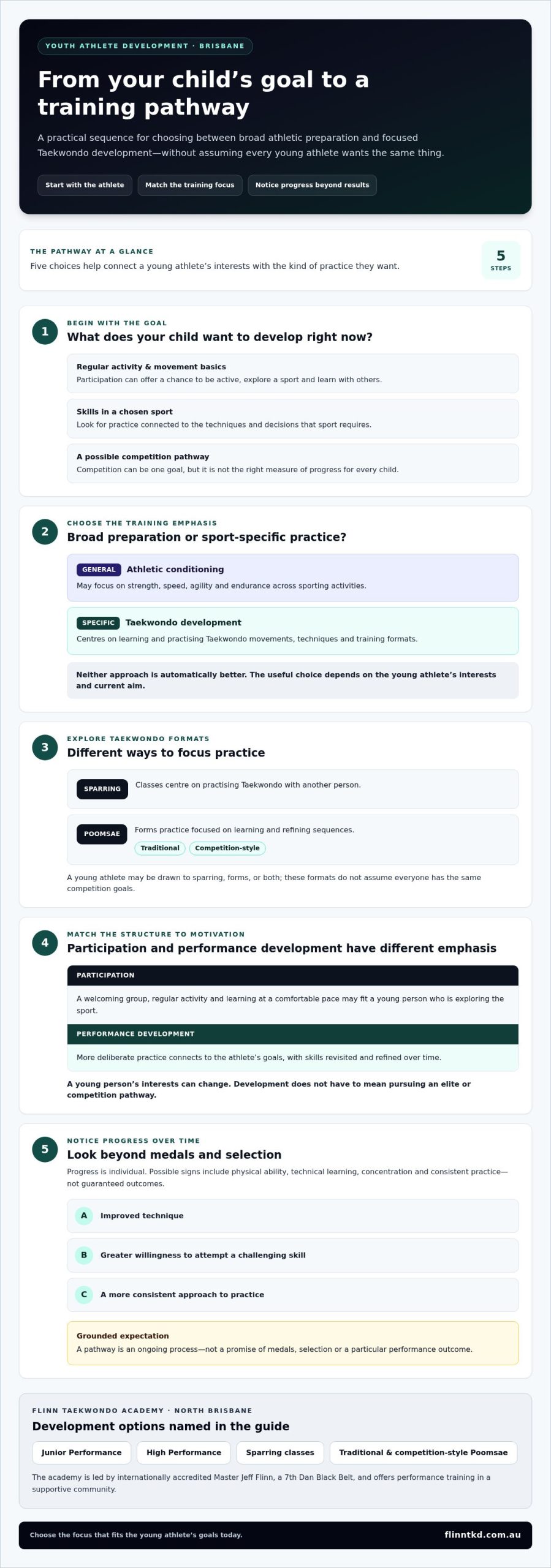
Choosing a youth program starts with a practical question: what does your child want to develop right now? Some young athletes want regular activity and the chance to learn movement basics. Others are ready to practise the techniques of a chosen sport or work towards competition. A clear goal helps you compare elite athlete development programs for youth brisbane without assuming every child needs the same level of structure or ambition.
Youth athlete development is progressive training that builds sport-specific skills and supports an athlete’s personal goals over time. Progress may involve physical ability, technical learning, concentration and consistent practice. The balance depends on the young person’s experience, interests and goals.
What does a youth athlete development program aim to develop?
Development is broader than getting fitter. A program may help a young athlete build movement control and coordination, then practise the techniques and decisions their sport requires. In Taekwondo, sport-specific learning means practising martial arts skills, rather than focusing only on general exercises such as running or bodyweight movements.
Focus and practice habits matter, too. A young person might work on listening to instruction, repeating a technique with care or staying composed while learning something unfamiliar. These are possible areas of development, not guaranteed results. A useful program connects practice to goals that make sense for the athlete instead of promising medals, selection or a particular performance outcome.
That distinction keeps expectations grounded. Competition results can be one measure of progress, but they aren’t the only one. Improved technique, greater willingness to attempt a challenging skill or a more consistent approach to practice can also reflect personal growth. For one child, success may mean preparing for competition. For another, it may mean enjoying training and gradually becoming more capable.
How do families distinguish participation from performance development?
Participation gives young people the chance to be active, explore a sport and learn with others. Performance development adds more deliberate structure: practice is connected to an athlete’s goals, and skills are revisited and refined over time. That doesn’t mean every participant should pursue an elite pathway. A young person’s interests can change, and development can support goals beyond competition.
Consider two examples. A child who wants to try Taekwondo and learn at a comfortable pace may value regular participation and a welcoming group. A child who already enjoys the discipline and wants to improve a specific technique may be drawn to more focused, sport-specific practice. Neither goal is more valid. The key is whether the training matches the young athlete’s motivation and current priorities.
General athletic conditioning and discipline-specific training serve different purposes. Conditioning may focus on qualities such as strength, speed and agility across sports. A Taekwondo pathway centres on the movements, techniques and practice of Taekwondo. Compare these options against your child’s interests rather than assuming one approach suits every athlete. For wider guidance on children’s training and family considerations, explore the Junior Taekwondo Brisbane parent guide.
How Taekwondo Builds a Sport-Specific Youth Development Pathway
General athletic conditioning and Taekwondo have different focuses. Conditioning may develop qualities such as strength, speed, agility and endurance across sporting activities. Taekwondo training centres on learning and practising the techniques of one martial art. Neither approach is automatically better. The useful choice depends on what your young athlete wants to work on.
That distinction matters for families considering elite athlete development programs for youth brisbane. If your child wants broader physical preparation, general conditioning may suit their current aim. If they’re motivated by Taekwondo, a discipline-specific pathway provides opportunities to practise its technical forms and training formats. Some athletes may value one focus now and another later.
What role do sparring and Poomsae play in Taekwondo development?
Sparring classes and Poomsae offer distinct ways to engage with Taekwondo. Sparring is a training format centred on practising Taekwondo with another person. Poomsae is forms practice, available in traditional and competition-style formats. These options help families consider whether a young athlete is drawn to sparring, the precision of forms, or both. They don’t assume every student has the same competition goals.
The formats provide a clear technical focus for practice. A student interested in Poomsae may be motivated by learning and refining forms, while someone drawn to sparring may prefer that training style. Concentration, discipline and repeated skill practice can be part of either approach, but they’re aspects of training, not guaranteed personal or competitive outcomes.
How can a performance pathway support different athlete goals?
A pathway is an ongoing process, not a promise of medals, selection or results. A young person might first want to build familiarity with Taekwondo, then decide to pursue more focused development as their interests take shape. The right emphasis can change over time, so keep the athlete’s own goals at the centre of the conversation.
At Flinn Taekwondo Academy, the training options include Junior Performance and High Performance, alongside sparring classes and traditional and competition-style Poomsae. These are different ways to train, not guarantees of a particular result. Families can also explore High Performance Taekwondo Brisbane for more information about the performance pathway.
For comparison, D1 Training describes its scholastic training programs for youth athletes in a broader athletic-development context. This illustrates how conditioning-focused training can differ from sport-specific technical practice. When weighing approaches, consider what your child wants to learn, what kind of practice keeps them engaged and whether competition is a personal goal or one possible direction.
There’s no single pathway every young athlete should follow. Let their interests guide the choice, then explore Taekwondo training in North Brisbane as a sport-specific option for a child keen to develop within the discipline.
General Athletic Training vs Taekwondo: Which Brisbane Program Fits?
Both general athletic training and Taekwondo can support a young person’s development, but they involve different kinds of practice. A conditioning-focused program may build broad physical qualities, while Taekwondo centres on learning the skills of a specific martial art. To compare elite athlete development programs for youth brisbane, start with your child’s goals, interests and preferred way to learn, rather than assuming one approach suits every athlete.
| What to compare | General athletic conditioning | Taekwondo |
|---|---|---|
| Training emphasis | Broad physical preparation, which may include strength, speed and agility. | Practice focused on Taekwondo as a martial art. |
| Technical skill | Movement and performance work, with emphasis varying by program. | Taekwondo techniques, sparring and Poomsae forms practice. |
| Competition orientation | Performance testing may be part of the approach; competition focus varies. | Training can include traditional or competition-style Poomsae, alongside sparring classes. |
| Community | The experience depends on the program and training environment. | Flinn Taekwondo Academy emphasises a supportive community and personal growth. |
When might a conditioning-focused program suit a young athlete?
A broad athletic program may appeal to a young person who wants to work on physical qualities that support different sporting interests. Strength, speed and agility are examples of qualities a conditioning program may address, and some programs include performance testing. These features help families understand the focus, but they don’t establish that conditioning is the right choice for every child or promise a particular result.
When might a Taekwondo-based pathway feel like a better fit?
Taekwondo may appeal to a child who wants to learn martial arts techniques and practise them within a dedicated discipline. Sparring and Poomsae provide distinct training formats, while a supportive community and personal growth can matter to families alongside technical development. Explore the Taekwondo classes North Brisbane guide for broader academy context.
Use a practical match, not a blanket ranking. If your child’s main interest is general athletic preparation, compare the stated focus on strength, speed, agility and testing. If they’re curious about martial arts skills, consider whether Taekwondo practice fits that interest. Some young athletes may value both kinds of development at different points; neither needs to replace the other. A Taekwondo pathway in North Brisbane offers a sport-specific option for families whose child is keen to train in the discipline.
A Practical Checklist for Choosing Youth Athlete Development in Brisbane
A strong program fit starts with your child, not a label such as “elite.” Use this checklist to compare training purpose, coaching experience and family logistics. It can help you decide whether a performance-focused pathway feels right now or whether another style better suits your young athlete’s current interests.
Which questions help clarify an athlete’s goals and preferred training style?
Talk with your child about what they enjoy and hope to learn. Separate current interests from longer-term ambitions: a young person curious about Taekwondo may later want to explore competition, but they don’t need to commit to that goal now. Let their priorities guide the comparison.
- Define the goal. Is your child looking to learn a sport, develop Taekwondo technique, work on personal discipline or prepare for competition? A clear priority makes program descriptions easier to compare.
- Match the training style. Consider whether they’re most interested in martial arts practice, sparring, Poomsae or broader athletic conditioning. Look for an approach that connects with their motivation.
- Consider competition interest. Is competition a current goal, a possible future interest or not a priority? Performance development can still be meaningful without a competition target.
- Look at coaching experience. Give weight to relevant, stated experience and accreditation. Flinn Taekwondo Academy is led by internationally accredited Master Jeff Flinn, a 7th Dan Black Belt.
- Assess community and practical fit. Consider whether the training environment feels supportive for your child and whether the location and hours work with family routines. A program is easier to sustain when it fits everyday life.
How can families assess coaching and community fit?
Instructor experience gives families useful context, while the training environment helps show whether a young athlete may feel encouraged to learn. Flinn Taekwondo Academy aims to provide a secure and supportive atmosphere, with an emphasis on personal growth. Consider how that approach aligns with what your child wants from training.
Practical details matter, too. The academy hours are Monday: 5:30 pm - 8:00 pm and Thursday: 5:30 pm - 8:00 pm. Compare those times with your family’s regular commitments to judge whether the schedule is manageable. This makes the decision more concrete: the training should match the athlete’s goals and fit your household’s routine.
If Taekwondo matches your child’s interests, book a free trial to experience the training environment as a family.
Start a Youth Taekwondo Development Journey with Flinn in North Brisbane
For families looking for elite athlete development programs for youth brisbane, a useful next step is to explore a pathway built around the sport your young athlete wants to practise. Flinn Taekwondo Academy is North Brisbane’s Premier Taekwondo Academy, led by internationally accredited Master Jeff Flinn, a 7th Dan Black Belt. The academy combines focused Taekwondo training with a supportive community where young people can work towards personal goals.
What confirmed training options can families explore at Flinn?
Flinn offers Junior Performance and High Performance as distinct training options. Families can also explore sparring classes and Poomsae, including traditional and competition-style forms practice. Each format gives a young athlete a different way to engage with Taekwondo. Their interests can guide which option feels most relevant, without assuming every student has the same aims or wants to compete.
Training is about more than a single performance outcome. Skill practice, discipline and personal growth can all be part of a young person’s experience, while progress remains individual. Flinn’s focus on a secure, supportive community gives families a sense of the environment the academy aims to foster. The aim is to encourage young athletes as they pursue their interests, without promising medals, selection or guaranteed results.
As you consider the options, talk with your child about what they’re keen to try. Are they interested in sparring, drawn to the detail of Poomsae or simply curious about Taekwondo? Their answers can help make the first step feel purposeful. Goals may change as they learn more about the discipline, so there’s no need to decide on a long-term performance destination before beginning.
How can a family take the first step?
Trying a class gives your family a practical way to experience the academy and see how Taekwondo feels for your young athlete. Flinn offers a free trial, two free classes on sign-up, a FREE uniform for new starters and no joining fee. These introductory offers provide a welcoming starting point without requiring your child to make competition their goal.
Choose a first step that fits your family. Your young athlete can explore Taekwondo, discover the training formats and begin building their own goals in a community-focused setting. Book your free trial with Flinn Taekwondo Academy.
Help Your Young Athlete Take the Next Step
Your child doesn’t need a complete competition plan before beginning. A first step can help them discover what they enjoy, what challenges them and whether Taekwondo feels like a good fit. Talk about what they’re curious to try, then let their experience shape the next goal. Progress develops through practice, encouragement and a willingness to keep learning.
As you weigh elite athlete development programs for youth brisbane, keep your young athlete’s voice at the centre of the decision. Their goals may develop over time, and a good starting point gives them room to build skills and confidence without pressure to follow someone else’s path.
Flinn Taekwondo Academy welcomes families to take that first step through a free trial. Give your child the chance to experience the training and decide what they’d like to pursue next. Book a free trial with Flinn Taekwondo Academy.
Frequently Asked Questions
Is Taekwondo a suitable athletic development option for a young person?
Taekwondo can suit a young person who wants a sport-specific martial arts pathway. Flinn offers Junior Performance, High Performance, sparring classes, and traditional and competition-style Poomsae. For families comparing elite athlete development programs for youth brisbane, the key is whether the discipline and its training formats match the young person’s interests. Participation can support their development, but it can’t guarantee athletic, academic or competitive outcomes.
Can a young athlete begin Taekwondo without competition experience?
Yes. A young athlete can explore Taekwondo without making prior competition experience the deciding factor. Flinn’s mission is to provide a supportive environment where individuals of all levels can enjoy the discipline. The academy offers Junior Performance, High Performance, sparring classes and Poomsae. A free trial gives your family a practical way to experience the training environment and consider whether it suits the athlete’s interests.
Does youth athlete development have to focus on winning?
No. Winning doesn’t have to define a young athlete’s development. Your family might value a child learning a new technique, practising consistently, developing discipline or feeling part of a community. For example, a young person may enjoy improving their Poomsae even if competition isn’t a goal. Flinn offers several Taekwondo training formats in a supportive, empowering community, but no program can promise medals, selection or a particular result.
How much training should a young athlete do each week?
There’s no single weekly schedule that suits every young athlete. Consider your child’s current goals, other commitments and interest in training rather than assuming more sessions always mean better development. Flinn’s published hours are Monday: 5:30 pm - 8:00 pm and Thursday: 5:30 pm - 8:00 pm. Use these hours to see whether the academy’s schedule fits your family’s routine and the athlete’s preferences.
What is the difference between sparring and Poomsae in Taekwondo?
Sparring and Poomsae are distinct Taekwondo training formats. Flinn offers sparring classes, while Poomsae involves practising traditional or competition-style forms. A young person interested in forms practice may be drawn to Poomsae; another who wants to explore sparring may prefer that format. Talk with your child about what they’re curious to learn, and let their interests help guide which aspect of Taekwondo feels engaging.
Can families try Flinn Taekwondo Academy before committing?
Yes. Families can book a free trial to experience Flinn Taekwondo Academy and consider whether the training suits their young athlete. New sign-ups receive two free classes on sign-up and a FREE uniform for new starters. There’s also no joining fee. These offers give your family a chance to explore Taekwondo and reflect on whether the academy’s training environment feels like a good fit.