What if your child’s wish to quit Taekwondo is a signal to understand, not an immediate yes-or-no decision? If you’re asking what to do if my child wants to quit taekwondo, it’s natural to feel torn. You want to respect your child’s feelings, but you may also wonder whether they’re going through a tough patch.
Pushing too hard can make training feel like a battle, while agreeing straight away may leave the real issue unexplored. A calm conversation can help you understand whether your child is struggling with confidence, enjoyment, the training environment or the time commitment. Listen to their reasons, then talk together about commitment and what comes next.
This guide will help you explore what may be behind the request, compare supportive options and agree on a clear next step. You’ll learn how to listen without dismissing your child’s feelings, when it may help to work through a difficult moment, and when stepping away could be right. The goal isn’t to win an argument. It’s to help your child feel respected while your family makes a thoughtful decision.
Key Takeaways
- Start by exploring what’s making Taekwondo feel difficult or less worthwhile for your child.
- Use calm, open questions to understand their experience before discussing whether to continue.
- Compare continuing, adjusting, pausing or stopping based on the reason your child shares.
- Answer the question “what to do if my child wants to quit taekwondo” by agreeing on one clear next step and a time to review it together.
- A constructive conversation with your child and a supportive coach can help clarify the path forward.
When your child wants to quit Taekwondo, start by understanding why
When your child says they want to stop Taekwondo, you don’t have to settle the decision on the spot. Begin with curiosity, not a lecture or a quick promise that they can quit. Their request is useful information: something about training or life around it may feel difficult or less worthwhile right now. Listening calmly shows you take their experience seriously, even if you haven’t decided what happens next.
Start with one question: what is making Taekwondo feel different now? The answer could involve enjoyment, confidence, friendships, changing goals or family routines. It could be one frustrating class or a concern that has been building for a while. Don’t assume which it is. If you’re searching for “what to do if my child wants to quit taekwondo,” understand their perspective before weighing up the options.
Taekwondo can involve physical skills, discipline and personal development. If your child is unsure what they value about training, exploring the philosophy and benefits of Taekwondo may give you both useful context. General information, though, can’t explain your child’s individual experience. Their words matter most.
What might be behind a child wanting to stop?
Invite your child to describe a recent class or moment that shaped the request. Try, “What happened at training that made you feel this way?” or “Is there a part you still enjoy?” They may mention a change in confidence, friendships, goals or the family schedule. Treat each answer as something to understand, not proof of a problem or a reason to dismiss their feelings.
How can parents tell whether this is a passing feeling?
Notice whether the request is new, repeated or linked to a particular experience. Then ask what your child still enjoys, without using those positives to talk them out of their concern. One difficult class doesn’t prove they want to stop for good, just as one enjoyable class doesn’t erase a repeated worry. Listen for patterns in what they say over time.
It may help to separate your child’s feeling from the decision you’ll make as a family. You can say, “I hear that you don’t want to go right now. Let’s understand what’s behind that before we decide.” This leaves room for temporary frustration and a lasting change of heart without labelling either one. Ask for a specific example, then reflect back what you heard: “It sounds like you’re enjoying the skills, but feeling unsure about training with the group.” Give them a chance to correct you.
Listen for what your child describes instead of trying to solve everything in the first conversation. If their answer points to a particular part of training or a family routine, you’ll have something concrete to consider. If they can’t explain yet, keep the conversation open and revisit it. Their request doesn’t need to become a test of commitment or an immediate yes-or-no decision.
How to talk with your child about quitting Taekwondo
A useful conversation isn’t a cross-examination, and it doesn’t need to end with a decision that day. Choose a calm moment when neither of you is rushing to training or already upset. Your aim is to understand your child’s experience, not persuade them to stay or prove that quitting is wrong. That gives you a clearer foundation for deciding what to do if my child wants to quit taekwondo.
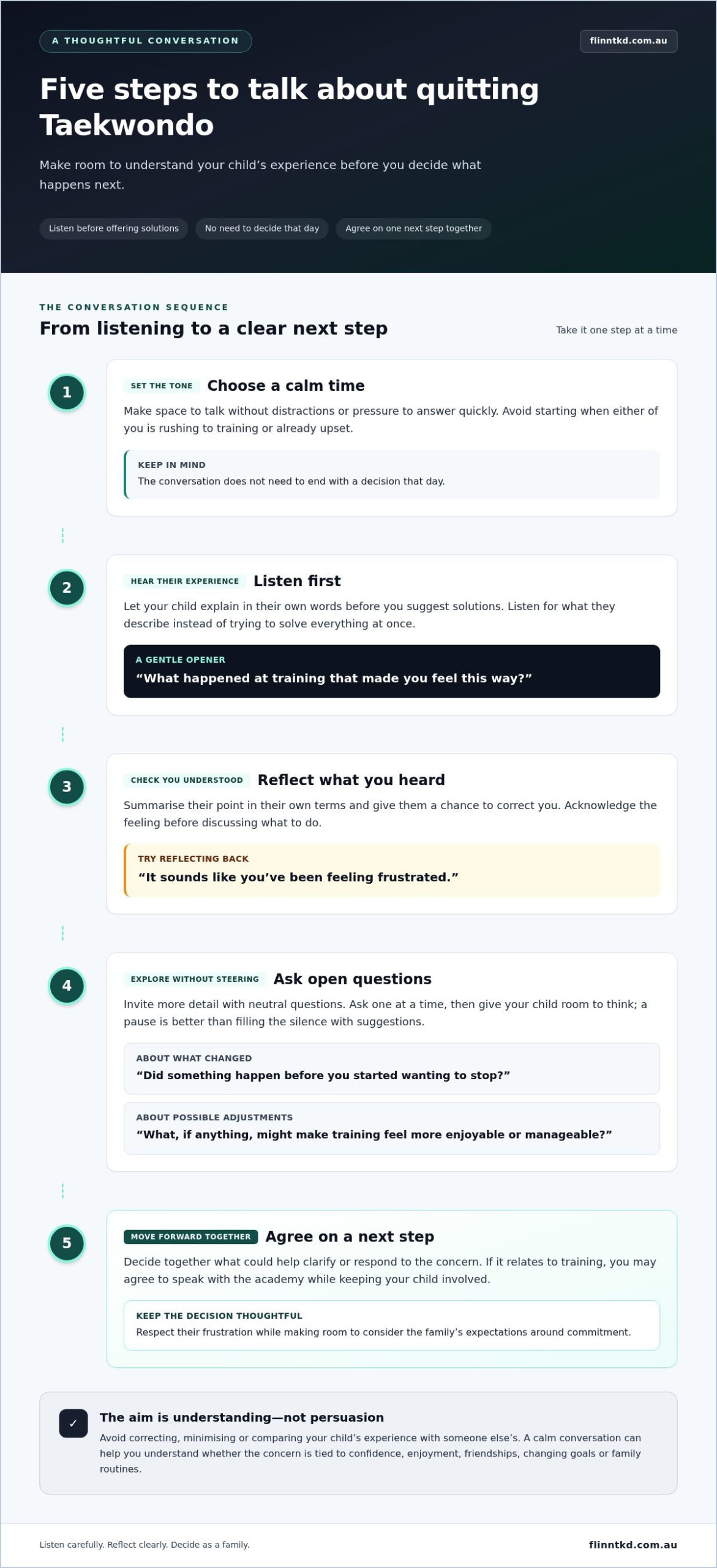
Try this simple sequence:
- Choose a calm time. Make space to talk without distractions or pressure to answer quickly.
- Listen first. Let your child explain in their own words before you offer solutions.
- Reflect what you heard. Summarise their point and check you’ve understood it correctly.
- Ask open questions. Invite more detail without steering the answer toward continuing.
- Agree on a next step. Decide together what could help clarify or respond to the concern.
Questions that help a child explain what has changed
Keep your questions neutral and easy to answer. You might ask, “What do you like least about training at the moment?” or “Did something happen before you started wanting to stop?” To explore possible solutions, try, “What, if anything, might make training feel more enjoyable or manageable?” Ask one question at a time, then give your child room to think. A pause is better than filling the silence with suggestions.
How to listen without turning the talk into pressure
Acknowledge the feeling before discussing what to do: “It sounds like you’ve been feeling frustrated.” Then reflect their own words: “You said the training feels harder lately. Have I got that right?” Avoid correcting, minimising or comparing their experience with someone else’s. Even if you see the situation differently, understanding their view helps keep the conversation open.
Separate what your child feels from what your family expects around commitments. You can respect their frustration and still explain that you want to consider the decision thoughtfully. For example: “I hear that you’re ready to stop. Let’s understand what’s making you feel that way, then we can talk about our options.” This isn’t a trick to make them continue. It shows that commitment matters while making clear their feelings matter too.
If your child describes a concern tied to training, speaking with the academy may help you discuss what’s happening and what could change. Keep your child involved and agree together on what you’d like to talk about. Flinn Taekwondo Academy provides a secure and supportive atmosphere, so a conversation about your child’s Taekwondo experience can be a useful next step. The decision remains a family one, made with your child rather than argued over them.
Continue, adjust, pause, or stop: compare the options
Once you understand your child’s concern, compare several possible responses instead of treating the choice as “force them to stay” or “let them quit today.” Each option may suit a different situation, and none guarantees that your child will feel differently. Use the comparison below to discuss what each response might address and what you’ll review together.
Continue as usual
May address: A short-lived dip in motivation when your child still enjoys training overall.
Review point: After an agreed training period, discuss whether the concern has eased or is still present.
Adjust a manageable aspect
May address: A specific concern about goals, routine or what your child focuses on during training.
Review point: Check whether the agreed change has made training feel more manageable or engaging.
Pause
May address: A need for space to think or temporary pressure on family routines.
Review point: Choose together when to revisit the decision and whether your child wants to return.
Stop
May address: A consistent preference to leave Taekwondo after your child has had the chance to explain their reasons.
Review point: Talk about what stopping means for current family commitments and future choices.
These are conversation aids, not rules. If you’re weighing what to do if my child wants to quit taekwondo, connect the response to the reason your child gave. Continuing unchanged may not address a concern about the training routine. A pause can offer space, but it won’t by itself explain what your child wants next. Agree on a review point that suits your family, rather than assuming there’s one timeline for everyone.
When adjusting the routine may be worth discussing
Match any proposed adjustment to the concern your child described. If they’re losing interest in their current goals, ask whether a different goal or class focus might feel more motivating. If the family routine feels stretched, discuss what practical change could help. Keep the plan specific, then review whether it addressed the concern. A change may help, but don’t promise it will restore your child’s enthusiasm.
When a pause or stopping may fit the situation
If your child’s preference remains consistent after an open conversation, include pausing or stopping in the discussion without calling either choice a failure. Talk through what each means for family expectations and whether returning might be an option later. A pause can leave the decision open; stopping can provide a clearer ending. Neither choice defines your child’s character or cancels the effort they’ve already put in.
Whatever you choose, make the next step clear: what will change, who is involved and when you’ll review how it’s going. A shared plan turns an uncertain decision into something your family can revisit calmly.
Make a Taekwondo decision together with a clear next-step plan
After discussing your child’s concern and considering the options, turn the conversation into one practical next step. A clear plan helps your child know what to expect and gives you both something specific to review. If you’re still wondering what to do if my child wants to quit taekwondo, match the plan to the reason your child shared rather than asking them to make a permanent decision before you understand what’s happening.
Keep the agreement simple. Write down or repeat back:
- The concern: What your child wants addressed, in their own words.
- The next step: One action that responds to it, such as discussing the experience with the instructor or trying an agreed adjustment.
- What you’ll each notice: Your child might reflect on enjoyment or willingness to attend, while you observe whether the agreed change works for the family.
- The review point: A mutually understood time or milestone to talk again, chosen to suit your circumstances rather than a universal timeline.
How to set expectations without making training a punishment
Be honest about your expectations and why they matter to your family. You might say, “I value following through on commitments, and I also want to understand what isn’t working for you.” Then give your child a genuine say in the next step. Agreeing on a practical action is different from requiring them to attend as punishment. Recognise their effort in speaking openly, without promising a particular outcome.
What to review when you revisit the decision
Return to the original concern first. Ask whether it has changed, stayed the same or shifted, then discuss what your child noticed about enjoyment, confidence and willingness to attend. Compare those observations with the plan you made, not with an expectation that everything must be better. Use the conversation to decide whether to continue, adjust, pause or stop, then agree clearly on what happens next.
If your child’s concern involves their experience in class, a respectful conversation with the instructor can help you understand the situation and discuss a constructive way forward. Keep the focus on your child’s perspective: explain what they’ve shared, ask for the instructor’s observations, and include your child where appropriate. The aim is not to assign blame. It’s to work together on a plan that respects your child and supports a positive training environment.
Flinn Taekwondo Academy provides a secure, supportive and empowering atmosphere. If speaking with the academy could help your family decide what to try next, start a conversation about your child’s Taekwondo experience.
Finding a supportive next step with Flinn Taekwondo Academy
After listening to your child and considering a next step, a conversation with the academy may help your family understand their training experience. Flinn Taekwondo Academy offers a secure, supportive and empowering environment with a focus on community. Share your child’s concern clearly and respectfully, then focus the discussion on understanding what they’re experiencing and what might be a suitable next step.
How a supportive academy conversation can help
Explain what your child has told you, using their own words rather than presenting guesses as facts. For example, “They’ve said they’re finding training less enjoyable, and we’d like to understand their perspective.” Invite your child to add their view where appropriate. A calm, shared conversation can help clarify what’s going on, though it can’t promise a particular outcome.
Keep the purpose practical: understand your child’s experience and consider whether there’s a reasonable way forward. That might mean agreeing on an adjustment, continuing with a shared understanding, or recognising that Taekwondo may no longer suit your child. For families asking what to do if my child wants to quit taekwondo, a conversation with a supportive coach can add perspective without taking the decision away from the child and family.
If you want programme context as part of that conversation, the Junior Taekwondo Brisbane guide can help families understand the academy’s junior Taekwondo offering. For a broader overview of the academy, see the Taekwondo Classes North Brisbane guide.
A low-pressure way to explore Taekwondo again
If your child is considering starting or returning, a free trial offers an opportunity to experience a class without pressure to decide on the spot. Treat it as a chance for your child to see how the experience feels, not as a promise that they’ll want to continue. New starters receive a FREE uniform, and there is no joining fee.
There’s no need to frame a trial as a test or a commitment to stay. Talk beforehand about what your child would like to notice, such as whether they feel comfortable taking part or enjoy the training. Afterwards, ask for their honest impressions and listen without pushing for a particular answer. This gives your family another piece of information to consider, while leaving room for your child’s choice.
Flinn Taekwondo Academy is a family-owned North Brisbane academy offering children’s classes, including a self-defence focus. If your family would like to explore a return, consider a free trial as one possible next step. If your child’s preference is to stop, a respectful conversation can still help bring the decision to a thoughtful close.
Let your child help shape the next step
Your child’s decision can be a chance to practise speaking up, weighing options and taking part in a family choice. You don’t need to force a quick answer. Keep the conversation open, follow through on the plan you agreed, and make room for your child’s honest view as you decide what comes next.
If you’re still considering what to do if my child wants to quit taekwondo, the best next step is one that responds to your child’s experience and feels clear to your family. Continuing, making a change, pausing or stopping can each be considered thoughtfully. If your child is curious about returning, a trial lets them experience training before deciding whether it feels right.
Flinn Taekwondo Academy offers a supportive, empowering community for children learning Taekwondo in North Brisbane. Book a free trial with Flinn Taekwondo Academy if your child would like to explore training again. Sign up today and receive two free classes. Take the next step together, with care, confidence and room for your child to grow.
Frequently Asked Questions
Is it normal for a child to want to quit Taekwondo?
It can happen, but a wish to stop doesn’t by itself show whether your child has lost interest for good. Their enthusiasm may shift as training, friendships, goals or family routines change. Ask what prompted the request and whether it connects to one specific moment, such as a challenging activity, or a broader feeling about Taekwondo. Listen to their explanation before deciding what the request means.
Should I make my child keep going to Taekwondo?
Not automatically. If you’re asking what to do if my child wants to quit taekwondo, consider both your family’s expectations about following through and your child’s actual experience. Ask what is making them want to stop, then discuss whether continuing, changing something, pausing or leaving fits that concern. You can encourage responsibility without using pressure or threats. Listening first gives you room to decide together, rather than requiring an immediate answer.
What should I say when my child wants to quit Taekwondo?
Start with a calm, open question such as, “What’s been feeling different about Taekwondo lately?” You could also ask, “Was there a moment that made you want to stop?” Let your child finish, then check your understanding: “So you’re finding the class tiring, but still enjoy learning new skills?” Once they confirm or correct you, discuss one next step together instead of arguing about whether they should quit.
How can I tell if my child is just having a bad day or really wants to stop?
One difficult day can’t settle the question on its own. Ask whether your child has felt this way just today or has brought it up before, and whether a particular event prompted it. You can also ask what parts of Taekwondo they still look forward to, if any. Treat their answers as clues for a conversation, not a scorecard: feelings can be mixed, and only your child can explain what they mean.
Can my child take a break from Taekwondo instead of quitting?
Yes, a break is one possibility, though it won’t suit every family or automatically resolve the concern. Before pausing, agree on what “break” means in practice: whether training stops for now, what your child hopes the time will help them understand, and when you’ll talk again. A clear review point prevents the pause from becoming an unspoken permanent decision, while leaving space to choose differently later.
What if my child wants to return to Taekwondo after quitting?
Returning doesn’t mean the earlier choice was a mistake; interests and circumstances can change. Talk about what feels different now and what your child hopes to get from training this time. For a child considering a return in Brisbane, Flinn Taekwondo Academy offers a free trial as a low-pressure way to experience a class. It gives your family a chance to explore the idea without assuming your child will choose to continue.