You sign your child up for sport hoping they’ll learn focus and structure, only to spend Saturday mornings watching them wander the field or sit disengaged on the bench. When weighing taekwondo vs soccer for building discipline, many parents assume any energetic activity will naturally curb classroom distractions and teach listening skills at home.
It’s completely normal to feel torn. You might worry that large team sports allow unfocused kids to slip through the cracks, or conversely, that combat training might accidentally encourage aggression rather than calm self-control. Every child develops at their own pace, and the training environment you choose directly shapes their everyday habits and emotional regulation.
Discover how martial arts and team sports cultivate focus differently so you can choose the best discipline-building path for your child. Ahead, we break down how constant mat participation compares to team field play, how structured mentoring impacts behavior at school, and the exact criteria you need to make the right choice for your family.
Key Takeaways
- Understand the fundamental differences in taekwondo vs soccer for building discipline, contrasting field-based team rules with personal self-regulation.
- Discover why open soccer fields can overwhelm sensitive children, whereas structured dojang boundaries channel high energy into calm, focused effort.
- Learn how continuous active participation eliminates the frustration of bench time, keeping every child engaged and progressing at their own pace.
- Use our clear decision matrix to evaluate your child’s personality and identify the exact sport environment where they will thrive.
- See how year-round mentorship under an experienced master instructor reinforces classroom attention, respect, and consistent family values at home.
Understanding Youth Discipline: External Compliance vs Internal Self-Regulation
Parents often view discipline as quiet obedience. In developmental psychology, genuine youth discipline means voluntary self-regulation: the ability to manage attention, emotional impulses, and physical energy without someone hovering over your shoulder. When comparing taekwondo vs soccer for building discipline, the real test is whether an activity builds internal drive or merely enforces rule-following while an adult is watching.
Soccer relies heavily on situational compliance. Children respond to boundary whistles, team offside calls, and referee directions. When the ball moves downfield or play stops, that external constraint disappears. Martial arts training shifts the responsibility inward. Gaining real ground in understanding youth discipline requires looking at how children master their own bodies and minds, transforming outside enforcement into lifelong personal control.
The Anatomy of Discipline in Youth Sports
Developing executive function demands consistent neural conditioning. Following game boundaries teaches social conformity, but self-control requires conscious physical restraint. In a martial arts dojang, children practice stillness, balance, and deliberate breathing before executing complex techniques. These structured physical rituals anchor a distractible child’s nervous system, dramatically cutting down emotional outbursts and building sustained focus.
Why Traditional Play Differs from Deliberate Character Training
Recreational games focus primarily on outcome and immediate play. Deliberate character coaching, by contrast, relies on formal behavioral boundaries built directly into every session. In structured martial arts, respect is not left to chance:
- Ritualised entry: Bowing onto the training mat signals an immediate mental transition from playground chaos to focused effort.
- Verbal standards: Clear vocal responses to instructors build immediate listening habits and accountability.
- Systematic progress: Earning new belt ranks directly ties patient technical repetition to measurable personal milestones.
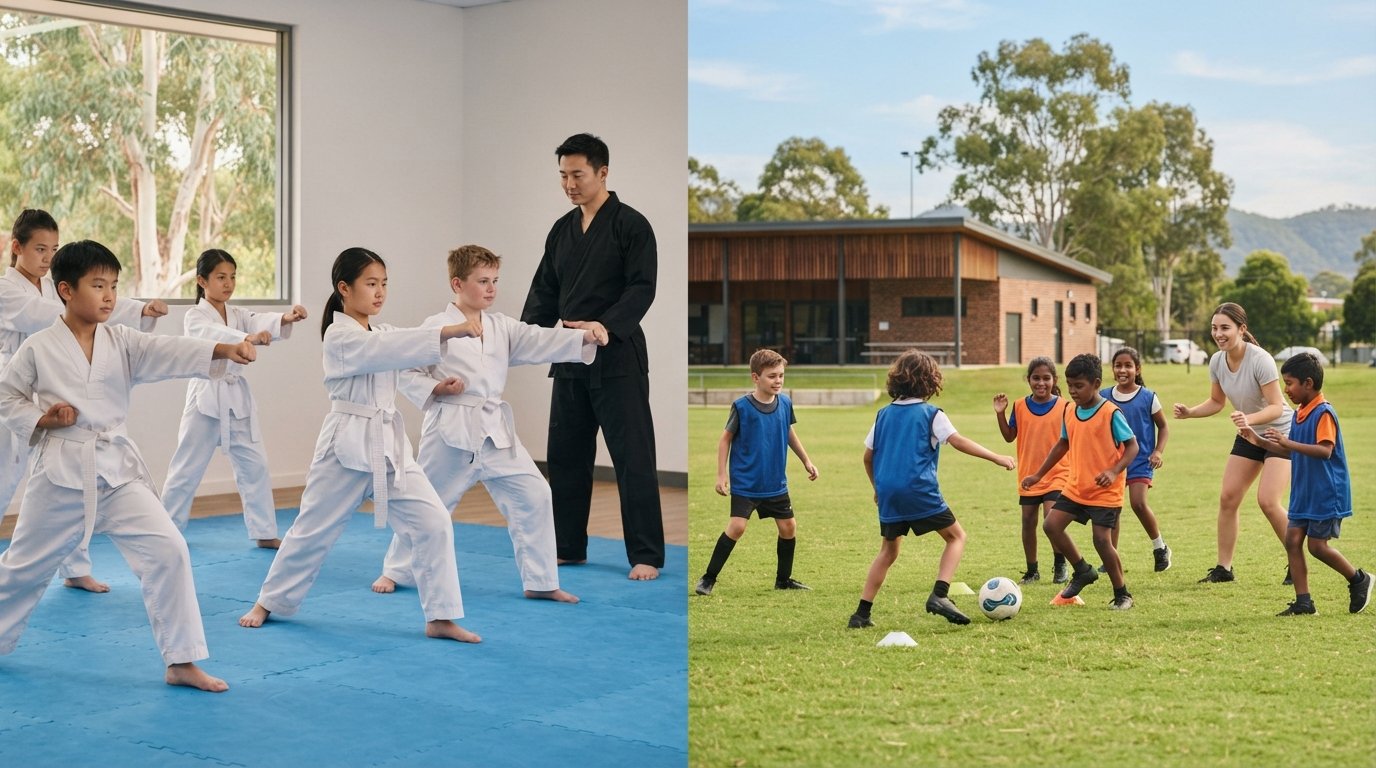
While soccer offers fantastic cardiovascular conditioning and teamwork, it treats self-control as a secondary byproduct of team strategy. Taekwondo makes personal self-mastery the primary goal of every drill. Evaluating taekwondo vs soccer for building discipline reveals that deliberate, ritualised practice creates self-regulation habits that transfer directly into classroom attention and cooperative behavior at home.
Head-to-Head Comparison: How Taekwondo and Soccer Build Key Habits
Choosing between these two sports means looking closely at how daily training sessions run. While both physical activities build motor coordination, understanding how sports build key habits reveals stark differences in student feedback, space boundaries, and personal accountability. Evaluating taekwondo vs soccer for building discipline comes down to how each environment structures a child’s attention.
- Coach-to-student ratio: Soccer squads often place 12 to 16 children under a single volunteer coach across a massive open pitch. Martial arts classes maintain tighter instructor ratios within defined mat borders.
- Spatial boundaries: Outdoor pitches present wind, sideline crowds, and weather shifts. A dedicated dojang provides a quiet, climate-controlled space free from external distractions.
- Feedback loop: Soccer players touch the ball periodically and receive broad tactical directions from the sideline. Martial artists receive hands-on, micro-corrections on posture, balance, and focus every few minutes.
Structure, Rituals, and Respect on the Mat vs Field
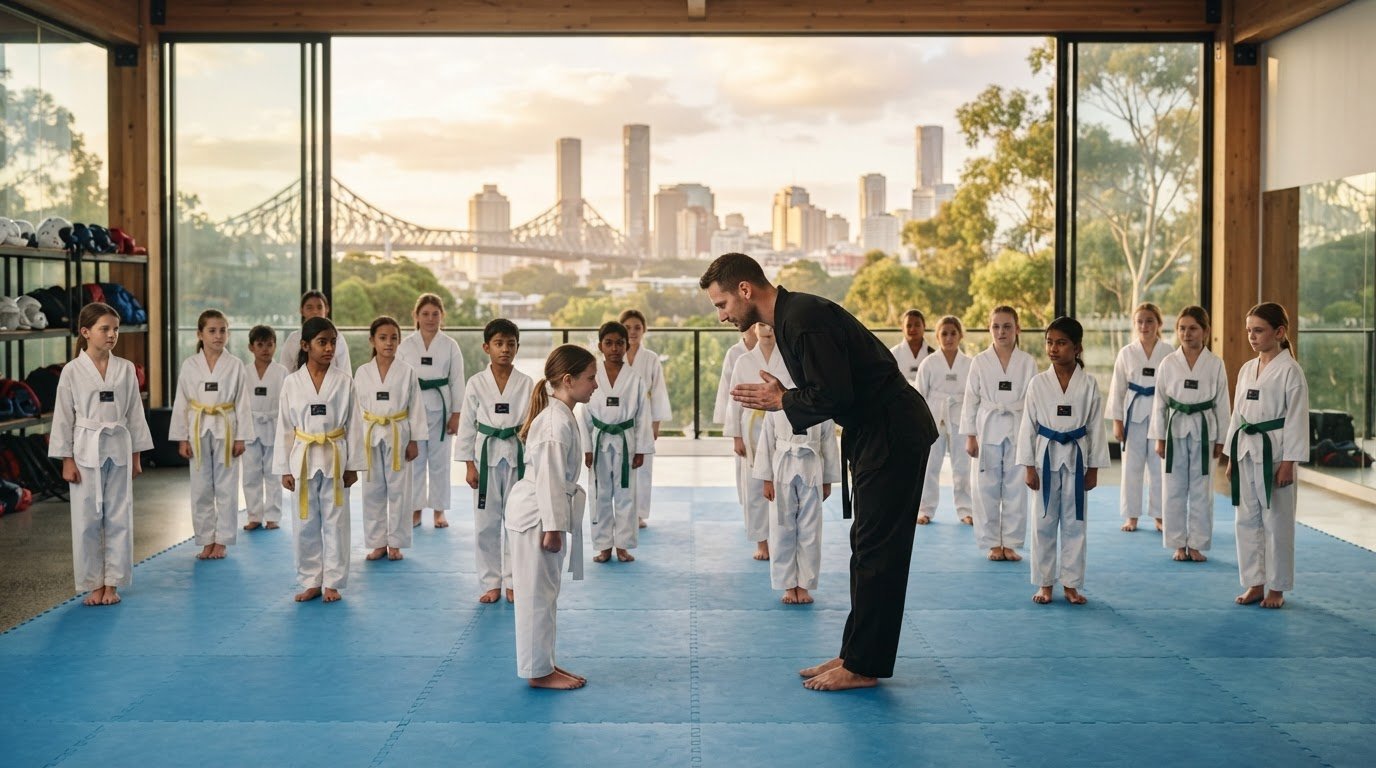
A child wearing a soccer jersey prepares for recreational gameplay. Putting on a traditional white uniform (dobok) creates a different mindset entirely. In our foundational guide on what is Taekwondo, we explore how martial traditions demand focused presence. Every session begins and ends with bowing to the instructor and training partners. This formal etiquette acts as a mental boundary line, helping distractible children switch instantly into listening mode.
Goal Setting and Milestones: Belts vs Match Outcomes
Soccer motivation hinges on weekend scorelines, team standings, and match outcomes. A child can play hard yet walk away disheartened because the team lost, or slack off while a dominant teammate scores every goal. Martial arts decouples progress from peer comparison. Through a structured belt ranking system, your child earns advancement purely through their own technical growth and patience. This tangible milestone framework builds genuine intrinsic motivation, proving that focused practice yields direct, undeniable reward.
Accountability: Individual Execution vs Team Delegation
Team sports permit hiding. Hesitant or unfocused children easily blend into the background during a large match, occasionally spending entire halves waiting on the bench. On the training mat, hiding is impossible. Every student executes each kick, block, and poomsae pattern simultaneously. If you want to see how this consistent participation transforms focus firsthand, exploring classes at Flinn Taekwondo Academy can show you how active engagement keeps young minds fully switched on.
When weighing taekwondo vs soccer for building discipline, this level of personal ownership makes all the difference. In martial arts, no child gets lost in the crowd, and nobody sits on the sideline waiting for a turn to grow.
Managing Overstimulation, Focus, and the Bench-Time Dilemma
A windy Saturday soccer match presents an intense sensory storm. Between shouting sidelines, barking referees, and opposing players racing across an open field, easily overwhelmed kids often shut down mentally. Instead of teaching self-regulation, wide-open team environments can trigger acute sensory fatigue. When evaluating taekwondo vs soccer for building discipline, you have to look at how each sport regulates environmental noise and manages nervous systems.
Soccer creates severe lulls in action. When the ball moves to the far corner of the field, a young player might stand completely idle for minutes. For an energetic child, this idle space invites grass picking, chatting, or wandering out of position. Even worse, sitting on the interchange bench sends an unintended message: if you aren’t performing right now, you sit out. That feeling of exclusion often breeds resentment rather than internal drive.
Navigating Field Distractions and Sideline Disengagement
Young minds crave clarity. On a massive pitch, competing voices pull a child’s attention in half a dozen directions at once:
- Sideline chaos: Shouting parents and coaching instructions blur together, making it difficult for an overwhelmed child to process next steps.
- The bench penalty: Rotating onto the sideline interrupts physical momentum, causing restless kids to lose their emotional anchor.
- Variable engagement: Touching the ball only two or three times a match leaves energetic children understimulated and prone to behavioral lapses.
Sensory Control and Deliberate Repetition in the Dojang
Martial arts takes the opposite approach by using sensory containment. Inside the dojang, the physical space is bounded, predictable, and free from external spectator commotion. Children channel excessive restlessness directly into high-intensity kicking drills against target pads. This physical impact provides immediate proprioceptive feedback, grounding hyperactive bodies in real time.
Poomsae (patterns) training challenges kids to coordinate precise hand strikes, deep stances, and rhythmic breath control simultaneously. There is no room for daydreaming. To reset their state, students utilize the kiahp, a sharp vocal shout that releases physical tension while locking in focus. Between technical repetitions, instructors call students into a silent, still attention stance (charyeot). Practicing physical stillness on command trains the brain to hit the brakes voluntarily.
As explored in our detailed Junior Taekwondo guide, school-age children need systematic sensory regulation to succeed academically. Comparing taekwondo vs soccer for building discipline highlights that structured repetition channels physical energy into genuine self-possession, ensuring every child stays actively engaged from the opening bow to the final salute.

Parent Decision Matrix: Which Sport Best Matches Your Child Temperament?
Every child processes instructions differently. An environment that inspires one youngster might leave another feeling lost or anxious. While roughly 26% of Australian children participate in soccer, popularity shouldn’t dictate what works best for your household. Deciding between taekwondo vs soccer for building discipline starts with an honest look at your child’s natural behavioural tendencies.
- The Daydreamer: Easily misses whistle cues and drifts out of position on large pitches. They gain sharp spatial awareness through direct martial arts coaching.
- The Impulsive High-Energy Mover: Struggles with unstructured sideline lulls. They thrive on rapid, continuous pad work that turns erratic movement into disciplined power.
- The Anxious Perfectionist: Freezes under team pressure or fear of letting down peers. They blossom through individual belt progressions where self-mastery is the only standard.
- The Natural Team Communicator: Possesses solid innate focus and loves collaborative play. They naturally flourish within the fast, shared tactical flow of outdoor ball sports.
When Taekwondo is the Clear Winner for Your Child
Choose martial arts if your child struggles with peer pressure, schoolyard boundaries, or low self-esteem. A study by The American Journal of Preventive Medicine noted that children participating in martial arts are 20% more likely to meet daily physical activity recommendations compared to those in traditional sports. Because every movement requires personal ownership, children can’t lean on dominant teammates to carry the workload.
Consistent mentoring under a black belt master instills calm authority. Students learn de-escalation skills, assertive body posture, and self-defense capabilities that defuse potential bullying before it starts. If your child needs a structured routine to build daily confidence, you can book an introductory trial class at Flinn Taekwondo Academy to see this transformation in person.
When Soccer Offers Complementary Athletic Value
Soccer excels as a seasonal athletic outlet for kids who already demonstrate steady baseline discipline. Running across wide open turf builds peripheral vision, cardiovascular stamina, and instinctive group communication. Passing drills teach young players to read team rhythms and celebrate shared victories.
Many active families don’t treat this choice as mutually exclusive. Using martial arts as a year-round behavioral foundation provides the core strength, balance, and mental grit that makes a child a far more coachable soccer player when winter season arrives. Ultimately, weighing taekwondo vs soccer for building discipline means matching your child’s current development needs to the training environment that supports them best.
Building Lifelong Character at Flinn Taekwondo Academy in Brisbane
Fostering genuine self-control requires a steady community and proven mentorship. Serving North Brisbane families since 2013, Flinn Taekwondo Academy provides a disciplined, welcoming environment where young people build focus that lasts a lifetime. The dojang is led by Master Jeff Flinn, an internationally accredited 7th Dan Black Belt whose coaching pedigree ensures every child receives high-calibre technical instruction within a supportive family culture.
Comparing taekwondo vs soccer for building discipline often leads parents right to our doors. While weekend ball sports run on seasonal schedules, year-round martial arts training anchors your child’s weekly routine. Our certified instructors actively partner with parents, ensuring the respect, manners, and focus practiced on the mats carry over into the classroom and everyday home routines.
A Structured Pathway from Little Tigers to Junior Excellence
Age-appropriate coaching makes all the difference when teaching self-regulation:
- Little Tigers Program (4-6 years): Early learners practice core motor fundamentals, impulse control, and active listening. Energetic exercises teach young children how to follow multi-step instructions without losing patience.
- Junior Taekwondo Program (7-12 years): School-age students tackle technical poomsae forms, practical children self defence, and controlled sparring. They build physical resilience while discovering how quiet concentration leads directly to belt advancement.
- Advanced Development: Older practitioners transition smoothly toward high performance competition training or senior technical streams as their passion deepens.
Our teaching methodology, detailed in our comprehensive guide to Taekwondo Classes North Brisbane, treats character development not as an afterthought, but as the foundational pillar of every technique.
Why Brisbane North Families Trust the Flinn Method
Local parents love our open, community-oriented atmosphere. You won’t find yourself shivering on an open sideline hoping your child gets rotated onto the pitch. In our dedicated academy, you can sit comfortably and watch your child gain confidence during every single class minute. Our instructors praise honest effort, demand polite conduct, and show children how to take deep pride in their own hard work.
When weighing taekwondo vs soccer for building discipline, give your child the benefit of an active environment where no one sits on a bench. Contact Flinn Taekwondo Academy today to book an introductory trial class and experience our life-changing youth programs firsthand.
Choose the Right Discipline Pathway for Your Child Today
Every child’s journey toward self-control looks different. While team sports offer energetic weekend recreation, settling the debate of taekwondo vs soccer for building discipline comes down to lasting personal habits. Martial arts replaces sideline waiting and sensory overwhelm with continuous, structured accountability. The self-regulation your child practices on the mat quickly becomes second nature at school and at home.
Since 2013, Flinn Taekwondo Academy has helped North Brisbane families turn restless energy into calm, respectful leadership. Under the guidance of internationally accredited 7th Dan Black Belt Master Jeff Flinn, our dedicated age-specific classes support your child every step of the way. When children are given clear boundaries and individual goals, they discover what they are truly capable of achieving.
Give your child the lifelong gift of self-belief and unwavering focus in an environment where no one sits on the bench. Book a trial session at Flinn Taekwondo Academy today and see their confidence flourish from the very first lesson.
Frequently Asked Questions
Is Taekwondo better than soccer for a child with ADHD or attention challenges?
Yes, Taekwondo is generally far better suited for children with ADHD or attention difficulties. Clear physical boundaries, repetitive movement, and zero sideline waiting remove the sensory overload common on open soccer pitches. In the dojang, instructors deliver one-step instructions with immediate feedback, anchoring attention through structured movement. Comparing taekwondo vs soccer for building discipline highlights how martial arts channels restless impulses into sharp motor control.
Will enrolling my child in Taekwondo make them aggressive or encourage fighting?
No, authentic Taekwondo training actively reduces aggressive behavior by instilling emotional self-regulation. Training emphasizes humility, self-control, and non-violent conflict resolution. Students learn that martial techniques are strictly reserved for dojang practice and practical self-defence. By providing a safe physical outlet for frustration, children develop the emotional maturity needed to walk away from playground conflicts rather than instigate them.
Can my child train in both Taekwondo and soccer at the same time?
Absolutely, many Brisbane families successfully balance both activities during the winter club season. Taekwondo provides year-round motor conditioning, agility, and mental focus that directly improves a child’s field awareness and kicking precision in soccer. The key is establishing a consistent weekly schedule. Martial arts instills the personal accountability and coachability that helps young athletes shine within their weekend soccer squads.
At what age should a child start Taekwondo to build discipline?
Children can begin building fundamental discipline as early as age four. At Flinn Taekwondo Academy, our Little Tigers Program (ages 4 to 6) focuses on basic listening drills, balance, and spatial boundaries. By age seven, children in our Junior Taekwondo Program possess the motor coordination for technical poomsae forms and belt grading. Starting early establishes positive behavioral routines before classroom habits solidify.
How quickly do parents typically see behavioral improvements at home and school?
Most parents observe noticeable improvements in home routines and classroom focus within four to six weeks. Consistency is crucial. Attending two structured classes each week reinforces habits like making eye contact, responding promptly to instructions, and caring for equipment. When weighing taekwondo vs soccer for building discipline, the immediate positive reinforcement on the mat accelerates how fast children apply respect outside the academy.
What happens if my child feels intimidated during their first martial arts class?
Feeling hesitant before trying a new activity is completely normal, and our instructors guide newcomers gently. At our North Brisbane academy, Master Jeff Flinn and our coaching team introduce beginner students with welcoming, low-pressure partner drills. Parents sit close by to observe, ensuring children feel safe and supported. New students quickly realize the dojang is an encouraging learning space rather than an intimidating arena.
How does Taekwondo teach respect differently than school sports coaches?
Taekwondo embeds respect into every physical ritual, treating character training as a core technical skill rather than a side rule. While team sports coaches often focus on tactical play and game strategy, martial arts instructors require formal bowing, respectful verbal responses, and deliberate listening stances throughout class. This continuous standard teaches children that genuine respect is an active, daily practice that applies to teachers, parents, and peers alike.