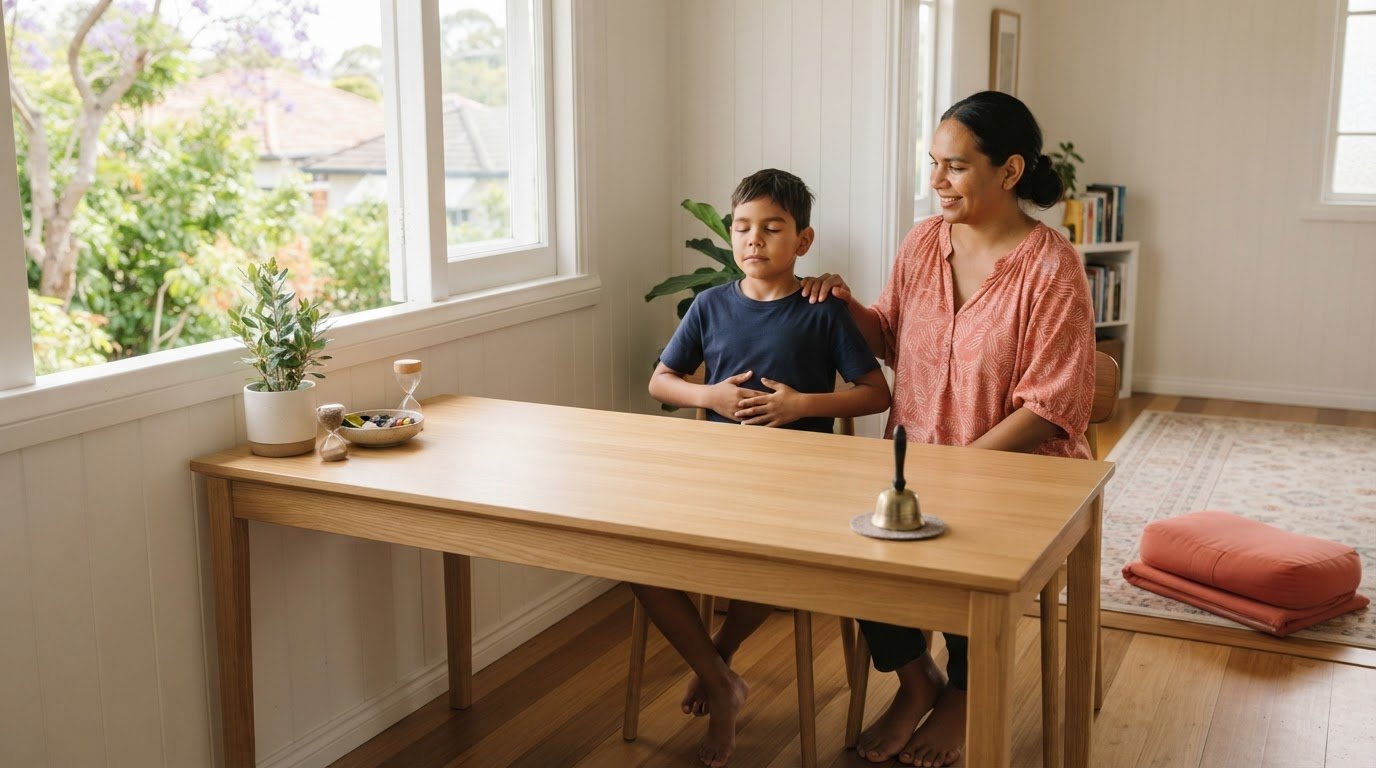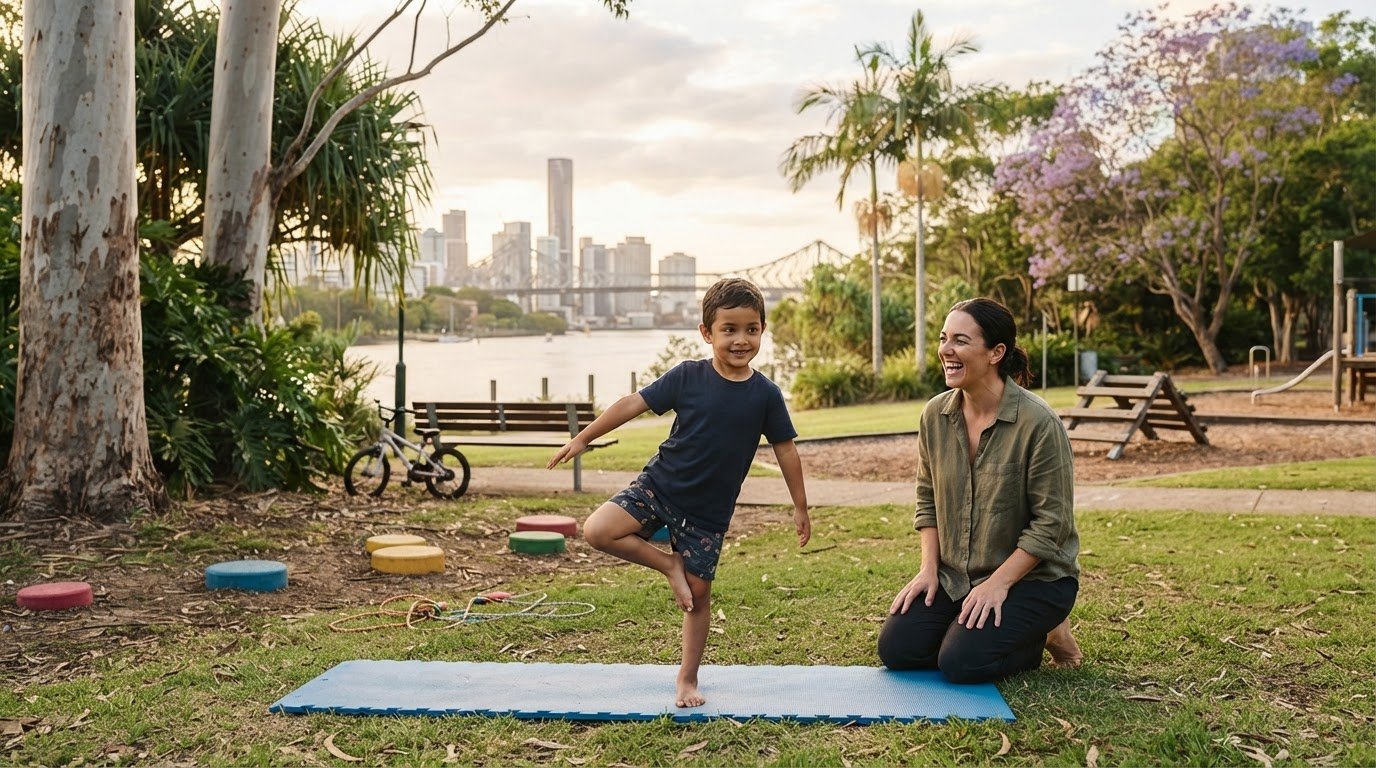
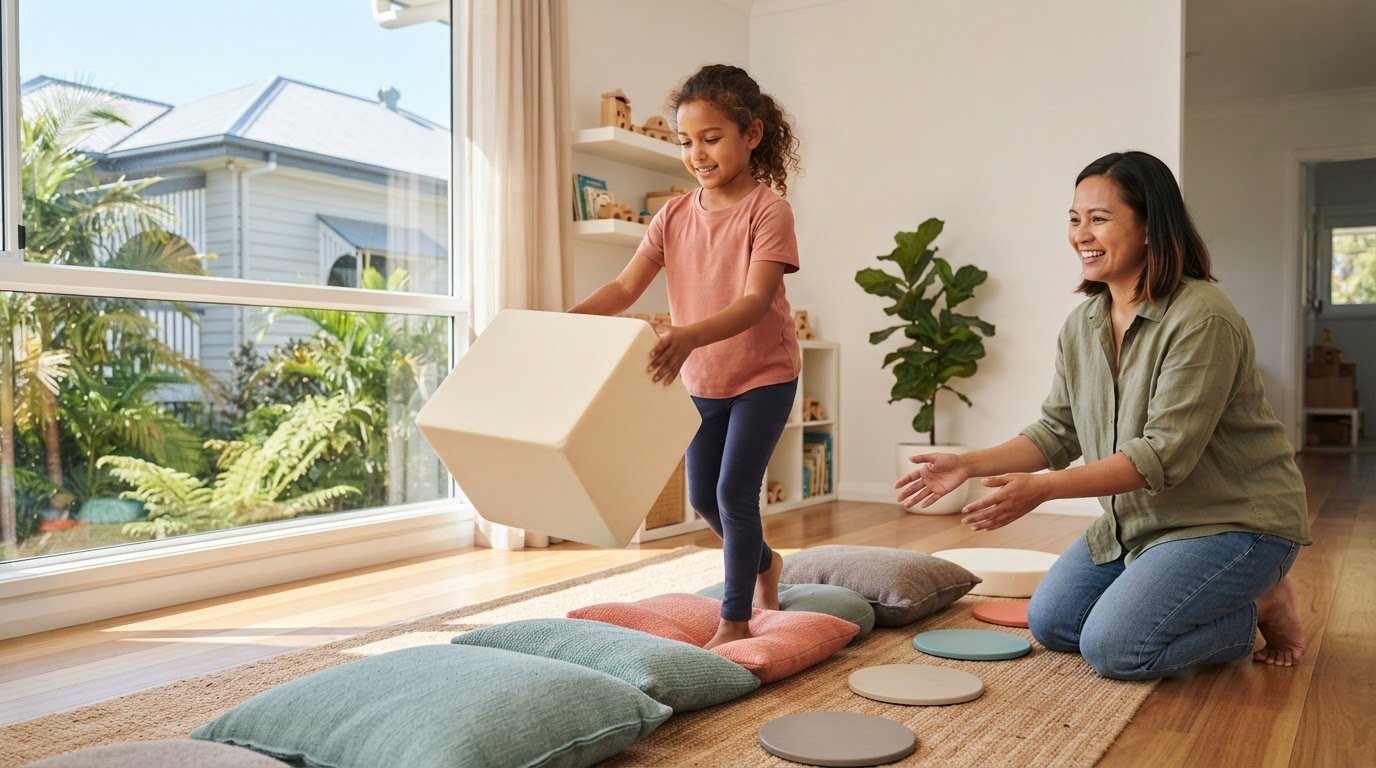
What if helping your child build body awareness starts with a game, not a complicated exercise plan? “Proprioception” can sound technical, and long activity lists can make it hard to know where to begin. But improving proprioception in children activities can be part of everyday play, using simple movements and familiar household items.
Proprioception is your body’s sense of where it is, how it’s moving and how much effort it’s using. It helps children adjust their movements as they play, climb, carry or balance. A practical starting point is to choose an activity that involves a movement you want to explore, then notice how your child responds.
This guide shares ideas for pushing and pulling, balancing and moving with control, along with ways to include them in familiar routines. Structured movement, including Taekwondo, can offer another way to practise purposeful actions. Start with a simple game, keep it enjoyable and adapt it to your family’s day.
Key Takeaways
- Proprioception is your child’s sense of body position and movement, helping them adjust actions without watching every movement.
- Explore improving proprioception in children activities through playful movements such as pushing, pulling, carrying or balancing.
- Choose activities to suit your space, available household items, your child’s interests and whether they want to play alone or with someone.
- Keep the routine flexible: choose one movement idea, make it fun, notice your child’s response and adapt as needed.
- Deliberate Taekwondo stances, steps and other controlled movements offer another way for children to practise body-position awareness.
What proprioception means for children’s movement and body awareness
Proprioception is the sense of where your body is and how it’s moving, even when you aren’t watching every action. Sensory receptors in muscles and tendons help the brain register changes such as stretch and effort. Information from joints and skin also contributes to a fuller picture of body position and contact. Together, these signals help children adjust movements as they go.
This sense is at work when a child grips a cup firmly enough to lift it without squeezing too hard, or steps over a toy without staring at their feet. The term may sound technical, but the experience is familiar: the body continually sends information that helps guide movement. Proprioception is one part of the sensory system, working alongside touch, vision and balance-related information.
Proprioception is the body’s internal sense of position, movement and effort, helping us adjust actions without having to watch every step. This describes a sense, not a result that any one game or activity can guarantee. For families exploring improving proprioception in children activities, a useful first step is to notice how a child moves during ordinary tasks and play.
How body awareness helps children move through everyday tasks
Information about body position helps the brain plan and fine-tune actions. A child carrying a lunchbox adjusts their grip as they walk; reaching for a shelf involves judging where the arm is in relation to the object. On playground equipment, a child shifts their weight while climbing, then changes direction to follow a friend. Vision and balance signals help guide these actions too, so proprioception works alongside other senses.
Proprioception is not the same as a diagnosis
Children explore movement in different ways. One may enjoy energetic games, while another prefers slower, more predictable play. A single behaviour, such as bumping into furniture or seeking lots of movement, doesn’t establish a sensory or developmental diagnosis. Consider the broader pattern and whether it affects everyday participation. If you have persistent concerns about your child’s development or movement, speak with an appropriately qualified health professional, such as your GP or a paediatric occupational therapist.
Keep the focus practical and curious. You don’t need to label a movement style before offering varied opportunities to move and play. Notice what your child chooses, how they adjust their actions and which activities hold their interest. These observations can help you choose suitable movement ideas while keeping play positive and responsive to your child.
Proprioception activities for children: movement ideas that involve pushing, pulling, and balance
Choose a movement that suits the moment, then let your child turn it into a game. Pushing and pulling involve effort through the muscles and joints, while carrying, jumping and balancing invite the body to adjust in different ways. Keep the focus on exploring movement rather than getting every action “right”.
Pushing, pulling, lifting and jumping all involve muscle and joint activity that provides proprioceptive input. The experience varies with the movement, so offer a few options and see which ones your child enjoys. Activities for improving proprioception in children can be simple, playful and adapted to what you already have at home.
Pushing, pulling, and carrying games
Use familiar objects to make movement part of pretend play. Your child might be a delivery driver, builder or helpful shopkeeper. Invite them to notice how their body moves and how much effort a task seems to take, without setting a performance target.
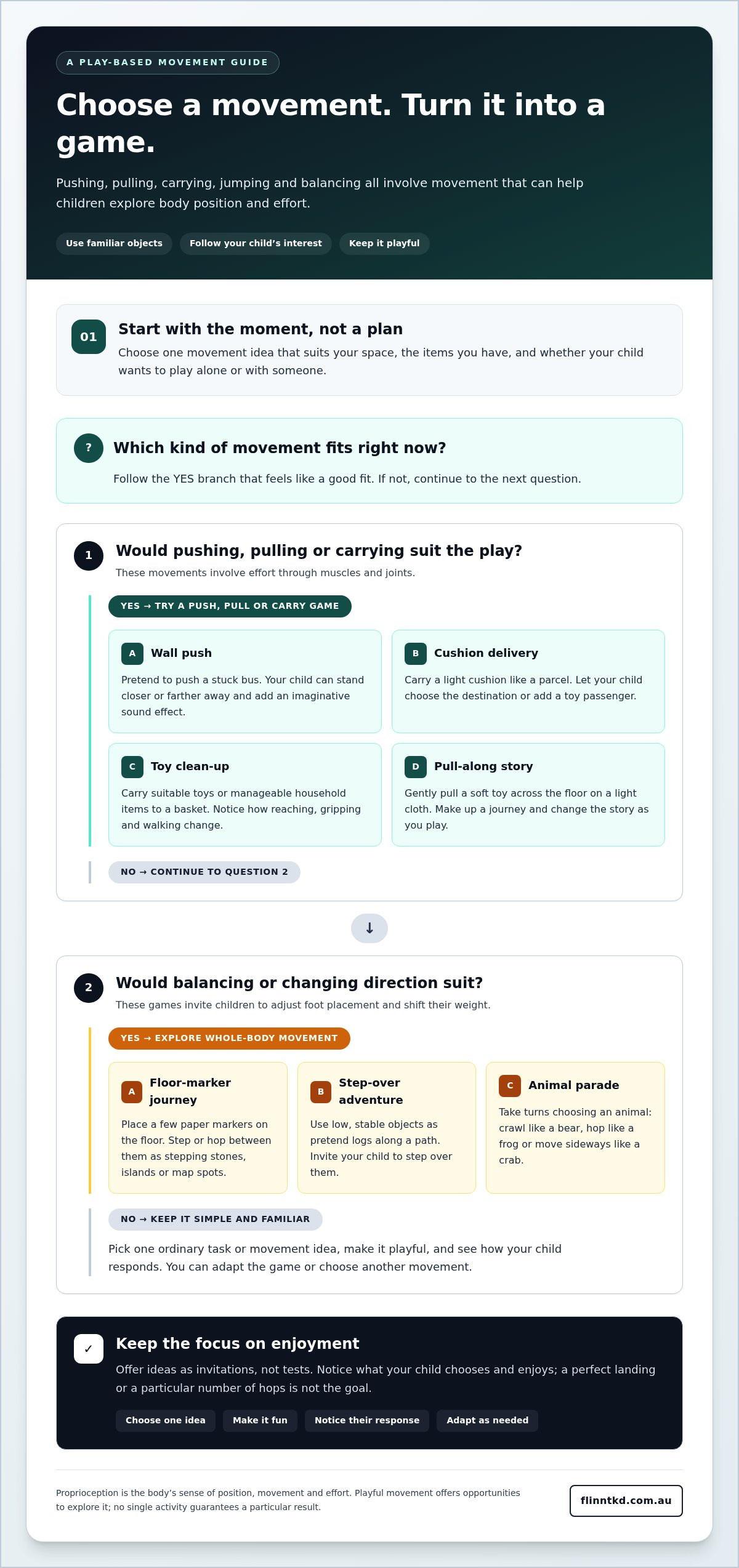
- Wall push: Invite your child to place their hands on a wall and pretend to push a stuck bus. They can stand closer or farther away, or make the bus move with an imaginative sound effect.
- Cushion delivery: Let them carry a light cushion from one spot to another as if it’s a parcel. They can choose the destination or carry a toy passenger on top.
- Toy clean-up: Carry suitable toys or other manageable household items to a basket. Notice how reaching, gripping and walking change as the item moves with them.
- Pull-along story: Your child can gently pull a soft toy across the floor on a light cloth, imagining it’s travelling somewhere new. Let them change the story as they play.
Jumping, balance, and whole-body movement
Balance and changes of direction ask children to adjust where they place their feet and how they shift their weight. Offer these ideas as invitations, not tests. Your child can change the story, simplify the route or choose a different movement.
- Floor-marker journey: Arrange a few paper markers on the floor and invite your child to step or hop between them. They can be stepping stones, islands or spots on a map.
- Step-over adventure: Use low, stable objects as pretend logs along a path. Stepping over them invites a child to judge foot placement and adjust their body position.
- Animal parade: Take turns choosing an animal to copy. A bear might crawl, a frog might hop and a crab might move sideways. Each variation changes how the body supports and moves itself.
Focus on whether your child is enjoying the game, not on a perfect landing or a particular number of hops. If they enjoy structured, purposeful movement, families in North Brisbane can explore children’s Taekwondo classes, where deliberate stances and steps offer another way to practise movement.
How to choose a proprioception activity for your child and the moment
You don’t need specialist equipment or a long activity list to get started. Choose one movement idea that suits the space, the time you have and your child’s interests. There isn’t one best activity for every child: the same child may want an energetic game one day and a quieter challenge the next.
Match the activity to the movement goal
First, decide what kind of movement you’d like to invite. Pushing and pulling involve working against an object; balancing and changing direction ask the body to adjust its position while moving. Some games combine both. Use the table as a starting point, not a programme you need to complete.
| Activity type | Example | Movement focus | Where it fits |
|---|---|---|---|
| Pushing | Pretend to push a wall or move a cushion | Pressing through the arms and noticing effort | Indoors, with little space |
| Pulling | Pull a soft toy on a cloth during a make-believe journey | Gripping, pulling and adjusting posture | Indoors, alone or together |
| Carrying | Take a suitable household item to a chosen destination | Holding a load while walking and changing position | Around the home, as part of play |
| Balance and direction | Follow a winding path or step between outdoor markers | Shifting weight, placing feet and changing direction | Outdoors or in a clear indoor space |
| Whole-body movement | Copy an animal moving across the room or yard | Coordinating limbs and adapting posture | Shared play, with room to move |
A single game can involve several movement demands. Carrying a toy along a winding route, for example, combines holding an object with balancing and changing direction. To keep improving proprioception in children activities manageable, choose one idea from the table that suits your setting and your child’s mood.
Adapt the idea to your child’s interests and setting
Let your child’s interests shape the story. A floor path can become a jungle trail indoors or a route between chalk marks outside. If they like vehicles, they might deliver toys; if they prefer animals, they can choose how to travel across the room. Familiar themes can make it easier to join in without turning play into a test.
Adjust the challenge to suit the moment. Keep a route simple or let your child decide where it bends. Take turns if they want to play together, or offer an individual activity if they’d rather play alone. Notice whether they stay engaged, suggest a rule change or lose interest. Preferences can shift from day to day, so follow their lead instead of working through a fixed list.
How to build a simple proprioception play routine at home
A useful routine doesn’t need a timetable or a stack of activities. Start with one movement idea and fit it into play your child already enjoys. You might add a pretend delivery job while putting toys away, or turn a trip across the room into an animal adventure. Improving proprioception in children activities can mean offering movement as part of ordinary play, without expecting a particular result.
A simple choose, play, and adapt sequence
Keep the process flexible. You’re setting up an invitation to play, not a test with right and wrong answers.
- Choose: Pick one movement idea that fits the space and your child’s interests. If they’re keen to help, carrying a suitable item to its usual place may work. If they want an imaginative game, try an animal movement or a pretend journey.
- Play: Introduce the idea with a simple story or let your child make up the rules. Join in if they’d like company, and give them room to explore the movement in their own way.
- Adapt: Notice their response as you play. If the game holds their interest, follow their lead. If they lose interest or want a change, simplify the idea, add a new story or choose a different movement.
There’s no need to set aside a separate session. A movement game can grow out of an everyday moment: pretend toys are parcels that need delivering, or make the walk to the backyard a route with a few stepping points. Keep the invitation light. If your child would rather carry one item than join a bigger game, start there.
Choose, play, observe and adapt: that’s a simple way to make movement part of family life. Offer opportunities to move when they fit your household and your child’s interests, rather than following a rigid schedule.
What to notice as your child plays
Look for clues about how the activity feels for your child. Are they taking part comfortably, changing the rules or asking to continue? Do they prefer to watch first, play alongside you or choose a different game? These observations can help you decide what to offer next time.
Keep your observations descriptive, not diagnostic. One response to one game can’t tell you whether a child has a sensory-processing or developmental condition. Children’s preferences vary, and play is only one part of the picture. If you have ongoing concerns about your child’s movement or development, discuss them with a qualified health professional.
For families in North Brisbane, the Little Tigers Program offers a structured way for children to explore Taekwondo movement in a supportive setting.
How Taekwondo movement can give children another way to practise body awareness
Children can practise body awareness through many kinds of movement. Taekwondo offers a structured option: children follow instructions, try deliberate movements and adjust their position as they move. A stance, for example, invites a child to notice where their feet are and how their weight is placed. A controlled step involves moving from one position to another with intention.
These movements involve proprioception, but Taekwondo is not a treatment, and taking part doesn’t guarantee a particular developmental result. It’s another way to explore purposeful movement. If you’re looking for improving proprioception in children activities, consider martial arts as one possible setting alongside everyday play, not a replacement for it.
From playful movement to structured practice
At home, play can be improvised and led by your child. In an instructor-led class, movements are introduced in a more organised learning environment. These approaches offer different experiences. A child might practise placing their feet in a stance, then take a deliberate step while following an instructor’s direction. These are examples of movement to explore, not exercises families need to prescribe. For a plain-language overview, see Taekwondo explained for Brisbane families.
Flinn Taekwondo Academy is a family-owned academy in North Brisbane with children’s classes and the Little Tigers Program. The academy provides a secure, supportive and empowering environment. Families can consider whether this kind of guided movement practice suits their child’s interests, alongside the games they enjoy at home. A class is an opportunity to experience Taekwondo, not a promise of improved proprioception.
Exploring children’s Taekwondo in North Brisbane
Notice what your child responds to: do they enjoy copying movements, listening to instructions or practising a sequence? Their interests can help you decide whether a structured class might suit them. Flinn Taekwondo Academy offers the Little Tigers Program and Children’s Classes. Learn more about Taekwondo classes in North Brisbane.
Families can book a free trial to experience a class and explore structured Taekwondo movement as one part of a child’s wider play and activity.
Make your child’s next movement moment count
Start with a small invitation: let your child choose a movement game, then give them room to shape it. Their curiosity can guide what you try next. There’s no need to turn play into a programme or measure progress after each activity. Keep offering enjoyable chances to move and pay attention to what your child finds engaging.
If you’d like to explore a more structured movement setting, Taekwondo can be one option alongside play at home. At Flinn Taekwondo Academy, classes are led by Master Jeff Flinn, a 7th Dan Black Belt with international accreditation. A class isn’t therapy or a guaranteed way to change body awareness; it’s an opportunity for children to practise purposeful movement in a guided setting.
For families considering improving proprioception in children activities through different kinds of play, the next step can be finding an approach your child enjoys. Book a free trial with Flinn Taekwondo Academy in North Brisbane. New starters receive a free uniform, there’s no joining fee, and signing up includes two free classes. Keep it playful, stay curious and celebrate each new chance to move with confidence.
Frequently Asked Questions
What is proprioception in a child?
Proprioception is a child’s sense of their body’s position and movement, even when they aren’t looking directly at it. It helps them make small adjustments during everyday actions, such as turning to sit on a chair or placing a foot on a stair. This sense works with vision, touch and balance information as children move through familiar spaces.
What activities help improve proprioception in children?
Play that invites children to push, pull, carry, balance or change direction can provide proprioceptive input. For example, they might move a light item during a pretend game, follow a path around the garden or copy a dance move. Families searching for “improving proprioception in children activities” can start with one simple idea that fits the child’s interests. No single activity works best for every child.
How can I practise proprioception activities with my child at home?
Build movement into something your family already does. For example, invite your child to put a few soft toys in a basket while pretending they’re packing for a trip. Let them choose what to move and where it goes, then follow their lead. If they change the game, that’s fine. Keep the activity enjoyable and adapt it to the space and the moment.
Can proprioception activities help with coordination?
Movement activities give children opportunities to practise coordinating different parts of the body, but they don’t guarantee improved coordination. Following a clapping rhythm while stepping to a beat, for example, asks a child to listen, move and adjust their timing. Children develop at different rates, so focus on participation and enjoyment rather than comparing their performance with another child’s.
How often should children do proprioception activities?
There isn’t a set frequency or duration for these play ideas. Offer movement as part of ordinary family life when it suits your child and routine, rather than treating it as a scheduled exercise prescription. A game might fit into playtime or a household task. Follow your child’s interest and change the activity when they’re ready for something different.
Is difficulty with proprioception a sign of a sensory disorder?
One behaviour or tricky moment can’t identify a sensory disorder. A child might stumble, avoid a game or seek lots of movement for many reasons, and their response can vary with the situation. Notice whether concerns persist and affect everyday activities, such as dressing, play or getting around. If you’re concerned about your child’s development, discuss what you’ve observed with a qualified health professional, such as your GP.