Most parents believe their child needs to be naturally athletic to succeed in sports, but coordination isn’t a gift you’re born with; it’s a skill you build. If you’re looking into taekwondo for an uncoordinated child, you’ve likely watched your little one struggle on the sidelines, feeling left out or frustrated by their own physical clumsiness. It’s difficult to see them lose confidence because they can’t keep up with the chaotic pace of team sports. You want them to feel strong and capable, but you’re worried about them getting hurt or feeling like they don’t belong in a high-pressure environment.
We understand those concerns and promise that the structured, repetitive movements of martial arts can transform that physical hesitation into disciplined strength. This article explores how our specialized programs, like Little Tigers and Junior Taekwondo, use technical training to improve gross motor skills and spatial awareness. You’ll see how we move beyond the scoreboard to focus on personal agency and character development. We’ll also look at why a supportive community is the secret ingredient to building a child’s self-esteem and helping them find their footing in 2026.
Key Takeaways
- Learn how coordination is a skill you can manufacture through training, offering a clear path for children who struggle with physical movement.
- Discover why taekwondo for uncoordinated child development is so effective through bilateral exercises that engage both sides of the body equally.
- See how the structured environment of a dojang builds spatial awareness and balance without the pressure or chaos of traditional team sports.
- Identify the standards to look for in North Brisbane schools, from international accreditation to a supportive, family-focused culture.
- Explore the Flinn Taekwondo philosophy and how our 2026 standards of excellence help every young athlete find their confidence.
Understanding the “Uncoordinated” Label: Why Some Kids Struggle with Movement
Many parents feel a pang of worry when they see their child trip over their own feet or struggle to catch a ball. You might use words like “clumsy” or “awkward” to describe these moments. It’s a common concern, but remember that coordination isn’t a fixed trait your child is born with. It’s a physical literacy that they can learn and master with the right guidance. When we label a child as uncoordinated, we’re often just describing a delay in their motor skill development that hasn’t been addressed through structured movement.
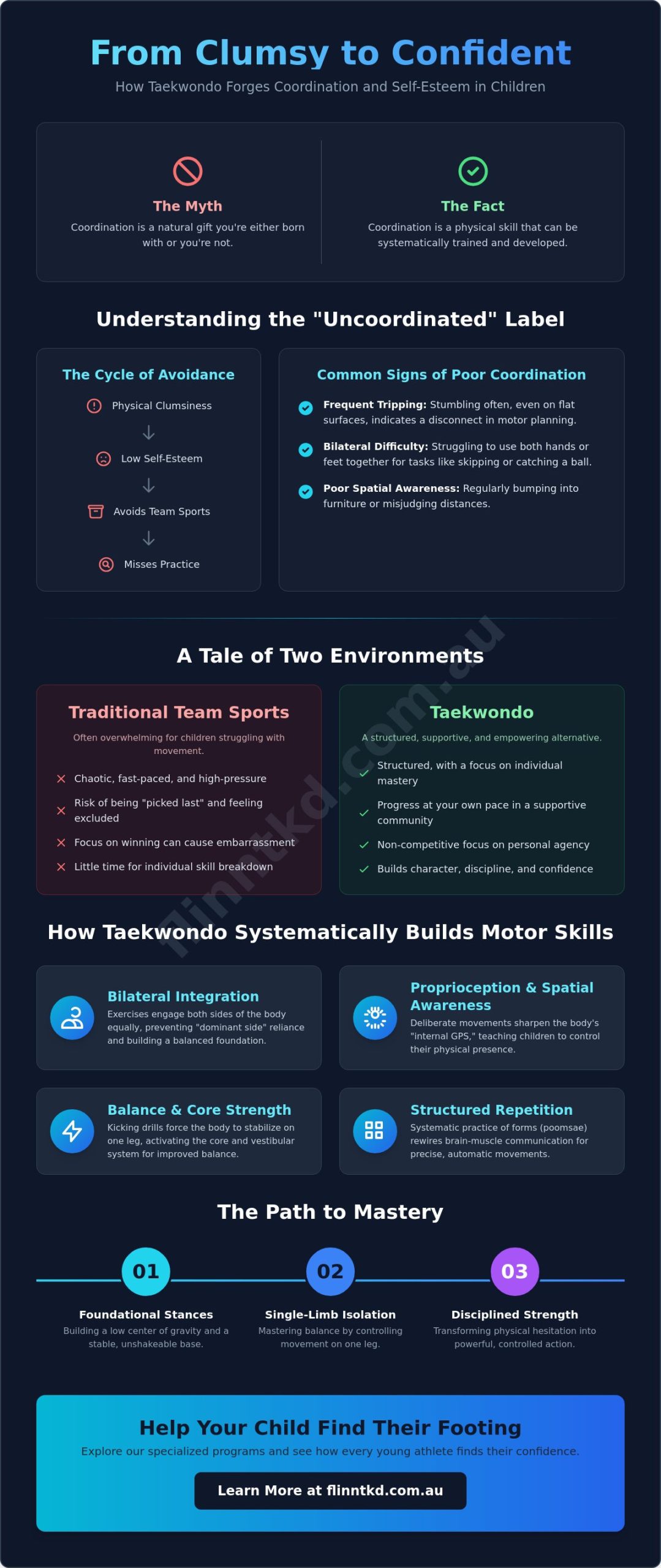
Poor coordination often shows up in small, daily struggles. Your child might have difficulty with bilateral movements, which involves using both sides of the body together. For many parents, investigating taekwondo for uncoordinated child support is the first step toward building that bridge between the brain and the body. These signs of a struggle with movement often include:
- Frequent tripping or stumbling on flat surfaces.
- Difficulty using both hands or both feet simultaneously.
- Bumping into furniture or misjudging the edge of a table.
- Difficulty with fine motor tasks that require balance and steady posture.
The emotional weight of being “the clumsy kid” is heavy. In a world where schoolyard status is often tied to athletic ability, falling behind can crush a child’s self-esteem. They start to believe they aren’t “sporty,” which leads to a cycle of avoidance. This avoidance ensures they don’t get the practice they need, making the coordination gap wider over time. Breaking this cycle requires a different approach to physical activity.
The Role of Proprioception and Spatial Awareness
Proprioception is your body’s internal GPS. It’s the sense that tells you where your limbs are without you having to look at them. Many children who seem uncoordinated simply have a “fuzzy” internal map. They lack the spatial awareness needed to move through a room or a field with precision. To understand the foundations of this discipline, you can explore what is taekwondo and how it serves as a powerful tool for body-brain mapping. By practicing specific, deliberate movements, children sharpen their internal senses and learn exactly how to control their physical presence in any environment.
Why Traditional Team Sports Can Be Discouraging
Traditional team sports like soccer or netball are often chaotic. For a child struggling with movement, the fast-paced environment is overwhelming. They might find themselves “picked last” for teams, or they might simply check out mentally to avoid the embarrassment of a mistake. In these high-pressure settings, there’s rarely time for a coach to break down the mechanics of a single step or a turn. This is why What is Taekwondo offers such a refreshing alternative. Rather than the chaos of the field, taekwondo for uncoordinated child development focuses on individual mastery. It provides a non-competitive, individual-focused starting point where your child can progress at their own pace within a supportive community.
How Taekwondo Systematically Builds Motor Skills
Taekwondo doesn’t leave coordination to chance. It follows a structured, technical methodology designed to rewire how the brain communicates with the muscles. While many sports rely on a child’s natural instincts, our training uses bilateral movement to ensure every limb gets equal attention. This prevents the “dominant side” reliance that often keeps children feeling off-balance. Bilateral integration is the brain’s ability to coordinate both sides of the body simultaneously. By mastering this, your child gains a level of physical control that carries over into every other aspect of their life.
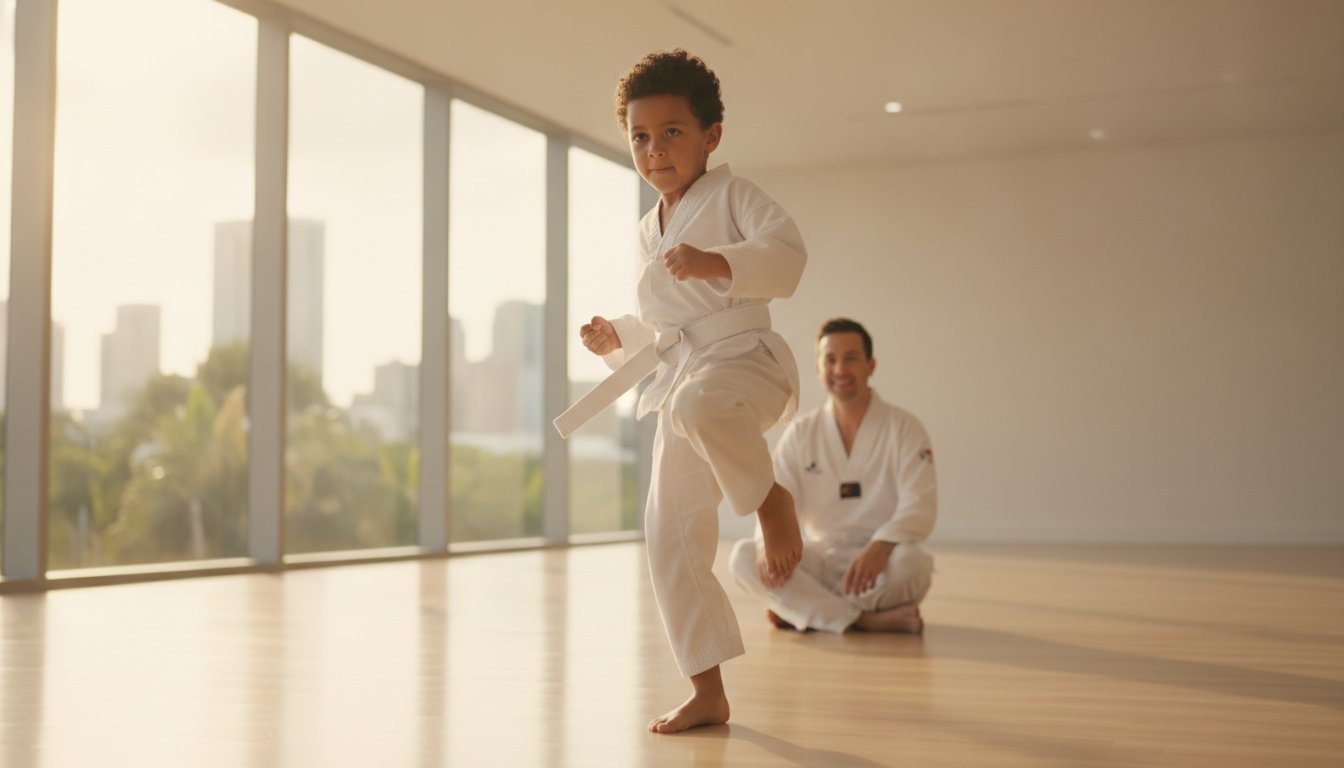
Repetitive kicking drills are a cornerstone of this development. When a child performs a kick, they’re doing more than just striking a target. They’re engaging their core and activating their vestibular system, which is responsible for balance. This is why taekwondo for uncoordinated child development is so effective. It forces the body to stabilize on one leg while the other moves with precision, turning a shaky stance into a solid foundation. Our students progress through specific stages to build this mastery:
- Foundational Stances: Building a low center of gravity and stable base.
- Single-Limb Isolation: Improving balance by focusing on one movement at a time.
- Bilateral Combinations: Coordinating arms and legs in a synchronized rhythm.
- Dynamic Movement: Applying coordination while moving across the mats.
The Science of Cross-Body Patterns
Crossing the midline is a critical developmental milestone. In our classes, we use techniques that require your child to reach across their body, which builds strong neural pathways between the left and right hemispheres of the brain. Blocking with one hand while striking with the other improves the brain’s ability to multi-task. This isn’t just theory; research on Taekwondo’s effect on coordination shows that structured martial arts training significantly boosts body coordination and agility in school-aged children. These exercises sharpen both fine motor skills, like the rotation of a fist, and gross motor skills, like a full-body pivot.
Poomsae: The Ultimate Coordination Tool
Poomsae, or patterns, are the heartbeat of our curriculum. Think of them as a moving meditation that requires exact footwork and timing. Your child must memorize a specific sequence of movements, which develops cognitive-motor sequencing. They learn to plan their next move while executing the current one. This high level of focus is a key part of our Junior Taekwondo Brisbane curriculum. It teaches them that coordination is a series of small, manageable steps. If you’re ready to see how these techniques can help your child, booking a trial program is the best way to witness the transformation firsthand.
Taekwondo vs. Other Activities for Clumsy Kids
Think of the chaos of a public playground or a weekend soccer match. For a child who feels physically awkward, these environments are minefields of potential embarrassment. The dojang offers the exact opposite: a structured, predictable space where every movement is intentional. We replace the “clumsiness” with a systematic approach to balance. Unlike grappling-based arts where beginners spend a lot of time on the ground, Taekwondo is a vertical discipline. This upright focus is vital for developing a strong center of gravity. It’s much easier to master balance when you’re learning to stand tall and move with purpose. Safety is our priority, and for beginners, we emphasize controlled, non-contact patterns that allow them to build confidence without the fear of injury.
Choosing taekwondo for uncoordinated child development means choosing a path of individual progress within a group setting. Your child isn’t competing against a teammate for a spot on the field; they’re working to better their own technique alongside peers who are doing the same. This creates a unique atmosphere where “clumsy” kids feel safe to fail, learn, and eventually succeed. They aren’t just another number on a roster. They are martial artists in training, and that shift in identity is often the spark that ignites their physical transformation.
Why Taekwondo Beats Team Sports for Beginners
In traditional team sports, the “uncoordinated” child often ends up with significant bench time. In our classes, there is zero bench time. Every student is active, every student is learning, and every student is improving from the moment they bow onto the mats. The belt system provides tangible proof of progress for kids who have spent years feeling “bad at sports.” When they earn that next stripe, it isn’t because they scored a goal; it’s because they mastered their own body. Our supportive community at Taekwondo North Brisbane Academy fosters this growth, ensuring every child feels like a valued member of the team.
Taekwondo vs. Gymnastics or Dance
Dance and gymnastics are excellent for building coordination, but they often lean heavily on “performance” and aesthetics. Taekwondo shifts the focus to “personal agency” and discipline. We aren’t training for a stage; we’re training for character and self-defence. The dobok, our traditional uniform, acts as a level playing field. It removes the social pressure of wearing the “right” athletic gear or having the “right” body type for a specific dance style. In a dobok, every child looks the same, allowing them to focus entirely on their personal journey of self-improvement and physical mastery.
Choosing the Right Program for Your Child in North Brisbane
Finding a local activity in suburbs like Brendale, Strathpine, or Warner is easy, but finding the right developmental fit for your child requires a bit more research. When you’re looking at taekwondo for uncoordinated child development, the school’s culture is just as important as the curriculum. You want a facility that balances a “fun-first” atmosphere with the discipline that martial arts is known for. It’s a delicate mix. Too much pressure can cause a child who already feels physically awkward to shut down; too little structure means they won’t gain the motor skills they need. Look for schools that hold their instructors to high standards, ensuring they are internationally accredited and possess a current Blue Card for working with children.
The environment should feel like a community. You aren’t just looking for a gym; you’re looking for a place where your child feels they belong. Visit the facility and watch how the instructors interact with students who aren’t naturally athletic. Do they offer encouragement? Do they break down movements into manageable steps? A great academy treats every student’s progress as a major victory, regardless of where they start on their journey.
What to Ask During Your First Visit
Don’t be afraid to ask direct questions. You’re the best advocate for your child’s growth. Start by inquiring about the instructor-to-student ratio, especially for younger age groups. If a class is too crowded, a child who struggles with coordination might get lost in the shuffle. Ask specifically how the coaches handle children who find certain movements difficult. You want to hear about patience and modified training techniques. Finally, check if the academy offers a trial period. A two-week trial is a low-pressure way to ensure the program is a good fit before you make a long-term commitment.
The Importance of Age-Appropriate Training
Developmental needs change rapidly in early childhood. A four-year-old and a twelve-year-old have vastly different motor control and attention spans. This is why we insist on age-specific classes. Our Little Tigers Program (4-6 years) focuses on foundational, play-based coordination. It’s designed to build the “basics of balance” through games and simple technical drills. As they grow and gain confidence, they naturally progress into the Junior Taekwondo Program. This stepped approach ensures they’re always challenged but never overwhelmed. If you’re ready to start this journey, explore our introductory programs and find the right class for your child’s age group today.
The Flinn Taekwondo Approach: Empowering Brisbane Families
Master Jeff Flinn leads our academy with a clear vision for 2026, setting a new standard of excellence for martial arts in North Brisbane. We don’t just teach kicks and punches; we build resilient individuals. When you choose taekwondo for uncoordinated child growth at our academy, you’re choosing a program that prioritizes the individual over the scoreboard. We’ve cultivated a family-first atmosphere where every child feels safe to explore their physical potential. This sense of belonging is what reduces the anxiety often associated with trying new things. It’s about creating a sanctuary where a child who feels “clumsy” can transform into a confident athlete at their own pace.
Our methodology seamlessly integrates practical children self defence with deep character building. We believe that true strength comes from a combination of physical skill and mental fortitude. By focusing on the core tenets of the discipline, we teach our students that perseverance and self-control are just as important as a perfect strike. This holistic method ensures that the coordination they gain on the mats translates into confidence in the classroom and beyond. You’ll see your child stand taller, speak clearer, and move with a new sense of purpose.
Expert Coaching for Every Ability
Our coaching staff is trained to work with children of all temperaments and physical abilities. Whether your child is naturally athletic or struggles with basic motor skills, we have the expertise to guide them. We take the same high-performance coaching principles used in our elite programs and adapt them for beginners. This means your child receives professional-level instruction tailored to their specific needs. Our focus always remains on the “personal best.” We aren’t interested in our students beating others; we’re interested in them becoming better versions of themselves every single day. This removes the fear of failure and replaces it with the joy of incremental progress.
How to Get Started at Flinn Taekwondo
Beginning your journey with us is a straightforward, low-pressure process. We invite all North Brisbane families to experience our community firsthand through a trial session. This allows your child to step onto the mats, meet our instructors, and see how they feel in the environment before you make a long-term commitment. We make it easy for new members by providing the necessary equipment and uniforms for those starting out. Our goal is to make the transition into martial arts as smooth as possible for both you and your child. Join the Flinn Taekwondo community and watch your child’s confidence soar.
Watch Your Child Find Their Balance
You don’t have to watch your child struggle on the sidelines anymore. We’ve seen how coordination is a skill built through repetitive, bilateral training rather than an innate talent. By focusing on taekwondo for uncoordinated child development, you provide a structured alternative to the chaos of the playground. This shift in environment allows your child to master their own body and build spatial awareness at their own pace without the pressure of a ticking scoreboard.
Since 2013, our academy has served as a trusted North Brisbane institution under the guidance of 7th Dan Black Belt Master Jeff Flinn. We take pride in our specialized Little Tigers program for ages 4-6, which is designed to turn physical hesitation into disciplined strength. Every lesson is an opportunity for your child to find their footing and realize their potential within a supportive team that celebrates every small victory.
Book a Trial Class for Your Little Tiger Today! and witness the transformation firsthand. We’re ready to help your child trade “clumsiness” for confidence and start a journey that builds character for a lifetime. We look forward to seeing you on the mats!
Frequently Asked Questions
Is my child too uncoordinated to start Taekwondo?
No child is too uncoordinated to begin their martial arts journey. Our programs are specifically designed to manufacture coordination through structured, repetitive movements from the ground up. We meet your child exactly where they are, focusing on foundational balance and basic motor control. Many of our most confident students started with the same physical hesitations your child might be experiencing right now.
How long does it take to see improvements in a child’s coordination?
Most parents notice a visible difference in their child’s balance and spatial awareness within 8 to 12 weeks of regular attendance. While every child’s developmental timeline is unique, the consistent practice of bilateral movements creates rapid improvements in how they navigate their physical environment. You’ll likely see them tripping less and moving with more purpose both on and off the mats during their first term.
Will Taekwondo make my child more aggressive?
Taekwondo has the opposite effect on children, promoting self-discipline and emotional regulation rather than aggression. We teach that physical skill is a tool for self-defence and personal growth, never for bullying. By providing a constructive outlet for energy and teaching the importance of respect, we help children become more composed and thoughtful in their daily interactions with peers and family.
What is the best age for a child to start martial arts in Brisbane?
We recommend starting children as young as four years old in our specialized Little Tigers program. At this age, their brains are highly receptive to learning the basic motor patterns and social skills that form the foundation of martial arts. Starting early helps them build a lifelong habit of physical activity and discipline before they enter the high-pressure environment of primary school.
Can Taekwondo help children with ADHD or sensory processing issues?
The predictable structure and clear expectations of a dojang are incredibly beneficial for children with ADHD or sensory processing issues. Using taekwondo for uncoordinated child development involves focusing on single tasks and repetitive patterns, which helps sharpen their attention and process sensory information more effectively. Our instructors create a calm, disciplined atmosphere that helps these students feel grounded, successful, and part of a team.
What should my child wear to their first Taekwondo class?
Your child should wear comfortable, breathable athletic clothing such as a t-shirt and shorts or leggings for their first class. We train barefoot on specialized mats, so there’s no need for specific footwear. Once they decide to continue their journey, we’ll provide them with their official dobok. This uniform helps them feel like a full member of our disciplined community and removes the pressure of wearing trendy gear.
Are there competitions for beginners in North Brisbane?
There are several local opportunities for beginners to participate in supportive, low-pressure events across North Brisbane. These competitions often focus on Poomsae or basic technical skills rather than full-contact sparring. We believe competition is a powerful tool for personal growth. It allows students to test their skills in a safe, encouraging environment that celebrates their courage, hard work, and individual progress.
How often should my child attend classes to see results?
Attending classes twice per week provides the best balance for steady skill development and retention. This frequency allows your child to build muscle memory and stay connected to our community without feeling overwhelmed by a busy schedule. Consistent attendance is the key to transforming physical clumsiness into technical mastery, ensuring they keep moving forward on their long-term path to achieving a black belt.