Mastering your Poomsae doesn’t require a full-sized dojang. It only requires a few square metres and the right mindset. While the academy is where you learn the movements, the decision to practice taekwondo patterns at home is where you truly forge your technical DNA. You’ve likely felt the frustration of trying to train in a small Brisbane lounge room, worrying that you’ll kick a coffee table or reinforce a bad habit without your instructor there to correct you. It’s a common hurdle that stops many dedicated students from reaching their full potential.
We’re here to help you turn those small spaces into high-performance training zones. This guide provides professional techniques to sharpen your strikes and perfect your stances between your regular classes. You’ll learn how to break down complex sequences into manageable drills that fit into a busy lifestyle, ensuring you’re always ready for your next belt grading. We’ll explore the 2026 World Taekwondo standards, essential home equipment like double kicking pads, and the mental strategies used by our high performance competition team to maintain precision and focus.
Key Takeaways
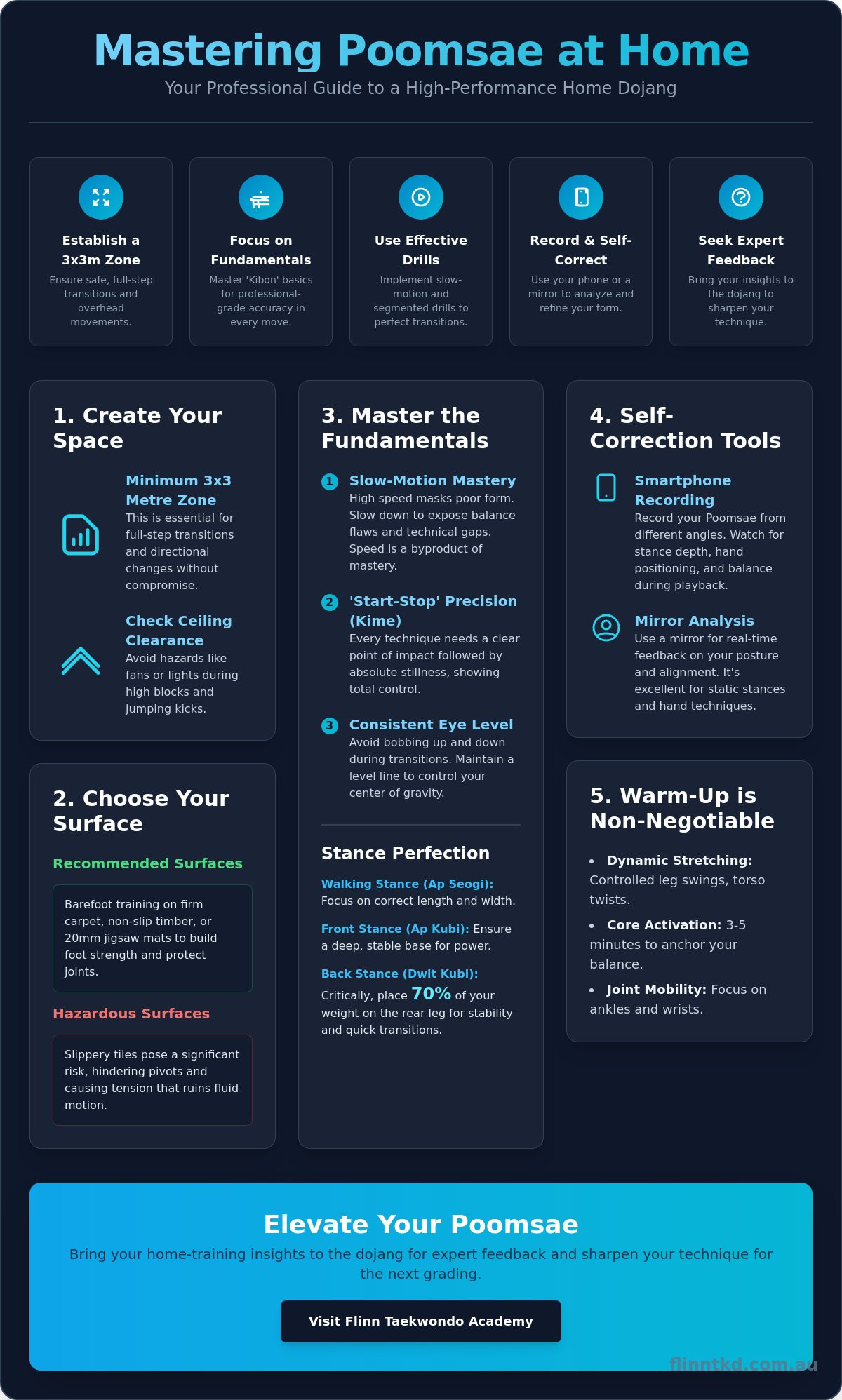
- Establish a dedicated 3×3 metre training zone to allow for safe, full-step transitions and overhead movements.
- Focus on stance precision and ‘Kibon’ fundamentals to ensure you practice taekwondo patterns at home with professional-grade accuracy.
- Implement slow-motion mastery and segmented drills to identify balance issues and perfect complex Poomsae transitions.
- Use smartphone recordings or mirrors as self-correction tools to bridge the gap between dojang sessions and home training.
- Bring your home-training insights to Flinn Taekwondo Academy to receive expert feedback and sharpen your technique for the next grading.
Creating Your Home Dojang: Space and Safety Essentials
Transforming your living room into a temporary training hall requires more than just moving a chair. To effectively practice taekwondo patterns at home, you need a dedicated 3×3 metre clear zone. This specific footprint allows for the full-step transitions and directional changes found in most foundation patterns. Don’t forget to look up. Ceiling clearance is often overlooked until a high block or a jumping front kick meets a low-hanging fan or a pendant light. Clear the area of “hidden” hazards like rug edges that could cause a trip or sharp coffee table corners. Creating this boundary helps you focus entirely on your technique rather than your surroundings.
The Best Surfaces for Barefoot Training
Your choice of flooring directly impacts your balance and joint health. Slippery tiles are a significant hazard for pivoting movements, as they lack the friction needed for stable stances. If your home has tiles, you might find yourself tensing up to avoid sliding, which ruins your fluid motion. Firm carpet or non-slip timber is a much safer alternative. Many Brisbane students choose to use portable jigsaw mats. These 20mm thick foam tiles provide a professional surface that mimics the dojang and protects your joints during impact. While trainers can offer grip on hard floors, practicing barefoot is superior for mastering Taegeuk poomsae. It allows your toes to “grip” the floor, building the intrinsic foot strength necessary for high-level performance.
Safety First: Warming Up Solo
Professional training starts before the first kick. Even in a confined space, a structured warm-up is non-negotiable to prevent strains. Begin with dynamic stretching routines that focus on the hips and hamstrings. Controlled leg swings and torso twists prepare your muscles for the explosive energy of a pattern. You should also spend three to five minutes on core activation. A stable core is the anchor for every movement, providing the balance needed for those difficult slow-motion transitions. Include specific mobility drills for your ankles and wrists. These joints are often under-prepared for the lateral forces of martial arts training. This disciplined approach is a cornerstone of our Junior Taekwondo Brisbane classes, where we teach that a prepared body is a safe body. By respecting your physical limits and preparing your environment, you set the stage for a productive and injury-free session.
Deconstructing the Pattern: Focus on Technical Fundamentals
Patterns are more than a sequence of moves; they’re a test of your technical discipline. When you practice taekwondo patterns at home, your primary goal shouldn’t be finishing the sequence quickly. It should be finishing it perfectly. High speed often masks poor form. By slowing down, you expose balance flaws and technical gaps that might go unnoticed in a fast-paced class. Speed is a byproduct of mastery, not a shortcut to it.
Start with the ‘Kibon’ or fundamental basics. Every block and strike in your pattern relies on these building blocks. If your middle punch lacks power in isolation, it won’t magically improve during a complex sequence. You must also develop the ‘Start-Stop’ precision that defines high-level Poomsae coaching Brisbane. This means every technique must have a clear point of impact followed by a split second of absolute stillness. This focus, known as ‘Kime’, shows the judges you’re in total control of your body.
Balance often fails during transitions. Keep your eye level consistent as you move from one stance to another. Imagine a level line across your field of vision. Bobbing up and down during steps signals a lack of control over your centre of gravity. Mastering this stability is a core part of the Kukkiwon Poomsae standards used in international competitions. If you find yourself wobbling, slow the movement down until your muscles memorize the correct path.
Stance Perfection: The Foundation of Poomsae
Your stances provide the power for your strikes. A common mistake at home is shortening your steps to fit the room. Don’t do it. Use your hallway to drill the difference between a ‘Walking Stance’ (Ap Seogi) and a ‘Front Stance’ (Ap Kubi). Use the lines in your floorboards or the edge of a rug as a guide for foot alignment. For a rock-solid ‘Back Stance’ (Dwit Kubi), ensure 70% of your weight sits on your rear leg. This distribution allows for immediate front-leg kicks or defensive shifts without losing your footing.
Chambering and Execution
Don’t ignore the preparation phase of a move. The ‘hidden’ chambering movements are where your power is generated. When you execute a block, ensure your reaction arm pulls back to your hip with equal force. This push-pull dynamic creates torque and stability. Understanding the ‘Bunkai’, or the real-world application of each move, will change how you train. When you know you’re blocking a specific kick or striking a precise target, your intent becomes sharper. If you’re looking to refine these technical details further, our Junior Taekwondo Program offers the structured feedback you need to excel.
3 Effective Drills for Mastering Taekwondo Patterns at Home
Mindless repetition is the enemy of progress. If you simply “go through the motions” from start to finish, you aren’t improving; you’re likely just reinforcing average habits. To truly master your craft, you must change how you practice taekwondo patterns at home. Moving beyond the standard sequence allows you to isolate weaknesses and build the mental fortitude required for a black belt mindset. These drills are designed to challenge your body and mind in ways a standard class might not have time for.
Segmented Training: The 3-Step Method
Break your pattern into four-move clusters. This allows you to achieve deep focus on specific transitions that usually cause trouble. Perfect one segment until it feels like second nature before moving to the next sequence. Once each individual segment is flawless, begin linking them together. This layered approach ensures that your technical precision remains high from the opening block to the final strike, preventing the “fatigue fade” often seen in longer Poomsae.
Slow-Motion Mastery for Balance
Perform your entire pattern at 25% of its normal speed. This is incredibly difficult and immediately exposes any “wobble points” in your kicks or high stances. By removing momentum, you force your stabilizer muscles to take over. This builds the foundational strength necessary for elite competition and ensures your alignment is perfect. If you can’t hold a stance in slow motion, you haven’t mastered it yet. Slow is smooth, and smooth is fast.
Once you’ve mastered the physical path of the moves, try eyes-closed training. This forces you to rely entirely on proprioception and muscle memory to maintain your position in the room. It’s a powerful tool for developing spatial awareness, ensuring you always finish exactly where you started. Don’t forget to integrate power-breathing, or Kihap, even in a quiet home environment. Controlled breathing isn’t just about sound; it’s about the timing of tension and release. This internal discipline is what separates a practitioner from a master. At Flinn Taekwondo Academy, we see students who use these home drills advance much faster during our Poomsae Technical Training sessions, as they arrive with a higher level of body control and technical awareness.
Overcoming the ‘No-Coach’ Barrier: Self-Correction Tools
The biggest risk when you practice taekwondo patterns at home is the lack of immediate feedback. Without a master to correct your shoulder height or foot angle, small errors can quickly become permanent habits. You need to build your own feedback loop. Start by positioning a large mirror in your training space. A mirror provides real-time visual data, allowing you to adjust your posture as you move. However, looking in a mirror can sometimes distract you from the intent of the move. That’s where technology becomes your best training partner.
Use your smartphone to record yourself from both front and side angles. This is one of the most effective ways to practice taekwondo patterns at home because it allows you to see exactly what an instructor sees. Side-on footage is particularly revealing for stance length and back posture, while front-on shots show the precision of your blocks and strikes. Once you have your footage, compare it against official taekwondo resources. To avoid feeling overwhelmed, pick just one specific correction to work on per session. Perfect your hand placement on Monday; focus on your stance width on Tuesday. This disciplined, incremental approach leads to lasting improvement.
The Video Review Checklist
When you sit down to review your training videos, look for these three critical technical markers that judges and instructors prioritise:
- Height Consistency: Check for ‘bobbing’ during transitions. Your head should move on a level plane unless the specific move requires a height change.
- Block Placement: Verify that your blocks stop exactly at the target level, whether it’s the shoulder, eye, or solar plexus.
- Kihap Timing: Ensure your shout is explosive and ends exactly at the moment of impact with your final strike.
Using Visual Aids and Diagrams
Mastering the floor pattern, or the ‘line’ of the Poomsae, is essential for competition success. If you find yourself drifting off course, use painter’s tape to mark specific points on your floor. This provides a physical guide for where your feet should land at the end of each sequence, ensuring your geometry is perfect. Reference your Flinn Taekwondo Academy curriculum notes to stay aligned with our specific standards. These visual cues build the spatial awareness needed to perform with confidence on the mats during grading. If you’re ready to get professional feedback on your progress, join us for Poomsae Technical Training and let our masters fine-tune your technique.
Elevating Your Poomsae at Flinn Taekwondo Academy
Your dedication to practice taekwondo patterns at home sets the foundation for excellence, but the final refinement happens on the mats. While home drills build muscle memory, the dojang provides the high-energy environment necessary to test your focus and intensity. We encourage all our students to bring their home-training insights and specific questions to their next Junior Taekwondo Brisbane class. Whether you’ve identified a persistent wobble in a back stance or a question about a specific transition, our instructors are here to provide the answers that bridge the gap between solo practice and mastery.
At Flinn Taekwondo Academy, you receive direct, professional feedback from Master Jeff Flinn and our team of expert coaches. We don’t just look at the sequence of moves; we analyse the technical DNA of your performance. This professional oversight is critical when preparing for belt gradings. We ensure your power, timing, and ‘Kime’ meet the highest standards of the discipline. For those looking to reach the elite level, our Poomsae Technical Training sessions offer a deep dive into the nuances of competition-grade patterns, helping you stand out in the eyes of the judges.
The Importance of Professional Feedback
An instructor’s eye is essential for correcting the subtle angle errors that a camera or mirror might miss. A slight misalignment in the wrist during a block or an incorrect weight distribution in a stance can limit your power and lead to point deductions in a tournament setting. We help you translate your home discipline into a powerful dojang performance. For our competitive athletes, booking a high performance session allows for a tailored analysis of your Poomsae technical training. This ensures every movement is optimised for maximum impact and precision.
Start Your Journey in North Brisbane
Located in Brendale, our academy serves a vibrant community across North Brisbane, including Strathpine, Warner, and Eaton’s Hill. We take immense pride in being a local institution that supports the long-term growth of our participants. Our Taekwondo North Brisbane Academy is specifically designed to support home learners by providing a structured curriculum that is easy to follow between classes. We invite you to join our team and experience the Flinn difference firsthand. Book a trial class today to begin your journey toward technical mastery and personal growth in a supportive, family-oriented environment. Your path to the next belt starts with the discipline you show at home and ends with the excellence we achieve together in the dojang.
Take Your First Step Toward Technical Mastery
You now have the professional blueprint to transform any small space into a high-performance training zone. By focusing on stance precision and using technology to build your own feedback loop, you ensure that every minute you spend to practice taekwondo patterns at home leads to lasting improvement. These disciplined home sessions are the secret weapon that will prepare you for the intensity of your next grading or competition. Technical excellence is a journey of a thousand small corrections, and you’ve already begun that path.
We are ready to help you refine those techniques and reach your full potential. As Brisbane’s premier family-focused martial arts academy, we offer specialised Poomsae technical training led by Master Jeff Flinn, a 7th Dan Black Belt. Our expert instructors are dedicated to helping you translate your home discipline into elite dojang performance. Ready to take your patterns to the next level? Book a trial at Flinn Taekwondo Academy today! Your community is waiting to celebrate your next big achievement on the mats. Keep training hard and stay focused on your goals.
Frequently Asked Questions
How often should I practise Taekwondo patterns at home?
Short, frequent sessions of 15 to 20 minutes, three to four times a week, are ideal for most students. This rhythm keeps the technical sequences fresh in your mind without leading to physical fatigue or mental burnout. It is much better to do a small amount of focused work often than one long, unfocused session once a week. Consistency is the key to building the rock-solid muscle memory needed for your next belt grading.
Can I learn a new pattern purely from a YouTube video?
No, you should never try to learn a brand-new pattern entirely from a video. While online resources are excellent for refreshing your memory on a sequence you’ve already started, they cannot provide the vital technical corrections a master offers. Learning purely from a screen often leads to incorrect hand angles or improper weight distribution. Always wait until your instructor has taught you the movements in class before you practice taekwondo patterns at home.
What should I do if I forget the next move in a pattern?
Stop immediately and refer to your official curriculum notes or a verified academy resource. Don’t guess or invent a movement, as this creates “bad” muscle memory that is very difficult to fix later. If you’re still unsure of the next step, focus on drilling the parts of the pattern you do know with perfect precision. Bring your specific question to your next Junior Taekwondo Program class so your instructor can clarify the transition.
Do I need to wear my full dobok to practise at home?
While not strictly required, wearing your dobok helps you transition into a disciplined and professional mindset. The sound of the uniform snapping provides valuable auditory feedback on the speed and power of your blocks. If you choose casual clothes, ensure they are loose and allow for a full range of motion. You can also supplement your training with tools like double kicking pads to practice your strikes with more intent while training barefoot.
How much space do I really need for Poomsae practice?
You generally need a clear area of approximately 3×3 metres to perform most foundation patterns safely. This space allows you to complete full-length front stances and directional turns without risking a collision with furniture. If your available space is smaller, you can perform “spot training” by executing the hand techniques and stances without taking the full steps. Always scan for overhead hazards like low-hanging lights or fans before you begin your session.
Is it better to practise patterns fast or slow for grading?
You should practice both, but you should spend the majority of your home sessions training in slow motion. Slow practice is the ultimate tool for exposing balance flaws and ensuring every transition is technically perfect. For a successful grading, patterns require a specific rhythm with explosive power and moments of absolute stillness. Master the technical details at a slow pace first, then gradually add the speed and power required for a high-performance display.
Can home practice help my child in the Little Tigers program?
Yes, short bursts of home practice are incredibly beneficial for children aged 4 to 6. Focus on simple, individual movements like basic blocks or high kicks to build their confidence and coordination. When you practice taekwondo patterns at home with your child, keep the atmosphere fun, positive, and encouraging. Even five minutes of focused play helps reinforce the character development and physical discipline we teach in our Little Tigers Program.
What is the best time of day to practise martial arts at home?
The best time is whenever you can be most consistent and free from distractions. Many students find that a morning session helps sharpen their mental clarity and focus for the rest of the day. Others prefer training in the late afternoon to transition from school or work into a more disciplined state of mind. Choose a quiet time when you won’t be interrupted so you can maintain total focus on the precision of your form.