What if a tough training moment gave your child a chance to practise resilience, rather than simply test it? Choosing brisbane kids sports for building resilience can feel daunting when you’re concerned that competition might add pressure or that a program won’t suit your child’s age and temperament. Those concerns matter: challenge is most useful when children feel supported, understand what to try next and have room to progress at their own pace.
This guide explains how sport can give children opportunities to practise effort, composure and persistence, while recognising that every child responds differently. You’ll find practical ways to assess a coaching environment, compare activities and support your child when training feels difficult. We’ll also look at structured Taekwondo at Flinn Taekwondo Academy, including Little Tigers for ages four to six and Junior Taekwondo for ages seven to twelve. The goal isn’t to push your child through every setback. It’s to help them meet manageable challenges with encouragement, reflection and steady practice.
主要心得
- Resilience isn’t about never struggling; it’s the ability to recover, adapt and try again after everyday setbacks.
- Look for coaches who give clear guidance, make progress visible and help children build skills gradually.
- When training feels difficult, listen first, acknowledge your child’s feelings and help them identify one manageable next step.
- Compare team and individual activities by your child’s preferred way to participate, then consider age fit, communication and inclusion.
- Structured Taekwondo practice is one option among brisbane kids sports for building resilience, with opportunities to work through skills using feedback and repetition.
What Does Resilience in Kids’ Sports Look Like?
You want sport to stretch your child, not leave them feeling incapable. Resilience is the ability to recover, adapt and try again after everyday difficulties. It doesn’t mean a child never feels nervous before a new activity, disappointed by a mistake, frustrated with a skill or tired after practice. Those feelings can be part of learning, not proof that a child lacks resilience.
The broader idea of Psychological Resilience includes adapting in the face of difficulty. In a sports class, look for practical signs of that process, while remembering that one session or result can’t tell you everything about how your child feels or copes.
How resilience can appear during a sports class
Imagine your child practising a movement that doesn’t click straight away. They might watch the coach demonstrate again, ask for help, adjust their stance and try once more. Or they may wait while another child takes a turn, then rejoin the activity. These small moments give children opportunities to respond to a challenge in a structured setting.
Look for patterns over time, not a single performance or competition result. Your child might start a task sooner, return after a mistake or use feedback to make a change. Those are observable actions, but they don’t reveal whether your child felt confident or calm inside. Ask how the experience felt rather than deciding for them. In brisbane kids sports for building resilience, progress is a developing response, not a label attached to a child.
Why a supportive challenge matters
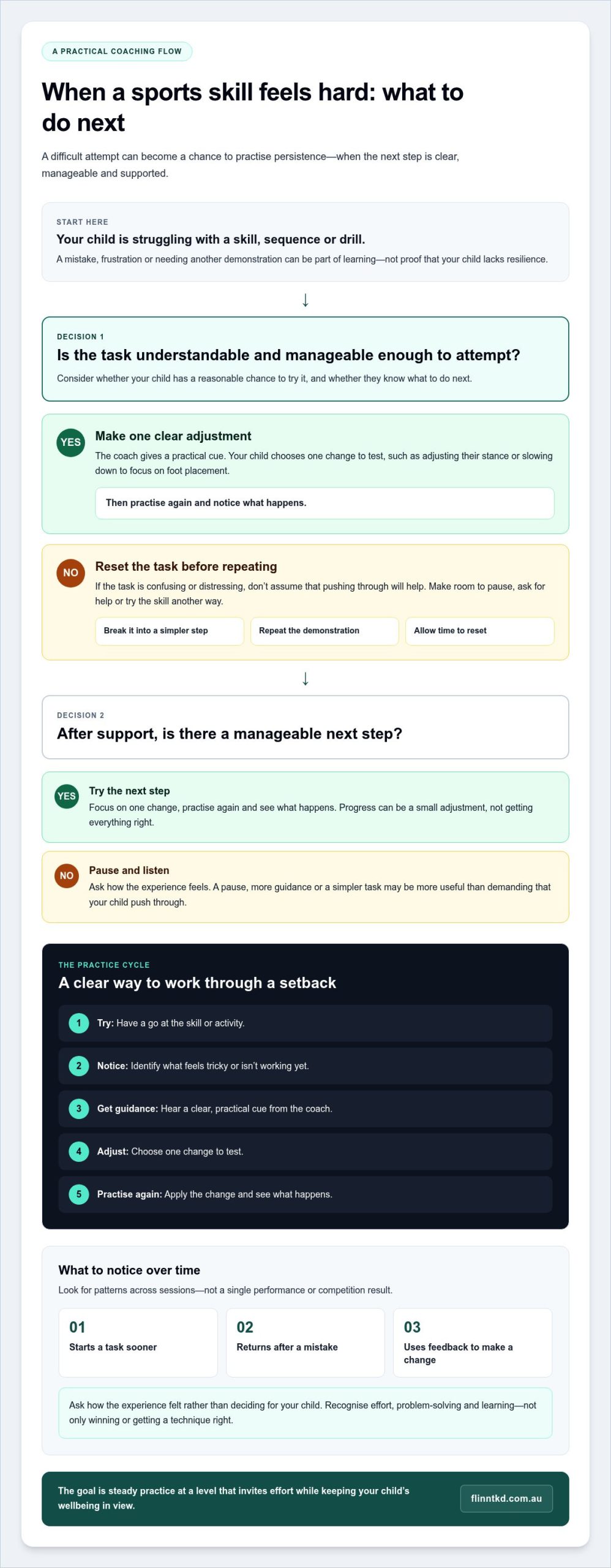
A task can be challenging without being overwhelming. When a child has a reasonable chance to attempt it, they can practise persistence and discover what helps them continue. The coach’s response matters: clear instructions and patient guidance can show a child what to try next. If a task remains confusing or distressing, simply demanding that a child push through may not help them learn.
Encouragement is most useful when it names the process. Try noticing, “You changed your foot position after the feedback,” or, “You kept working out what might help.” This recognises effort, problem-solving and learning without making praise depend only on winning or getting a technique right. It also gives children useful language for reflecting on their choices.
Support doesn’t mean removing every obstacle. It means giving a child room to pause, ask for help or attempt the skill another way. A coach can offer a simpler step, repeat a demonstration or allow time to reset. Parents can reinforce that approach by treating mistakes as information, not failure. Aim for steady practice at a level that invites effort while keeping your child’s wellbeing in view.
How Can Kids’ Sports Help Children Practise Resilience?
Sport can give children a place to practise responding when an activity doesn’t go to plan. The useful part isn’t simply repeating a drill; it’s having support to work out what to do after a difficult attempt. A simple learning cycle looks like this:
- Try: Have a go at a skill or activity.
- Meet difficulty: Notice what feels tricky or doesn’t work yet.
- Receive guidance: Hear a clear, practical cue from the coach.
- Adjust: Choose one change to test.
- Practise again: Apply that change and see what happens.
This cycle makes the next step clearer. It doesn’t guarantee a particular emotional or developmental outcome, and children respond differently to sport. But a well-paced class can offer repeated opportunities to practise effort, take in feedback and make choices after a setback. That’s why parents exploring brisbane kids sports for building resilience can look beyond results and notice how learning happens during ordinary training.
Practice, feedback, and small setbacks
A child might lose balance while learning a movement, forget the order of a sequence or struggle to coordinate a drill. Repetition gives them another chance, but the coach’s response shapes what that chance feels like. A calm cue such as “slow down and focus on your foot placement” offers a manageable next step. Specific guidance is more useful than praise tied only to winning or getting everything right.
Routines can make progress easier to see. Repeating a warm-up, practising a familiar skill and then working on a new challenge gives a child a sense of what to expect. A small goal, such as remembering the first part of a sequence, gives them something within their control. Keep the measure personal: notice what your child can do now compared with their earlier attempts, rather than ranking them against peers or medals.
Belonging and progress at a child’s pace
Feeling welcomed can make joining in more approachable. Clear turns, respectful communication and room to learn without ridicule help a child focus on taking part. In a group, encouragement from a coach or classmates may support participation, though children differ in the pace and social setting they enjoy. Notice how your child responds over time and whether they feel able to ask for help or try again.
Progress can mean engaging with a task, remembering a cue or choosing to return after a mistake. It doesn’t have to mean being the fastest or earning recognition. Some children find a shared group goal motivating; others prefer focusing on their own technique. If structured practice sounds like a fit, explore children’s Taekwondo classes as one way to work on skills through repetition and coaching.
Evidence about sport and child development needs careful interpretation. A link between participation and a positive outcome doesn’t prove sport caused that outcome; family support, the coaching environment and a child’s circumstances may also matter. To judge whether an activity is serving your child, look at what you can observe: whether they feel included, receive useful guidance and have achievable steps to work on.
Which Brisbane Kids’ Sports Environment Best Fits Your Child?
The best fit isn’t automatically the most competitive, popular or familiar sport. It’s an environment where your child can participate, understand what’s expected and keep learning at a suitable pace. When comparing brisbane kids sports for building resilience, focus on what your child will experience in class, not just the sport’s name.
Start with your child’s interests and preferred way of joining in. Then consider age fit, how activities are structured, how coaches communicate, whether beginners feel included and whether skills can develop gradually. Brisbane families may also want to factor in travel time and how training fits with school, rest and other routines. A class that looks appealing on paper also needs to work for your family in practice.
Team sports and individual sports: different practice settings
Team activities can centre on shared goals, cooperation and learning alongside other children. Individual activities can place more attention on personal practice and skill development. Neither setting is automatically better for resilience: both can involve effort and challenge. The coach’s approach, group atmosphere and your child’s comfort with that participation style all affect how the experience feels.
| Consider | Team activity | Individual activity |
|---|---|---|
| Participation | Working with others towards a shared task | Focusing more on personal attempts and development |
| Feedback | May include guidance within a group setting | May focus on an individual’s technique or next step |
| Progress | Can include contributing, communicating and practising skills | Can include developing a skill at an individual pace |
| Challenge | May involve cooperation and responding to group dynamics | May involve persistence with personal goals or techniques |
These are broad tendencies, not rules. A team class can include individual practice, and an individual sport can still have a strong community. Use the comparison to talk with your child about what sounds enjoyable or comfortable.
Questions that help assess a child-friendly class
Notice how the class communicates with children, especially those who are new. Instructions should be clear, activities should suit the age group, and coach-child interactions should be respectful. Look for a setting where children can learn without prior experience or immediate success. Beginner-friendly doesn’t mean challenge-free; it means the steps are understandable and progress can build over time.
- Can children follow the instructions and understand what to practise?
- Does the coach respond constructively when a child is unsure or makes a mistake?
- Are children included and given room to develop at different speeds?
Age fit matters too. Flinn Taekwondo Academy’s Little Tigers Program is for ages four to six, while Junior Taekwondo is for ages seven to twelve. For more age-specific context, explore this Junior Taekwondo Brisbane parent’s guide. After class, ask your child what they enjoyed, what felt challenging and whether they’d like to try again. Their answers can help you judge the fit more clearly than a result alone.
How Can Parents Support Resilience Before and After Sport?
Your response before and after training can help your child feel supported without making every class a test of character. Keep the conversation calm and simple. Before a session, ask what they’re looking forward to or whether anything is on their mind. Afterward, give them time to talk before offering advice.
Try this sequence when your child has had a tough session:
- Listen: Let them explain what happened without interrupting or rushing to solve it.
- Acknowledge: Reflect their feeling. “That sounds frustrating” shows you heard them without insisting they should feel differently.
- Ask: Invite them to share more: “Which part felt hardest?” or “What were you trying to do?”
- Identify one next step: If they’re ready, ask what they might want to practise, change or ask the coach next time.
- Encourage reflection: Help them notice an effort or choice they made, without requiring them to find a positive in every difficult experience.
What to say after a tough training session
Start by listening, not teaching. If your child says, “I couldn’t do it,” resist replying, “You just need to try harder.” You could say, “It sounds like that was tough. Do you want to tell me what happened?” Once they’ve had a chance to talk, ask, “What might you try differently next time?” They may want help, or they may simply need you to hear them.
Praise the effort or problem-solving you saw, while letting your child be disappointed about how the session felt. For example: “You kept listening to the instructions, even though you felt frustrated.” Don’t turn every trip home into a performance review. A child doesn’t need to produce a lesson or a cheerful takeaway after each class.
Keeping sport motivating rather than pressuring
Choose small goals with your child, based on what interests them: remembering one part of a routine, asking the coach for a cue or joining a particular drill. Goals should feel clear and manageable, not like a demand to improve every week. Recognise effort while leaving your child room to decide what matters to them.
Pay attention to patterns. A little hesitation before a new activity is different from ongoing distress or growing reluctance that doesn’t ease. Ask what’s behind it rather than labelling it a lack of grit. Your child may need reassurance, a rest, a smaller challenge or a conversation with their coach about approaching the activity.
Resilience isn’t built by filling every afternoon with organised activity. Leave space for unstructured play, rest, school responsibilities and other interests. A balanced routine can help sport remain one part of a child’s life, not a source of constant pressure. For families considering Taekwondo, explore children’s Taekwondo training as a structured activity where practice and feedback support gradual skill development.
Could Taekwondo at Flinn Taekwondo Academy Suit Your Child?
Taekwondo is one structured option for families considering brisbane kids sports for building resilience. Children learn physical skills through practice, and a new movement or sequence may take time to feel familiar. This gives them opportunities to listen to guidance, adjust an attempt and practise again. It doesn’t guarantee a child will become more resilient, and it won’t suit every child. Your child’s interests, readiness and experience of the class matter.
Flinn Taekwondo Academy is a family-owned school in North Brisbane, established in 2013. Its age-specific programs give families a clear starting point for considering whether Taekwondo may suit their child. Think about more than age: does your child enjoy learning structured skills, and are they ready to participate in a class with a coach and other students? It can take time to settle into something new, so notice your child’s comfort and response.
Choosing between Little Tigers and Junior Taekwondo
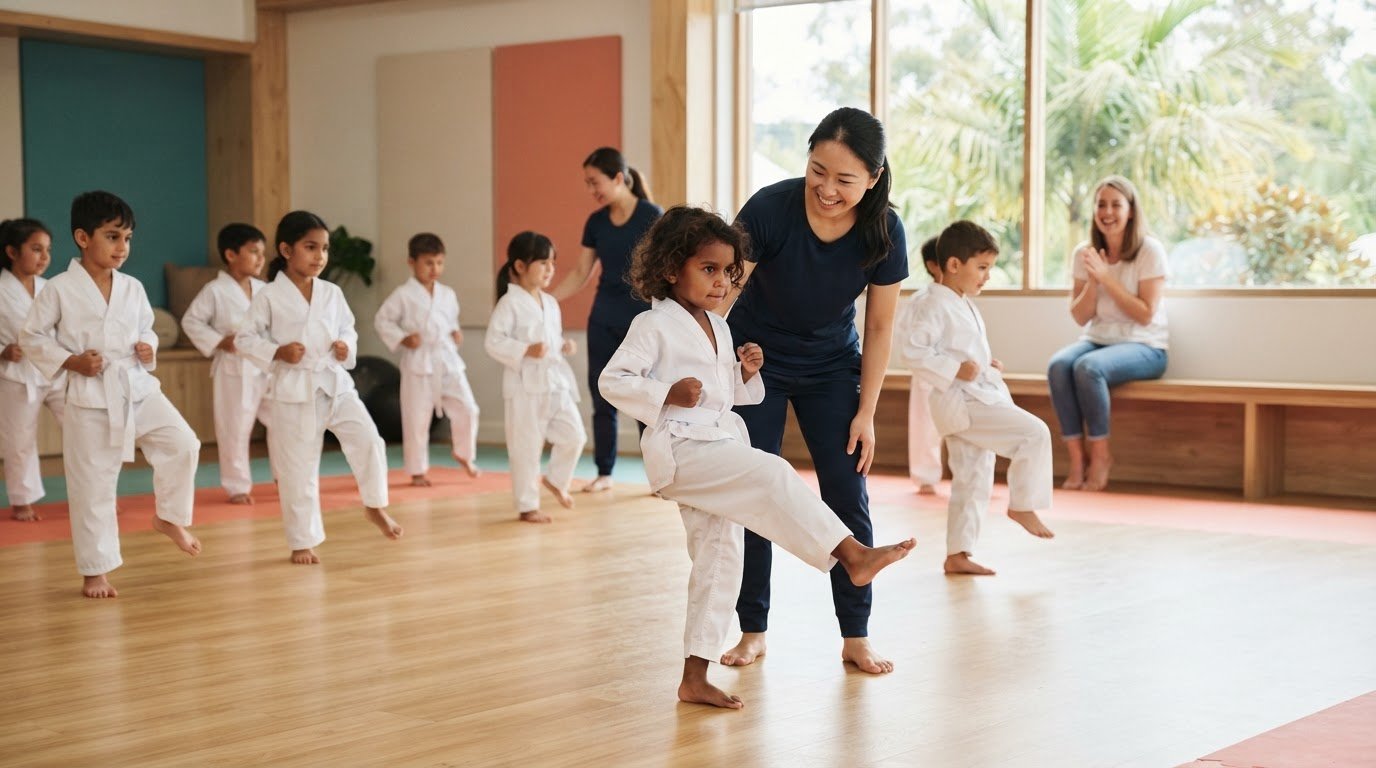
的 Little Tigers Program is for children aged four to six. The Junior Taekwondo Program is for children aged seven to twelve. These age ranges help families identify an appropriate pathway, but your child’s interests and readiness matter too. Consider whether they’re curious about Taekwondo and comfortable taking part in a structured activity. The right fit should invite learning, not make a child feel they have to master skills straight away.
Meet the coaching experience behind the academy
Master Jeff Flinn is a 7th Dan Black Belt with international accreditation. His experience provides a foundation for the academy’s Taekwondo instruction, but a coach’s credentials aren’t a promise of a particular personal outcome. Resilience develops through many experiences, and children respond differently. As you explore a class, consider whether your child can understand the guidance, participate at a manageable pace and build skills through continued practice.
If you’re learning about the activity before deciding, this complete Taekwondo guide for Brisbane families is a useful next step. It can help you understand Taekwondo and consider how a structured martial arts class might align with your child’s interests.
Invite your child into the decision. Ask what they’d like to learn, what they think a class might be like and how they feel about giving it a try. Keep the conversation low-pressure. If Taekwondo appeals to them, explore the program suited to their age and notice how they feel as they experience the training. A good starting point isn’t a promise of transformation; it’s an opportunity to learn, practise and see whether the environment feels right for your family.
Take the Next Step at Your Child’s Pace
You don’t have to find the perfect activity straight away. Start with a conversation: what would your child like to learn, and what kind of class feels inviting? Treat the first step as a chance to explore, not a test they need to pass. Their interest, comfort and willingness to keep learning can help guide what comes next.
If Taekwondo sounds like a good fit, explore how structured training could suit your child’s interests and stage of development. Flinn Taekwondo Academy offers age-specific programs, giving families a clear place to begin. Keep the focus on curiosity and steady participation, rather than expecting sport to change a child overnight.
Explore children’s Taekwondo at Flinn Taekwondo Academy and take a thoughtful first step towards brisbane kids sports for building resilience. With encouragement and room to grow, your child can discover what they enjoy and what they’re ready to try next.
常見問題
Can kids’ sports help shy children build resilience?
Yes, a suitable sports setting can give a shy child ways to participate that don’t depend on being the loudest or most outgoing. When considering brisbane kids sports for building resilience, look for opportunities to observe, join an activity when ready and communicate with a coach in a way that feels manageable. Ask your child what would make the next session easier, such as knowing what to expect or having a familiar person attend with them.
Is competition necessary for children to develop resilience through sport?
No, competition isn’t essential. Children can practise dealing with challenge by learning a new skill, following instructions or taking part in a group activity without competing for a place or medal. If competition is part of a sport, keep the focus on what your child can control, such as preparation and how they respond to a result. Ask whether competing feels motivating or stressful, and take their answer seriously.
What should I do if my child feels like quitting a sport?
First, find out what’s behind the wish to quit instead of insisting they stay or agreeing they should leave immediately. Ask whether the issue is the activity, a particular interaction, tiredness or a change in interest. If there’s no immediate safety concern, consider a calm conversation with the coach about your child’s experience. Then decide together whether to pause, adjust expectations or move on. Leaving an activity isn’t automatically a failure.
How often should a child play sport to practise resilience?
There’s no single weekly frequency that suits every child. Consider their age, energy, school commitments, enjoyment and recovery, rather than adding sessions to meet an assumed resilience target. A child might benefit more from attending one activity consistently and feeling ready to return than from a packed schedule. Watch for tiredness or stress that affects everyday life, and leave room for rest, informal play and interests outside sport.
Can a child build resilience if they are not naturally athletic?
Yes. Athletic ability isn’t a prerequisite for practising persistence, decision-making or asking for support. A child who finds coordination difficult, for example, can still notice what helps them learn: watching a demonstration, slowing down or practising one part at a time. Avoid describing them as “not sporty” based on early attempts. Focus on whether they enjoy participating and feel they have a fair opportunity to learn.
What is the difference between resilience and simply pushing through discomfort?
Resilience includes recognising what’s happening and choosing a response; it doesn’t mean ignoring pain, fear or exhaustion. A child may choose to pause, speak to a coach or stop an activity, and that can be a sensible response rather than a lack of determination. Treat physical pain and ongoing distress seriously. Ask what they’re experiencing, and seek appropriate support when you’re concerned about their wellbeing.
Is Taekwondo a suitable sport for children who are new to physical activity?
It can suit a child who’s interested in learning martial arts, even if they haven’t done much organised activity before. Taekwondo includes different areas of practice, such as poomsae and self-defence, but children’s comfort and readiness vary. Talk together about what they’re curious about and what might feel unfamiliar. Choose a pace that respects their starting point, and let their experience help guide the next step.