What if your child’s first Taekwondo tournament wasn’t about winning a medal, but about taking a brave first step? Preparing your child for their first taekwondo tournament can feel daunting when you’re unsure what happens at the venue, how the day is organised or how your child will handle nerves. A clear plan can make the experience more manageable for you both.
It’s natural to want your child to feel ready while also worrying they might feel overwhelmed or disappointed. Set a realistic goal: their first event is a chance to participate, learn and build confidence. Find out whether they’re entering poomsae, where they perform a sequence of techniques, or sparring, where they compete in a match. That information will help you focus preparation on what matters.
This guide covers what to review before the event, what to practise and how to support your child on tournament day. You’ll also learn how Flinn Taekwondo Academy’s Poomsae, Sparring and performance classes can support young students’ development in a welcoming North Brisbane Taekwondo community.
主要心得
- Think of a first tournament as a chance to participate, learn and practise, not a test of whether your child can win.
- Preparing your child for their first taekwondo tournament starts with reviewing the event information, confirming their division and planning around the organiser’s schedule.
- Poomsae and sparring call for different preparation, so tailor practice to your child’s event and follow the organiser’s published procedures.
- A calm tournament-day checklist can help you allow time to arrive, check in and settle before your child’s event.
- Explore how Flinn Taekwondo Academy’s Poomsae, Sparring and performance classes can support your child’s ongoing Taekwondo development.
What Should Your Child Expect at a First Taekwondo Tournament?
If the venue, schedule and competition process feel unfamiliar, that’s normal. Your child is learning how a tournament works as well as preparing to perform. Treat the first event as a chance to participate, practise Taekwondo in a new setting and discover what they’d like to work on next. Preparing your child for their first taekwondo tournament means helping them feel ready to take part, not asking them to prove themselves.
Each organiser sets the event format, divisions, schedule and instructions. The day may include different competition areas or event types. For a broader overview of tournament disciplines, the World Taekwondo Championships page introduces events such as kyorugi, or sparring, and poomsae. For your child’s event, use the information supplied by its organiser.
What happens at a Taekwondo tournament?
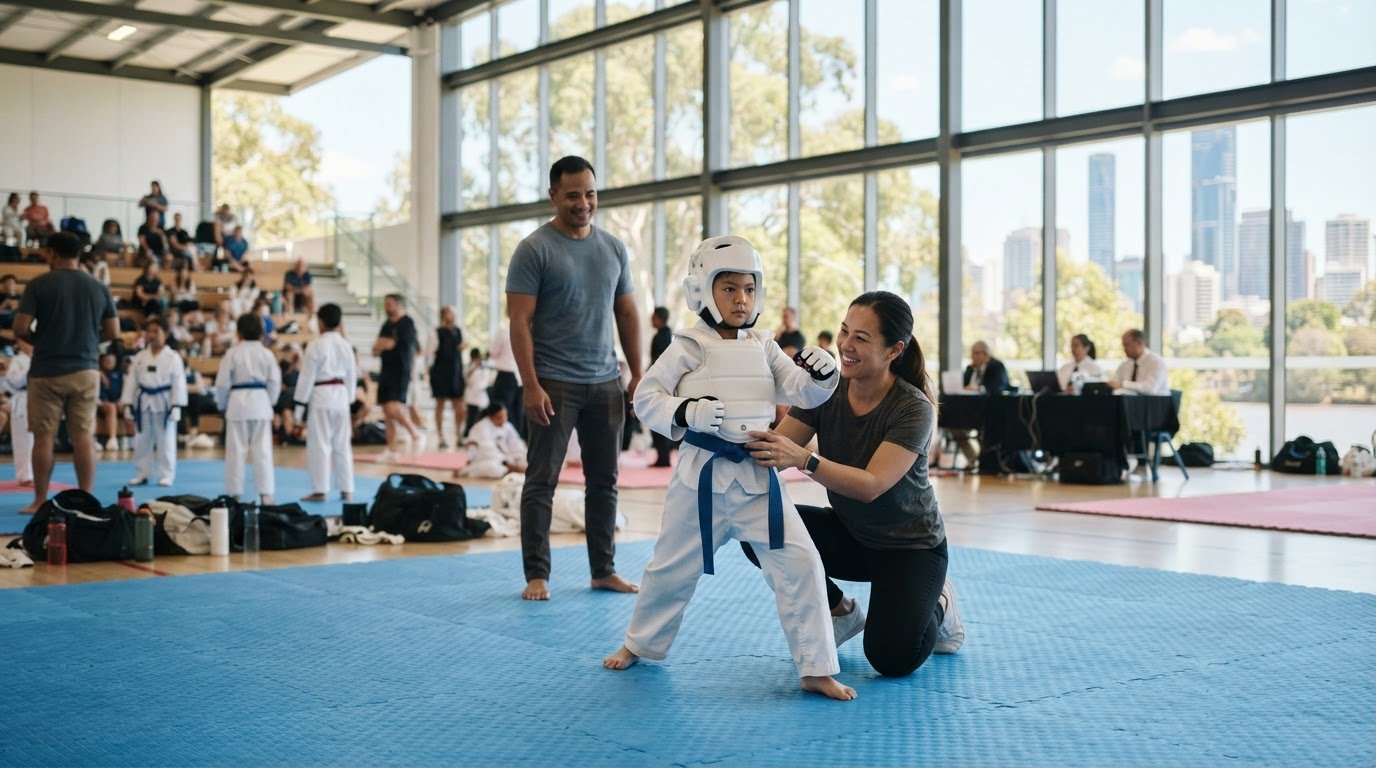
A tournament day usually involves several practical steps, not just the time on the mat. You’ll arrive at the venue, follow the organiser’s directions, check in and find out where your child should wait. Competitors may be called to a designated area when their division is ready. There can be a wait between arrival and your child’s event, so use that time to stay together, review instructions and help your child settle.
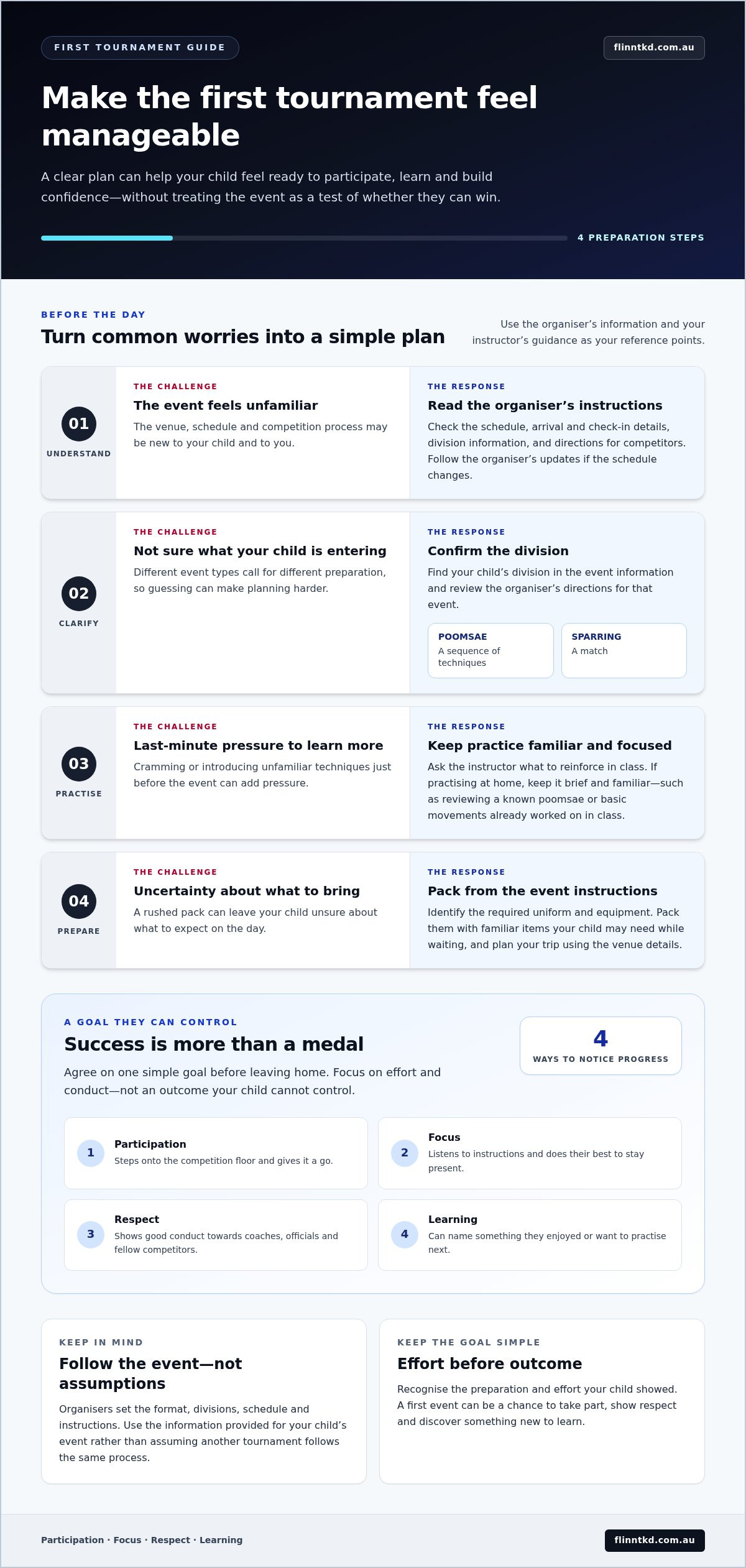
Keep the organiser’s published schedule and instructions close at hand. Check the event information for arrival guidance, check-in arrangements, your child’s division and where to go. If the schedule changes on the day, follow the organiser’s updates rather than assuming another tournament’s process will apply.
How can parents define a successful first event?
Before you leave home, agree on a goal your child can control. They might focus on listening carefully, giving their best effort, showing respect to officials and other competitors, or remembering a technique they’ve practised. These goals give your child something positive to aim for, whatever the result. A medal can be exciting, but it isn’t the only way to recognise progress.
- Participation: Your child steps onto the competition floor and gives the event a go.
- Focus: They listen to instructions and do their best to stay present.
- Respect: They show good conduct towards coaches, officials and fellow competitors.
- Learning: They can name something they enjoyed or want to practise after the event.
Praise the preparation and effort your child showed, not only the outcome. A positive first tournament is one where your child takes part, shows respect and leaves with something new to learn. That message makes room for nerves, unexpected results and small wins. Your steady encouragement can help your child see competition as part of their Taekwondo journey, not a judgement of their ability.
How to Prepare Your Child for a Taekwondo Tournament Before the Day
A simple plan replaces last-minute guesswork with clear, manageable steps. Start with the event information, then speak with your child’s instructor about the division and skills to focus on. Keep practice familiar and positive. Preparing your child for their first taekwondo tournament doesn’t mean adding pressure or trying to learn everything at once. It means helping them feel ready for the event they’ve entered.
Build a simple plan with the instructor
Your child’s instructor can help identify the event format and which techniques or sequences they already know are most relevant. Use regular classes to reinforce those skills. If your child wants to practise briefly at home, keep it light and familiar, such as reviewing a known poomsae sequence or basic movements they’ve worked on in class. Avoid introducing unfamiliar techniques just before the tournament.
Agree on one goal your child can remember, such as staying focused through their performance or listening carefully to instructions. Keep the goal about their effort, not a result they can’t control.
Review event details and get ready
As the event approaches, go through the organiser’s information with your child. The schedule and instructions are your guide to what to expect and bring. Make the details concrete: show your child where their division appears in the event information, explain when you plan to leave and pack together so they know what’s coming.
- Read the event instructions. Note the schedule, arrival and check-in details, division information and any directions for competitors.
- Clarify the division. Confirm whether your child is entered in poomsae, sparring or another listed category, and review the organiser’s instructions for that event.
- Choose focused practice. Ask the instructor what to reinforce in class, then keep any extra practice short and based on familiar skills.
- Prepare the essentials. Use the event instructions to identify the required uniform and equipment. Pack them with familiar items your child may need while waiting, and plan your trip using the venue details.
Keep preparation steady and follow your instructor’s guidance. There’s no need to impose a rigid training schedule. Consistent class practice and a clear plan can help your child feel more settled than cramming or making big changes at the last minute.
Support the basics beyond the mat, too. A familiar routine, a good night’s sleep and drinking water as usual can help your child feel ready for the day. Children’s Healthcare of Atlanta’s tips for young athletes also discuss general habits such as rest and hydration.
Know the event, practise the format and support your child. That’s a useful plan to keep in mind. Flinn Taekwondo Academy’s classes provide a supportive place for children in Brisbane to develop their Taekwondo skills with instructor guidance. Explore Taekwondo training at Flinn Taekwondo Academy.
Poomsae or Sparring: What Changes in Tournament Preparation?
The best preparation depends on the event your child is registered for. Poomsae and sparring call for different skills, so there’s no need to prepare for every competition format at once. Check the organiser’s published information for the division and procedures, then ask your child’s instructor how to focus practice on that event. This keeps preparing your child for their first taekwondo tournament clear and relevant.
| Preparation area | 柔術 | 對打 |
|---|---|---|
| What the child does | Performs a sequence of Taekwondo techniques with control and focus. | Participates in a match, applying Taekwondo skills in response to an opponent. |
| What to practise | The required sequence, accurate technique and steady concentration. | Familiar movement, timing and techniques practised in class, following instructor guidance. |
| What parents review | The organiser’s division information and instructions for the performance. | The organiser’s division, schedule and event-specific equipment instructions. |
This is a general guide, not a substitute for the event details. Organisers set their own divisions and procedures, so use the published information to understand what applies to your child’s entry. If anything about the format is unclear, your child’s instructor can help you understand it and keep preparation focused.
Preparing for poomsae competition
Poomsae is a set sequence, so practice centres on performing the required techniques in order with focus and control. Ask your child’s instructor which sequence applies and what to concentrate on. Repeating a familiar sequence in class can help your child feel more at ease with its flow. Flinn Taekwondo Academy offers traditional and competition-style Poomsae classes to help students develop their technique.
Preparing for sparring competition
Sparring differs from performing a memorised sequence. The child responds to an opponent during a match, drawing on skills and movement developed in training. Keep practice within the guidance of their instructor rather than adding unfamiliar techniques at home. Read the organiser’s instructions for your child’s division and any equipment details. Flinn’s Sparring classes help students develop sparring skills as part of their Taekwondo training.
Help your child focus on the event in front of them. For poomsae, that might mean recalling the sequence and staying composed. For sparring, it might mean listening carefully and using familiar skills. Aim for thoughtful preparation and a positive learning experience, not a promised result.
How to Support Your Child on Tournament Day
Your child will take cues from you, especially if the venue feels busy or the schedule changes. Keep your manner calm and the next step clear. A simple plan helps you manage practical details while your child focuses on participating. Calm encouragement helps them concentrate on taking part, not meeting someone else’s expectations.
A practical checklist for arriving and settling in
Before leaving home, review the organiser’s schedule and check-in instructions, including your child’s division and any event-specific directions. Allow enough time to find the venue, complete check-in and settle before the event. Arriving in a rush can add pressure, while arriving with time to orient yourselves gives your child a moment to take in the surroundings.
- Check the details: Have the schedule, check-in information and event instructions available so you can refer to them during the day.
- Pack what’s required: Bring your child’s uniform and any items identified in the organiser’s instructions.
- Find the right area: Once inside, locate the relevant competition area and follow directions from event staff.
- Keep the next step simple: Tell your child what happens next, such as checking in, waiting with you or moving to the area when directed.
There may be a gap between arriving and your child’s event. Use that time to stay together and keep the atmosphere relaxed. Avoid adding extra instructions or repeatedly quizzing your child about their performance. If the schedule or directions change, follow the organiser’s updates and explain the new plan in a few clear words.
Help your child manage nerves and results
Nerves don’t automatically mean your child is unprepared. Acknowledge what they’re feeling instead of dismissing it: “It’s okay to feel nervous. You’ve practised, and I’m here with you.” Before the event begins, agree on one short encouragement phrase that feels natural to your child. “Take a breath and do your best” is specific and supportive without putting the focus on winning.
During the event, let your child concentrate on their own performance. Offer encouragement, but avoid comparing them with other competitors or calling out technical instructions while they’re taking part. Their instructor can guide the Taekwondo skills; your steady presence provides reassurance.
Afterwards, give your child time to process the experience before discussing results. Start with an open question such as, “What did you enjoy?” or “What’s one thing you learned?” Listen to their answer. They may want to talk about a technique, a moment they felt proud of or how it felt to compete. Recognising effort and learning helps keep the day in perspective, whatever the outcome.
If your child is ready to keep developing their confidence through Taekwondo, explore training at Flinn Taekwondo Academy, where competition can be part of a supported learning journey.
How Flinn Taekwondo Academy Can Support Your Child’s Competition Journey
A first tournament can be one step in a child’s Taekwondo development, not a demand to win or a commitment to compete at every event. With guidance, your child can build skills, confidence and discipline at a pace that suits their interests. For North Brisbane families, Flinn Taekwondo Academy offers a supportive training community where competition can be part of a broader learning journey.
Preparing your child for their first taekwondo tournament is easier when their practice connects to the event they’ve chosen. Flinn Taekwondo Academy provides a secure, supportive atmosphere for students to develop through Taekwondo. Its classes include Poomsae, Sparring, Children’s Classes with a self-defence focus, Junior Performance and High Performance, giving young students different ways to build skills and explore competition.
Find training that matches your child’s competition interests
Poomsae and sparring involve different skills. Poomsae training focuses on performing a sequence with focus and control, while Sparring classes relate to the skills used in a match. Flinn offers traditional and competition-style Poomsae, as well as Sparring classes, so families can connect training with the format their child is interested in. The event organiser’s published information determines the child’s division and tournament procedures.
As a young student grows in confidence and commitment, Junior Performance or High Performance classes may suit their interests. These options support continued development, while competing remains a choice and training doesn’t promise a particular result. Families interested in a more focused route can explore the High Performance pathway as part of a longer-term competition journey.
Make the next step welcoming for your family
Starting Taekwondo doesn’t have to begin with a tournament goal. Your child can first become comfortable in class, learn foundational techniques and discover which parts of training they enjoy. Flinn Taekwondo Academy serves families in North Brisbane with a community-focused environment where progress matters more than turning every class or event into a performance test.
If you’d like broader context as a parent, the Junior Taekwondo parent guide can help you explore what your child’s training journey may involve. You can also take a low-pressure first step: book a free trial at Flinn Taekwondo Academy. New starters receive a FREE uniform, and signing up includes two free classes, giving your family a chance to experience training and consider what feels right for your child.
Let Their First Tournament Shape What Comes Next
Your child doesn’t need to decide now how far they’ll take competition. Let their first experience spark a conversation about what they enjoyed, what felt challenging and what they might like to practise next. That reflection can help your family choose a steady next step, whether it’s building confidence in class or exploring a particular competition format.
Preparing your child for their first taekwondo tournament is part of a bigger journey of effort, courage and personal growth. Keep encouraging curiosity and celebrate the progress your child makes along the way. If your family is ready to begin or continue that journey, book a free trial at Flinn Taekwondo Academy.
Every confident step starts with showing up. Help your child take the next one.
常見問題
Is my child ready for their first Taekwondo tournament?
Readiness depends on the event, your child’s experience and their instructor’s guidance, not a universal belt rank or age. Discuss the specific tournament with their instructor and review the organiser’s instructions together. Ask your child how they feel about taking part, too. Preparing your child for their first taekwondo tournament should support a learning experience, not set a pass-or-fail test or an expectation to win.
What should my child wear to a Taekwondo tournament?
Follow the organiser’s instructions for your child’s event and division, as uniform and equipment requirements can differ. The instructions may specify a uniform or other items to bring. Your child’s instructor can help you understand how those directions relate to their training. Lay out the required items beforehand, then use the event information as your guide rather than relying on what another competitor wore at a different tournament.
How can I help my child feel less nervous before a Taekwondo competition?
Nerves can be a natural response to trying something new. Give your child space to explain what feels worrying, then respond calmly instead of telling them not to be nervous. Keep practice familiar and agree on a short phrase, such as “I’m proud you’re giving it a go.” Remind them that effort and participation matter more than medals, and avoid adding new expectations on the way to the venue.
What is the difference between poomsae and sparring at a Taekwondo tournament?
Poomsae involves performing a sequence of techniques, while sparring is a match-based competition format. Your child’s preparation should suit the event they’re registered in, rather than trying to cover both formats at once. The organiser’s published information explains the event’s divisions and procedures. Flinn Taekwondo Academy offers Poomsae and Sparring classes to support these different interests and ongoing skill development.
How early should we arrive at a Taekwondo tournament?
There isn’t one arrival time that suits every tournament. Check the organiser’s schedule, check-in instructions and venue details, then plan enough time to reach the venue, find the relevant area and help your child settle. For example, allow time to locate the check-in point after you arrive. Follow event updates on the day, since the organiser’s directions take priority.
What should parents say to a child after their first Taekwondo tournament?
Recognise your child’s effort, focus and willingness to participate before talking about scores or results. Try asking, “What was your favourite part?” or “What would you like to practise next?” These open questions let your child lead the conversation and share what mattered to them. If they bring up a difficult moment, listen first and help them consider what they learned, without turning the discussion into a performance review.
Does Flinn Taekwondo Academy offer a free trial for children?
Yes. Families in Brisbane can book a free trial at Flinn Taekwondo Academy. New starters receive a FREE uniform, and signing up includes two free classes. A trial lets your family experience Taekwondo training and see how your child feels in the class environment. Take the first step together and let their interest develop from there.