Powerful kicks are only one part of advanced Taekwondo. Advanced Taekwondo techniques for black belts combine precise front, side, crescent and roundhouse kicks with punching, linear and circular self-defence, and the control to choose an appropriate response. Each technique is most effective as part of purposeful practice, not as an isolated move.
Reaching black belt takes more than learning a longer list of techniques. The next challenge is making your movement accurate, adaptable and connected, whether you’re practising a kick, striking combination or defensive action. This guide explains how these techniques fit into advanced training, what distinguishes linear from circular self-defence, and how punches and kicks can work together. Precision and control matter as much as power when refining your skills.
主要心得
- Refine front, side, crescent and roundhouse kicks by understanding how each uses body position and direction.
- Make punching techniques more effective by linking accurate strikes with balance and controlled movement.
- Approach spinning hook and 540-degree kicks progressively, using instructor guidance to develop sound technique.
- Build sparring combinations that connect techniques through changing positions, movement and varied practice speed.
Front, side, crescent and roundhouse kicks
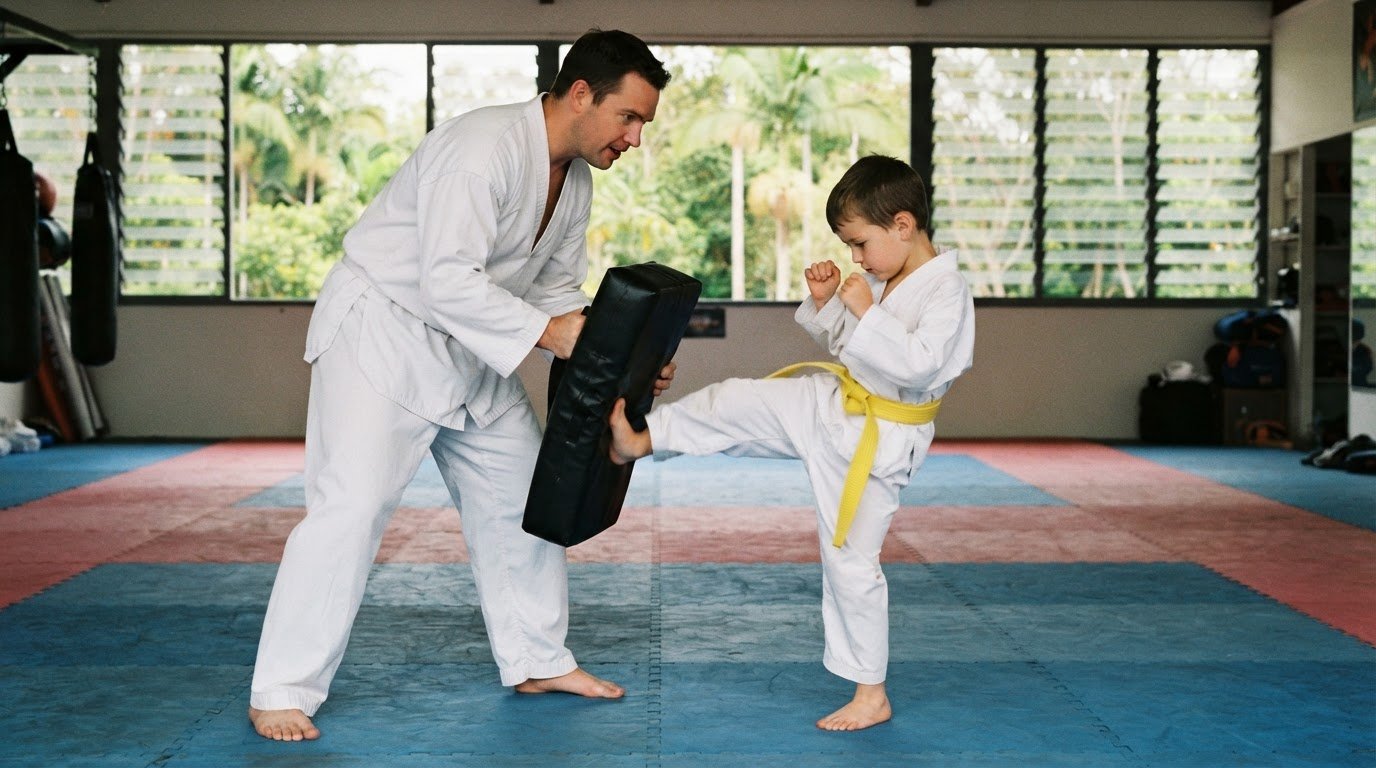
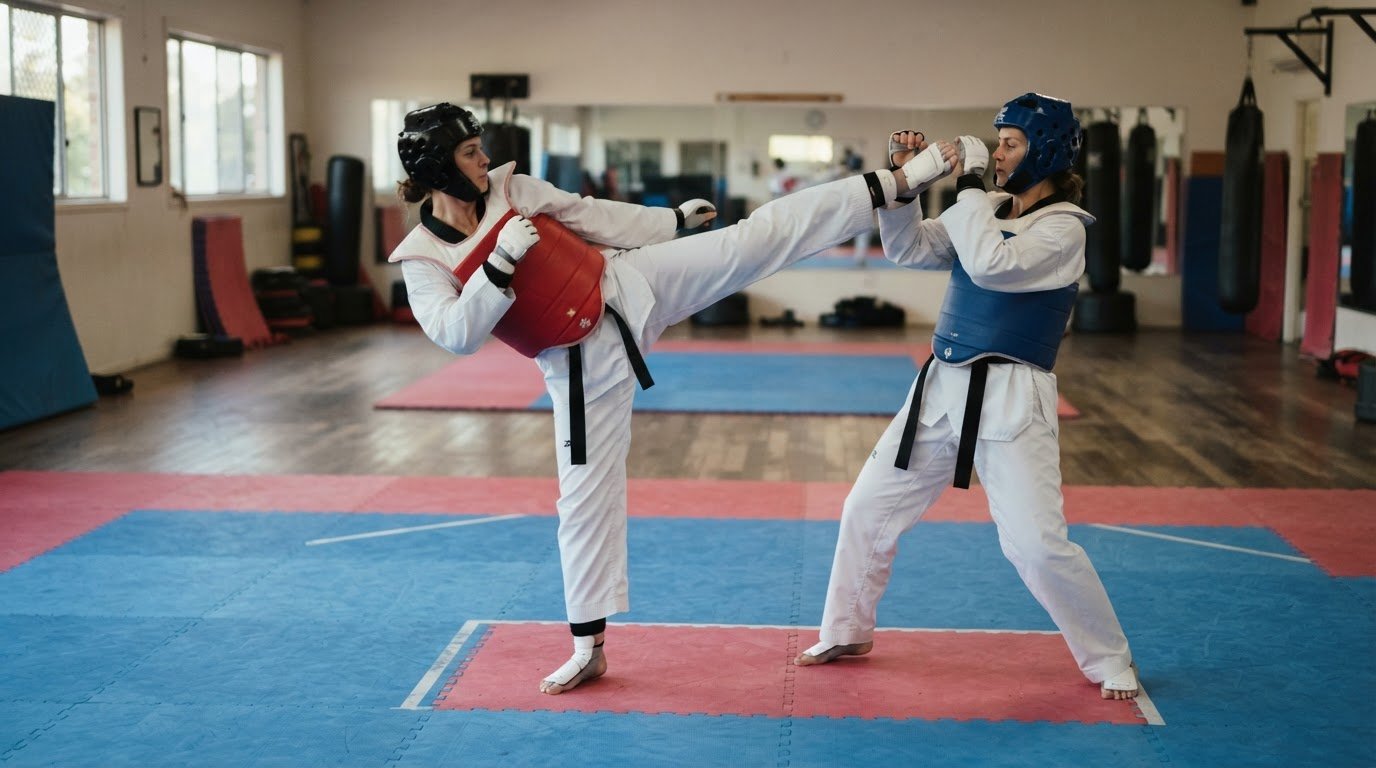
A front kick drives the ball of the foot forward towards a target. A side kick extends the leg sideways, with the body rotating 90 degrees. A crescent kick swings the leg in an arc across or towards the body’s centre line. A roundhouse kick snaps horizontally towards a target after the hips turn and the supporting foot pivots.
Refine each kick by separating its actions before combining them. For a front kick, raise the knee, extend the lower leg, retract it, then return to stance. For a side kick, chamber the knee and rotate the body before extending the heel. A crescent kick needs a controlled arc and a stable supporting leg. In a roundhouse, pivot on the non-kicking foot and turn the hips before snapping through an 80 to 90-degree angle. Keep your guard active throughout each movement.
Which Taekwondo techniques score most effectively in WT sparring? In the scoring system described, a spinning kick to the head earns five points, while a spinning kick to the torso earns four. A head kick earns three points, a torso kick earns two, and a torso punch earns one.
How do black belts train breaking, jumping kicks and aerial techniques? Practise each movement in stages, developing balance, timing and accurate target control before attempting a board break or aerial kick. Board breaking can develop precision, effectiveness, speed and agility; jumping techniques also require control during take-off and landing.
What are the injury risks of advanced Taekwondo kicks, and how can they be reduced? Fast, high or poorly controlled kicks can strain the body, particularly when balance or technique breaks down. Build flexibility and strength progressively, practise within controlled limits, and seek instructor guidance when refining demanding movements.
Follow a clear training sequence: practise each kick slowly, check your balance, then add speed and combinations. A front kick can set up a roundhouse; a side kick can create distance before you reset. In sparring, choose a technique that fits your position rather than forcing a high or spinning kick. Controlled repetition helps make each movement crisp, accurate and purposeful.
Punching techniques
A straight punch is a direct fist strike along a forward line. Practise it from a stable stance, keeping your other hand near your guard. Start with your fist chambered beside your hip, then drive it forward as your hips and shoulders turn. Keep your wrist aligned with your forearm at impact and retract the fist promptly. For example, practise one controlled punch, reset your stance, then repeat on the opposite side. Accuracy and balance matter more than reaching beyond your stable range.
A reverse punch is a straight strike delivered with the hand opposite your lead leg. Coordinate the punch with a small hip rotation, keeping your head centred above your stance. Avoid raising your shoulder or flaring your elbow sideways. Practise slowly: check your stance, extend along a direct path, then return to guard. A partner-held target provides a clear focus point, while controlled contact helps maintain alignment.
A guard keeps your hands ready to protect and strike. Maintain it as you punch, step or turn, rather than dropping both hands during a combination. In poomsae, punches are performed within set sequences, so crisp timing and consistent technique keep each movement deliberate. Try a simple drill: step forward with one punch, recover your stance, then repeat while keeping your eyes level. An instructor can correct your fist’s line and the coordination of your hips.
For advanced Taekwondo practice, connect punches to movement instead of treating each strike as a stationary action. A step-in punch closes distance; a punch after a retreat can create space before you reset. In sparring, controlled timing and a clear target help you practise without swinging wildly. Keep the movement compact, return to guard, and stay balanced after every strike. Instructor-led Taekwondo training can help you refine these details through focused practice.
Competition rules shape how these techniques are used: Taekwondo competition aims to score kicks and punches in the opponent’s torso and head scoring zones. Punches to the head and knee attacks are penalized, so keep punches controlled and directed within the permitted target area.

How to perform spinning hook kicks and 540-degree kicks safely and correctly
A spinning hook kick turns the body before the heel travels across the target line. Begin in a balanced stance, pivot and turn your head to locate the target, then let your hips follow. Chamber the kicking leg, extend it through a controlled arc, then bend the knee to retract. Finish facing a stable direction with your guard restored. Practise the turn and retraction without striking first to develop control before adding speed or height.
A 540 kick uses a 1½-turn jump before a kick, usually a back spinning hook kick. Treat it as a sequence of separate skills, not one explosive movement. First practise the take-off and turn without kicking. Next, rehearse the kicking motion at a lower height, then coordinate it with the airborne rotation. Keep your eyes on the target as long as the turn allows. Land with control, regain your stance, and pause before repeating. The kick’s extra rotation makes timing and orientation central to good execution.
Use this progression for either technique:
- Set your base: Start from a balanced stance and choose a clear target.
- Rehearse the turn: Practise pivoting and spotting the target without adding the kick.
- Add the chamber: Raise the knee only as high as you can control, then retract cleanly.
- Link the actions: Combine the turn, kick and landing at a measured pace.
- Build intensity gradually: Add speed or height only while your balance and technique stay consistent.
For a spinning hook kick, a common breakdown is losing sight of the target during the turn. Slow the rotation and practise spotting before extending the leg. For a 540, rushing the jump can disrupt the kick and landing. Return to separate stages when either part becomes uncontrolled. An instructor or higher-level student can guide your technique and help you progress through each stage. Use focused repetitions, stop when control slips, and resume with the simpler movement before attempting the full kick again.
Ask your instructor or a higher-level student for guidance as you work on these movements. Applying that guidance can support gradual progression from basic turns to complete kicks.
Advanced Taekwondo combinations for sparring and competition
A combination links techniques into a planned sequence. In sparring, connect each action so the next responds to your partner’s movement. A simple example is a feint, a scoring kick attempt, then a quick exit. A feint is a controlled movement intended to draw a reaction. Use it to create an opening, not to replace accurate technique. A counter responds to an opponent’s attack. Practise counters by recognising the movement, choosing a suitable response, then regaining your stance.
Build combinations around a clear purpose: create an opening, respond or change position. For example, step to the side as your partner advances, then deliver a controlled counter. Another sequence can begin with a hand feint, continue with a kick and finish with a retreat. Keep your guard active between techniques. A combination should remain balanced from its first movement through the final reset.
Use this progression to turn a sequence into a practical drill:
- Choose a goal: Decide whether the sequence draws a reaction, counters an attack, or creates space.
- Set the starting position: Practise from a stable stance, then repeat from a different distance.
- Connect the actions: Link a feint, attack and exit without pausing between movements.
- Add a partner: Have a partner change position or respond differently, so you adapt the sequence.
- Vary the pace: Begin slowly, then change speed while keeping each movement controlled.
Drills become more useful when instructors demonstrate how techniques connect and students practise them through practical application. Add movement, changing positions and varied speed to challenge your timing without relying on a fixed pattern. For example, begin with a partner approaching; respond with a sidestep and counter, then reset when the partner changes direction. Review whether each technique had a clear purpose. If a movement leaves you off-balance or exposed, simplify the sequence and practise that transition before adding speed.
Sharpen your combinations through focused sparring and competition training, with attention to movement, timing and control.
Flinn 跆拳道學院
Flinn Taekwondo Academy helps students develop Taekwondo skills through structured training suited to their age and goals. If you’re refining advanced kicks, building sharper combinations or preparing for competition, focused coaching can help connect technique with timing, balance and control. High Performance Competition Training supports athletes working towards competitive goals, while the Little Tigers Program (4-6 years), Junior Taekwondo Program (7-12 years) and Senior & Adult Taekwondo Program (13+ years) provide age-appropriate pathways into training. The next step is to choose the focus that fits your current practice and keep progressing with purpose. For guidance on training at Flinn Taekwondo Academy, contact the academy.
Make your next training session count
Develop advanced Taekwondo techniques for black belts by giving each session a clear focus. Choose one movement or transition to refine, then monitor how well you maintain control as you practise. This keeps your development purposeful and helps you see where consistent effort can make a difference.
Set a personal goal that suits your current training, such as improving a transition or making a combination more adaptable. Bring that focus into class, listen to instruction and learn from each attempt. Taekwondo is a continuing journey, and steady practice can strengthen discipline as well as technique.
Ready to take your next step? Contact Flinn Taekwondo Academy to discuss training. Keep showing up with purpose, stay open to learning, and build your skills one deliberate movement at a time.
常見問題
What advanced Taekwondo techniques are appropriate for black belts?
Advanced Taekwondo techniques for black belts should build on established control and support a clear training goal. When choosing advanced Taekwondo techniques for black belts, consider whether your practice focuses on poomsae, sparring or self-defence. For example, refine transitions between movements rather than adding complexity without purpose. At Flinn Taekwondo Academy in North Brisbane, sparring classes and poomsae training offer focused ways to develop these skills with instructor guidance.
What are the ITF and WT rules for advanced black-belt techniques?
In the described WT scoring system, a spinning kick to the head earns five points, a spinning kick to the torso four, a head kick three, a torso kick two, and a torso punch one. The material provides no ITF-specific rules.
How often should black belts practise advanced techniques to improve safely?
Practise consistently, starting slowly and adding speed or height only while your control remains steady. If control slips, stop and return to a simpler movement.