
What if your child’s martial arts belt wasn’t just a piece of colored fabric, but a living map of their personal transformation? Many Brisbane parents feel overwhelmed by complex ranking systems or worry that the path to a black belt is an impossible mountain to climb. It’s completely normal to feel a bit of “grading anxiety” when you aren’t sure what each level requires or how long the total journey takes for your family.
This guide clarifies the taekwondo belt order and meanings for 2026, revealing the deep philosophical symbolism behind every color. We’ll show you the clear, disciplined path we use to lead students from their very first lesson to Black Belt excellence. Whether your child is starting in our Little Tigers program or you’re joining the Senior Taekwondo classes yourself, you’ll gain total confidence in the grading process.
You’ll discover the “seed to tree” metaphor that defines our curriculum and learn how our community-focused approach turns every technical challenge into a milestone for character growth. Let’s explore the hierarchy that turns beginners into leaders and see how these ancient traditions fit perfectly into your modern Brisbane lifestyle.
主要心得
- Understand how the belt system serves as a powerful roadmap for your child’s goal setting and long-term perseverance.
- Explore the taekwondo belt order and meanings to uncover the deep symbolism that marks each stage of a student’s transformation.
- Learn how our specialized Little Tigers and Junior programs adapt the curriculum to fit every developmental milestone.
- Gain a clear understanding of the grading process and attendance requirements to help your family prepare for success.
- Discover how Master Jeff Flinn’s 7th Dan expertise fosters a culture of excellence and community within our North Brisbane academy.
The Philosophy of the Taekwondo Belt System: More Than Just Fabric
When you step into our Dojang, you aren’t just entering a gym. You’re entering a space of mutual respect where every bow and every belt tells a story of personal growth. For Brisbane families, the taekwondo belt order and meanings act as a tangible roadmap for character development. It isn’t just about the physical mechanics of a kick. It’s about teaching your child that big goals are achieved through small, consistent steps. This structured environment promotes a level of discipline that helps Brisbane school-aged children excel both on the mats and in their daily lives.
The Symbolic Journey: From Seed to Tree
We often describe the belt progression as the life cycle of a plant. This metaphor helps students visualize their own transformation. The white belt represents innocence, like a seed buried in the winter soil, waiting for the first sign of spring. As you progress, the colors deepen, reflecting the sun, the earth, and the sky. While most World Taekwondo schools follow a similar path, organizations like the ATA Songahm Taekwondo belt system use their own unique variations to represent these stages of development. This consistent structure across the globe ensures that a student’s hard work is recognized as they transition from a beginner to a mature practitioner.
Gup vs. Dan: Understanding the Terminology
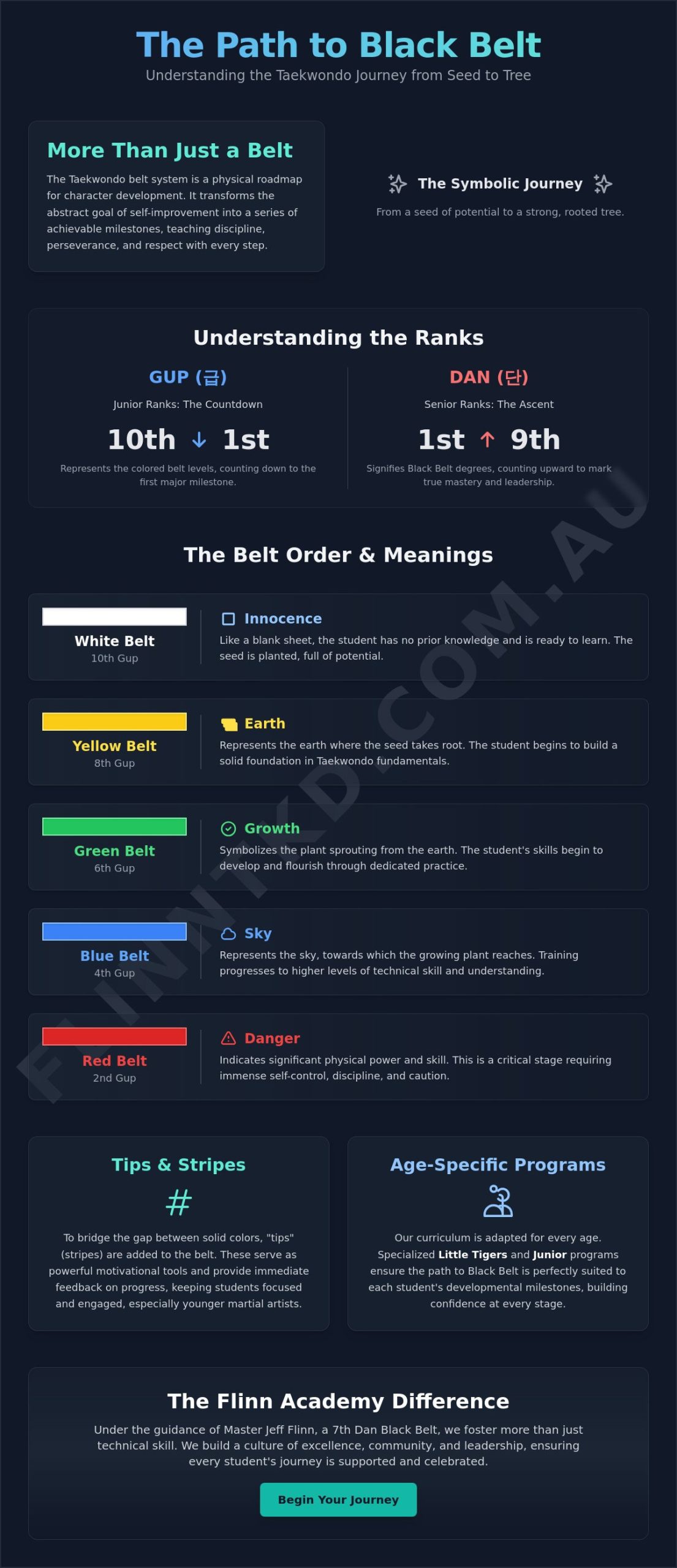
To understand the taekwondo belt order and meanings, you first need to know the difference between Gup and Dan ranks. You’ll encounter these two categories as you move through our programs.
- Gup (Junior Ranks): These represent the colored belt levels. Think of Gup as a countdown toward your first major milestone. You start at 10th Gup and earn your way down to 1st Gup.
- Dan (Senior Ranks): This term applies to Black Belt degrees. Unlike the Gup ranks, Dan levels count upward. A 1st Dan marks the beginning of true mastery, while higher ranks like 7th Dan signify a lifetime of technical training and community leadership.
This structure provides students with a clear sense of momentum. Each time a child earns a lower Gup number, they feel the tangible reward of their focus. It transforms training into a tool for mental fortitude and holistic growth. By the time a student reaches the Dan ranks, they’ve shifted from learning the basics to refining their character. They aren’t just practicing a sport; they’re living a standard of excellence that reflects the transformative power of the discipline.
Taekwondo Belt Order: Meanings and Symbolism
Every step in your martial arts journey is marked by a shift in color. Understanding the taekwondo belt order and meanings helps students appreciate the weight of their progress and the responsibilities that come with each new rank. These colors aren’t chosen at random. They follow a specific philosophical path that mirrors the growth of a living thing. While specific academies might add unique stripes, the core taekwondo belt order and meanings remain a universal language of martial arts excellence, often rooted in the official ITF belt meanings that many international schools respect.
- White Belt: This signifies innocence. Like a blank sheet of paper, the beginner has no prior knowledge of Taekwondo and is ready to be shaped by discipline.
- Yellow Belt: This represents the earth. It’s the stage where the foundation is laid, much like a seed taking root in the soil.
- Green Belt: This symbolizes the plant’s growth. Skills begin to develop, and the student starts to see the results of their hard work.
- Blue Belt: This represents the sky. The plant is now reaching upward, signifying that the student’s training is moving toward higher levels of technical proficiency.
- Red Belt: This signifies danger. It’s a critical stage where the student has physical power but must exercise intense self-control and caution.
Intermediate Ranks: Tips and Stripes
The jump between solid colors can sometimes feel long, especially for younger students. That’s why we use “tips” or stripes as vital mid-way milestones. These small additions to the belt serve as powerful motivational tools. They provide immediate feedback on a student’s technical improvements and help them maintain focus during longer training cycles. At Flinn Taekwondo Academy, we use a specific stripe order to ensure every child in our Junior Taekwondo Program feels a constant sense of achievement and momentum.
The Black Belt: Mastery and Beyond
Reaching a Black Belt is the opposite of the White Belt stage. It represents maturity, proficiency, and a total rejection of darkness and fear. However, the journey doesn’t end at the first Black Belt. We use the Dan system to categorize levels of mastery, ranging from 1st Dan to 9th Dan. While a 1st Dan is a “trained beginner” who has mastered the basics, higher ranks signify decades of dedication. Master Jeff Flinn’s 7th Dan status is a mark of elite expertise, representing a lifetime spent refining both the physical craft and the mental fortitude required to lead a community. This level of experience ensures that every student receives instruction grounded in the highest international standards.
Age-Specific Progression: Little Tigers to Adult Ranks
Martial arts training isn’t a one size fits all experience. A four year old child processes information and develops motor skills differently than a forty year old professional. While the core taekwondo belt order and meanings remain consistent across the World Taekwondo belt system, the curriculum must adapt to the student’s developmental stage. We believe in setting age-appropriate goals that challenge students without causing burnout. This structured approach ensures that every member of our Brisbane community finds a clear, sustainable path to personal excellence.
Little Tigers: Building Early Focus
我們的 Little Tigers Program is specifically designed for children aged 4 to 6. At this tender age, the focus shifts away from complex combat and toward foundational life skills. We use specific introductory ranks that act as stepping stones toward the traditional yellow belt. These levels prioritize listening skills, basic coordination, and following instructions. Small, frequent wins are the heartbeat of this program. By earning stripes and introductory belts, preschoolers build the self-belief necessary to tackle bigger challenges. When they eventually transition into our Junior Taekwondo stream, they do so with a solid foundation of discipline and a genuine love for training.
Senior and Adult Advancement
Adults and teenagers often join our academy with different motivations, ranging from high-level fitness to practical self-defence. Our Adult Taekwondo Brisbane classes allow you to progress at a pace that respects your individual starting point. We balance technical mastery with physical conditioning, ensuring you gain mental fortitude alongside physical strength. This stage of training often involves a deeper dive into the taekwondo belt order and meanings, as older students appreciate the philosophical nuances of each rank.
For our younger high achievers, the system includes a specific “Poom” rank. If a student under the age of 15 reaches the black belt level, they receive a Poom belt rather than a Dan rank. This junior black belt recognizes their elite technical proficiency while acknowledging their ongoing developmental journey. Once the student reaches 15, their Poom rank typically converts to an adult Dan certificate. This distinction maintains the integrity of the senior ranks while celebrating the incredible dedication of our younger martial artists. Whether you’re a parent or an adult beginner, this structured progression ensures your hard work is always met with the appropriate level of recognition.
Preparing for Your Grading in North Brisbane
Grading is the bridge between consistent training and tangible achievement. It is the moment you or your child proves a commitment to the taekwondo belt order and meanings. While some local academies, such as Moon Lee Tae Kwon Do, have their next gradings scheduled for June 2026, we ensure our students are prepared for every milestone through a structured, four step process. We don’t just want you to pass; we want you to feel a deep sense of pride in your progress.
- Step 1: Attendance and Skill Requirements. You cannot rush mastery. Students must meet minimum class attendance and demonstrate the required technical skills before they are invited to grade.
- Step 2: Formal Application. Once you’re ready, you’ll complete a grading application and process the necessary fees. This covers your examination, your new belt, and your official certification.
- Step 3: The Physical Examination. This is the “big day.” You will perform your Poomsae (patterns), demonstrate sparring techniques, and answer theoretical questions about the history and philosophy of Taekwondo.
- Step 4: The Presentation. Success is celebrated with the official presentation of your new belt. It is a powerful moment that reinforces the value of hard work and mental fortitude.
What Instructors Look For
We look for more than just a high kick or a loud shout. Our instructors evaluate your technique, power, and that essential “Indomitable Spirit.” You’ll need to demonstrate a solid grasp of the curriculum found in our self defence classes, showing that you can apply your skills in practical, real world scenarios. Most importantly, your attitude and respect for your peers are just as vital as your physical performance. A black belt is a leader, and leadership begins at the white belt level.
Managing Grading Nerves
It’s completely natural to feel butterflies before a grading. We encourage parents to frame the day as a celebration of everything their child has already achieved rather than a stressful “test.” At Flinn Taekwondo Academy, we pride ourselves on a supportive community environment where everyone is rooting for your success. We turn grading into a positive, transformative experience that builds lifelong confidence. If you’re ready to see what your family can achieve, join our community and start your journey today.
The Flinn Academy Difference: Achieving Black Belt Excellence
Choosing the right environment for your martial arts journey is just as vital as the training itself. While understanding the taekwondo belt order and meanings provides you with a clear roadmap, you still need an expert guide to help you navigate the path. At Flinn Taekwondo Academy, we don’t just teach kicks and punches. We mentor students through a proprietary methodology that balances traditional martial arts values with modern, high performance coaching. Our North Brisbane facility serves as a hub for families who want to see their children grow into confident, disciplined leaders.
Master Jeff Flinn brings a wealth of international accreditation to our mats. As a 7th Dan Black Belt, his experience ensures that the taekwondo belt order and meanings taught here align with the highest global standards. This level of expertise allows us to offer specialized Taekwondo classes North Brisbane families can trust for both safety and technical precision. We’ve built a community where personal growth is the priority, ensuring every student feels supported from their very first white belt lesson.
Expert Mentorship in Brisbane
Learning from an internationally recognized master changes the way a student approaches challenges. We provide personalized feedback that helps every practitioner reach their full potential, whether they are four years old or forty. For those interested in the competitive side of the sport, our High Performance Competition Training prepares athletes for major events. For instance, we actively help our students prepare for the Brisbane Open Taekwondo Championships held at Nissan Arena on August 29, 2026. This focus on excellence ensures our students aren’t just earning belts; they’re gaining the mental fortitude to succeed on the world stage.
Join the Flinn Taekwondo Family
We invite you to step onto the mats and experience our welcoming, family-oriented atmosphere firsthand. Our North Brisbane dojang is a place where respect is earned and community is built. We offer dedicated trial programs for new students, allowing you to see how our Little Tigers or Junior Taekwondo programs fit your child’s needs without any initial pressure. The journey to a Black Belt is a marathon, not a sprint. By staying the course, your family will gain more than just a rank. You’ll develop a high standard of living characterized by discipline, health, and a sense of belonging to a winning team.
Ready to start your transformation? Contact us today to learn more about our class schedules and begin your path toward Black Belt excellence with a team that cares about your success both inside and outside the academy.
Your Path to Black Belt Excellence Starts Today
Understanding the taekwondo belt order and meanings provides your family with a clear vision of the transformation ahead. You’ve seen how each rank represents a new stage of growth and how our structured grading process builds the mental fortitude needed for life’s biggest challenges. Whether your child is starting as a Little Tiger or you’re looking for a new challenge in our adult classes, you’re joining a community dedicated to your success.
Flinn Taekwondo Academy has been a family owned Brisbane institution since 2013. Led by 7th Dan Master Jeff Flinn, we offer specialized programs for ages 4 to 60+ that prioritize safety, respect, and personal agency. We don’t just teach martial arts; we help you build a legacy of discipline and achievement. It’s time to turn your interest into action and see what you can accomplish on the mats.
Begin your journey to Black Belt with a trial at Flinn Taekwondo Academy! We can’t wait to welcome you into our dojang and help you take that first step toward technical mastery and lifelong confidence.
常見問題
How long does it take to get a Black Belt in Taekwondo?
It typically takes between three to five years of consistent training to achieve a Black Belt. Your progress depends on how often you attend classes and your dedication to mastering each level. We focus on the quality of your technique rather than rushing through the ranks. This timeline ensures you develop the mental fortitude and physical skill required for elite mastery.
Do I have to pay for each belt grading?
Yes, grading fees are a standard part of martial arts progression across the industry. These fees generally cover the cost of the examination, your new belt, and the official certification of your rank. It’s best to check with your specific academy for their current administrative requirements. This investment reflects your commitment to moving through the taekwondo belt order and meanings with professional oversight.
What happens if a student fails their belt grading?
Failing a grading is simply a signal that you need more time to refine specific skills. We view this as a powerful teaching moment for building resilience and an indomitable spirit. Your instructors will provide personalized feedback to help you overcome technical hurdles. You’ll be encouraged to practice and attempt the grading again once you’ve reached the necessary standard of excellence.
Are Taekwondo belt orders the same in every school?
Most World Taekwondo schools follow a similar color progression, but slight variations exist between different organizations. While the core colors usually move from white to black, some academies use different colored stripes or intermediate tips to mark progress. Understanding the taekwondo belt order and meanings at your local academy ensures you stay focused on their specific technical requirements and curriculum.
What is the highest belt you can achieve in Taekwondo?
The highest rank you can achieve is a 9th Dan Black Belt. This level represents a lifetime of dedication to the discipline and is recognized globally by the Kukkiwon. While reaching 1st Dan is a major milestone, the journey continues through the senior ranks. These higher degrees signify profound technical knowledge and a deep commitment to mentoring the next generation of martial artists.
Does my child need to compete in tournaments to advance in rank?
Tournament competition is usually not a mandatory requirement for advancing through the colored belt ranks. We encourage participation in events like the Brisbane Open Taekwondo Championships to build confidence, but it isn’t the only way to progress. Our focus remains on your personal growth, technical proficiency, and character development within the dojang. Competition is a tool for those who want to test their skills in a high performance setting.
Can adults start as a white belt even if they have no fitness background?
Absolutely. Our Senior and Adult Taekwondo Program is designed to welcome beginners of all fitness levels. You’ll start at your own pace and build strength, flexibility, and coordination as you move through the ranks. We focus on your individual journey toward holistic growth. You don’t need to be in peak shape to begin; the training itself is what transforms your fitness and mental clarity.