

Listening isn’t just a mental choice for a preschooler; it’s a physical skill that needs to be trained like a muscle. If you find yourself repeating the same request five times only to end up yelling, you aren’t alone. Many Brisbane parents feel like they’re stuck in a cycle of nagging that leads nowhere. Learning how to teach a 4 year old to follow instructions starts with shifting your focus from their ears to their entire body. It’s about moving away from the frustration of being ignored and toward a home where “listening ears” are the standard.
We understand the anxiety that comes with wondering if your child is truly ready for Prep. You want them to have the self-regulation and focus required to succeed in a busy classroom environment. This guide will show you how to master the art of getting your child to listen the first time using proven developmental techniques and martial arts inspired focus drills. We’ll explore the science of 2-step instructions, the power of physical “ready” positions, and how our Little Tigers programme helps children build the character they need for life. Let’s transform your household into a calmer, more focused environment where your child feels confident and capable.
主要心得
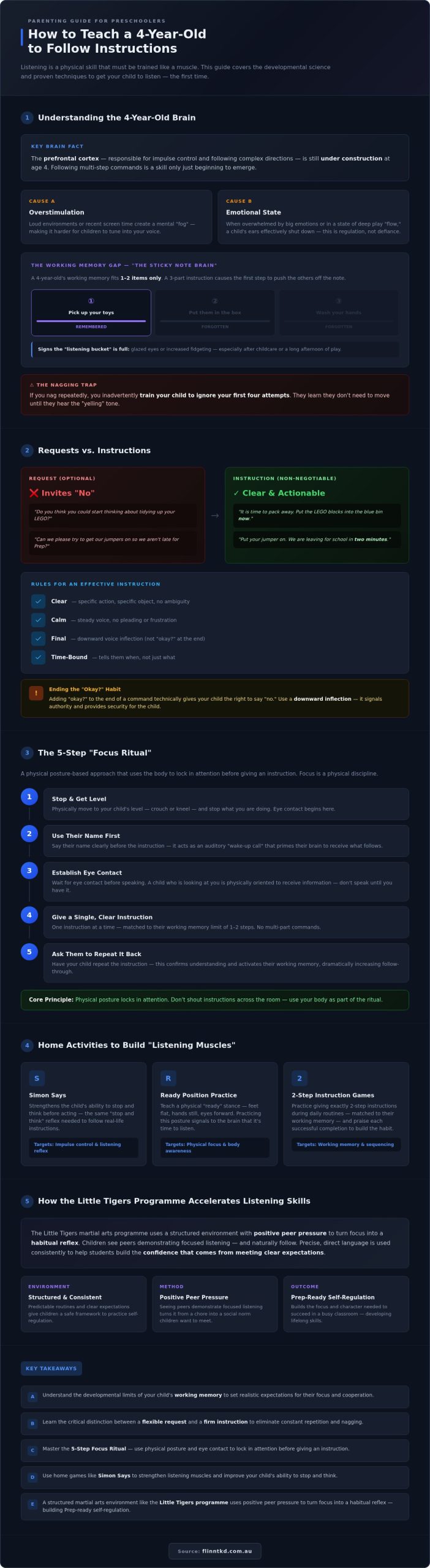
- Understand the developmental limits of your child’s working memory to set realistic expectations for their focus and cooperation.
- Learn the critical distinction between a flexible request and a firm instruction to eliminate the need for constant repetition and nagging.
- Master the five-step “Focus Ritual” that demonstrates how to teach a 4 year old to follow instructions by using physical posture to lock in attention.
- Implement simple home-based games like Simon Says to strengthen your child’s “listening muscles” and improve their ability to stop and think.
- Explore how a structured martial arts environment like the Little Tigers programme uses positive peer pressure to turn focus into a habitual reflex.
Understanding the 4-Year-Old Brain: Why Instructions Often Fail
It’s 7:00 AM in Brisbane, and you’ve already asked your child to put their shoes on four times. By the fifth attempt, your voice has reached a volume you aren’t proud of. Before you label your preschooler as “difficult,” it’s vital to look at what’s happening inside their head. At four years old, the prefrontal cortex, the part of the brain responsible for impulse control and following complex directions, is still very much under construction. When you’re looking for child development milestones, you’ll find that following multi-step commands is a skill that is only just beginning to emerge.
Understanding how to teach a 4 year old to follow instructions requires a shift in perspective. Your child isn’t necessarily ignoring you to be defiant. Often, their brain simply hasn’t processed the information yet. Overstimulation from loud environments or recent screen time can create a mental “fog” that makes it even harder for them to tune into your voice. Validating your own frustration is the first step; parenting a preschooler is exhausting, and feeling like a “nag” is a common experience for many local families preparing for the transition to Prep.
The ‘Working Memory’ Gap
Think of working memory as a small mental sticky note. For a four-year-old, that note only has enough room for one or maybe two items. When you say, “Pick up your toys, put them in the box, and then go wash your hands,” the first instruction usually pushes the others off the note. By the time they reach the toy box, they’ve literally forgotten what comes next. You can tell if their “listening bucket” is full for the day by observing their glazed eyes or increased fidgeting. If they’ve had a big day at childcare or a long afternoon of play, their capacity to hold onto instructions drops significantly.
Emotional Regulation vs. Stubbornness
There is a massive difference between a child who “won’t” listen and a child who “can’t” listen. When a preschooler is overwhelmed by big emotions or deep in a state of “flow” while playing, their ears effectively shut down. This isn’t stubbornness; it’s a lack of emotional regulation. If you fall into the trap of nagging, you inadvertently train your child to ignore your first four attempts. They learn that they don’t actually need to move until they hear that specific “yelling” tone in your voice. Breaking this cycle means understanding that focus is a physical discipline we must help them develop through patience and structure.
Requests vs. Instructions: The Secret to First-Time Cooperation
If your child treats every direction like a suggestion, you’ve likely fallen into the “request trap.” A request is an optional invitation to help, such as asking, “Would you like to help me water the garden?” An instruction is a non-negotiable, time-bound direction that requires action. Mastering how to teach a 4 year old to follow instructions requires you to distinguish between these two modes of communication. When you ask a child to do something that is actually a requirement, you create confusion and invite a “no.”
Consider these common household examples to see the difference in clarity:
- Before: “Do you think you could start thinking about tidying up your LEGO?”
- After: “It is time to pack away. Put the LEGO blocks into the blue bin now.”
- Before: “Can we please try to get our jumpers on so we aren’t late for Prep?”
- After: “Put your jumper on. We are leaving for school in two minutes.”
This shift isn’t about being a drill sergeant; it’s about being a clear leader. Children feel safer when they know exactly where the boundaries lie. In our Little Tigers programme, we use this precise, direct language to help students build the confidence that comes from meeting clear expectations.
Ending the ‘Okay?’ Habit
The “Question Inflection” is a habit where your voice goes up at the end of a sentence, making an instruction sound like a query. Adding “okay?” to the end of a command technically gives your child the right to say “no.” To fix this, practice using a downward inflection. This tonal shift signals authority and provides a sense of security for the child. An effective instruction is clear, calm, and final.
The Power of Choice within Instructions
While the end goal of an instruction is non-negotiable, you can still respect your child’s growing need for independence. This strategy aligns with AAP developmental milestones for 4 to 5 year olds, which emphasise the importance of fostering age-appropriate agency. Use “Limited Choices” to maintain the boundary while giving the child a sense of control. For example, say, “It’s time to put on your shoes. Do you want the blue ones or the red ones?” The outcome of wearing shoes is settled, but the child chooses the path to get there. This simple technique reduces power struggles and encourages cooperation without the need for nagging.
The 5-Step ‘Focus Ritual’ for Better Listening
Listening is a physical skill. In the dojang, we don’t just tell students to listen; we show them how to position their bodies for maximum focus. This “Physical Listening Posture” creates a mental bridge between hearing a sound and taking action. Mastering how to teach a 4 year old to follow instructions involves moving beyond verbal requests and implementing a repeatable ritual that prepares their brain for cooperation. When you use a consistent physical routine, you signal to your child that it’s time to switch from “play mode” to “listening mode.”
Follow these five steps to lock in their attention every time:
- Step 1: Get on their level. Move into their physical space and crouch down so your eyes are at the same height as theirs.
- Step 2: The ‘Touch Connection’. Place a gentle hand on their shoulder or arm to ground them in the present moment.
- Step 3: Eye contact and the ‘Ready’ signal. Wait for them to look at you before you speak. You might say, “Eyes on me,” to confirm they’re ready.
- Step 4: The ‘Quiet Voice’ instruction. Deliver your direction in a calm, low volume. Whispering often commands more attention than shouting.
- Step 5: The ‘Check for Understanding’. Ask them to repeat the instruction back to you before they move.
Physical Proximity: The 2-Metre Rule
Shouting from the kitchen while your child is in the lounge room is a guaranteed way to be ignored. For a four-year-old, your voice becomes background noise when you aren’t physically present. The 2-metre rule requires you to close the gap before you speak. Getting down to eye level is especially important because it reduces the “threat” response that can occur when a large adult towers over a small child. Your body language communicates the importance of the task far more effectively than the volume of your voice. When you take the time to move closer, you show them that the instruction is worth their full attention.
The ‘Repeat Back’ Technique
Asking your child to repeat the instruction in their own words is the “secret sauce” of effective parenting. This simple act forces their brain to move the information from short-term hearing into active memory. It prevents the “nod and forget” habit that many preschoolers develop. If they can’t repeat it, it’s a sign that your instruction was too long or they were too distracted to process it. Always use positive reinforcement when they get the “repeat” right. A quick “Spot on!” or “That’s exactly it!” builds their confidence and reinforces the habit of active listening. This technique is a cornerstone of how to teach a 4 year old to follow instructions because it confirms the message was received before the action even begins.
Home Activities to Build ‘Listening Muscles’
Play is the primary training ground for a preschooler’s discipline. If you want to master how to teach a 4 year old to follow instructions, you need to turn listening into a game they actually want to win. These activities aren’t just for fun; they are targeted drills designed to strengthen inhibitory control and working memory. By practicing these skills in a low-pressure environment, your child builds the mental fortitude needed for real-world cooperation.
- Simon Says: This is the gold standard for teaching inhibitory control. It requires children to filter out the “noise” and only act when they hear the specific cue.
- The ‘Freeze’ Game: Put on some music and have your child dance. When the music stops, they must freeze immediately. This builds the ability to stop an action mid-flow, which is a vital safety skill.
- Red Light, Green Light: This classic game sharpens reaction time and focus. It teaches children to pay close attention to changing commands while their bodies are in motion.
- Multi-Step Scavenger Hunts: Start with one item, then move to two. Say, “Find a red sock and a wooden spoon.” This safely stretches their working memory without causing a total meltdown.
Transitioning Games to Real Life
You can bridge the gap between play and household chores by using “game logic.” Instead of a direct command to clean up, try using a timer on your phone. The timer becomes the “referee,” which removes you from the role of the antagonist and turns the task into a race. This approach builds the foundational focus required for our Junior Taekwondo Brisbane prep, where students learn to respond to cues with precision and speed. If you find yourself struggling with daily routines, try turning the next instruction into a “mission” to keep the energy positive and productive.
Preparing for the Brisbane Prep Classroom
As your child approaches their first year of Prep in North Brisbane, teachers will expect them to follow instructions delivered to the whole group. Success during “Mat Time” depends on their ability to stay focused on the teacher’s voice while twenty other children are moving around them. Strengthening these skills at home directly impacts their social success at school. Children who can follow a two-step direction quickly feel more confident and are less likely to feel overwhelmed by the fast-paced classroom environment. If you want to give your child a head start on their school journey, enrol them in a programme that prioritises focus and discipline.
Consistency is your greatest tool. When you make listening a physical habit through these games, you’re doing more than just getting them to pick up toys. You’re teaching them how to teach a 4 year old to follow instructions by showing them that paying attention leads to success and recognition. Keep the sessions short, keep them energetic, and always celebrate the small wins of first-time listening.
How the Little Tigers Program Accelerates Listening Skills
While home activities provide a great foundation, the Little Tigers Program (4-6 years) acts as a specialised “listening lab” where focus skills are refined through structured training. In our dojang, your child experiences the power of positive peer pressure. When they see their peers standing still and responding to commands, they naturally want to mirror that behaviour. This social mimicry is one of the most effective ways for how to teach a 4 year old to follow instructions because it removes the direct parent-child friction and replaces it with a team focused goal.
The rituals of 跆拳道, such as bowing before entering the mat or standing at attention, are designed to build a “Focus Reflex.” These actions aren’t just about tradition; they are physical anchors that tell the brain it’s time to pay attention. Over time, following directions becomes an automatic response rather than a daily struggle. We call this “Black Belt Excellence,” a standard of character development that prepares our students for success in the Brisbane Prep classroom and beyond.
Ritualised Discipline vs. Punishment
Many parents worry that discipline requires being “mean,” but in our programme, structure makes following rules fun. We replace the stress of punishment with the reward of achievement. Children often find it easier to listen to a Master Instructor because the relationship is built on the shared goal of earning a new stripe or belt. The psychological impact of the uniform, or dobok, is also significant. Putting on the gear signals a major mindset shift, helping your child leave home distractions behind and step into their role as a focused martial artist.
Building Confidence through Competence
Every time a Little Tiger masters a new kick or block, they prove to themselves that they are capable. This sense of competence is directly linked to the mental discipline of listening. They realise that by following the instructor’s guidance, they achieve results they can be proud of. This “I can do it” attitude carries over into their daily lives, making them more resilient and cooperative at home. If you’re ready to see your child transform into a focused, confident listener, we invite you to book a trial at Flinn Taekwondo Academy. It’s the first step toward a calmer home and a successful start to their school journey.
Build a Foundation for School Success
Transforming your home from a place of constant nagging to an environment of calm cooperation is entirely possible. By understanding the limits of your child’s working memory and implementing a physical focus ritual, you provide them with the structure they need to thrive. Mastering how to teach a 4 year old to follow instructions is about more than just obedience; it’s about building the character and self-regulation skills they will carry into their first year of Prep and beyond.
At Flinn Taekwondo Academy, we specialise in helping preschoolers find their “listening ears” through our dedicated Little Tigers programme. Led by 7th Dan Black Belt Master Jeff Flinn, our family-owned academy in North Brisbane provides a safe, supportive space for your child to develop a lifelong focus reflex. We invite you to see the transformative power of our specialised 4-6 year old curriculum firsthand. Book a Free Trial for our Little Tigers Program in Brisbane North! and join a community that values personal growth and discipline. You’ve got this, and we’re here to help your family every step of the way.
常見問題
How many steps of instructions should a 4-year-old be able to follow?
A 4-year-old should typically be able to follow one to two steps at a time. Their working memory is still developing, so a three-step command often leads to them forgetting the middle part. If you are learning how to teach a 4 year old to follow instructions, start with single, clear directions. Once they master one step consistently, you can gradually introduce a second related task to build their mental stamina.
Why does my child follow instructions at daycare but not at home?
Children often listen better at daycare because of the highly structured environment and positive peer pressure. When they see twenty other children sitting for “Mat Time,” they naturally follow the group’s lead. At home, the boundaries are more flexible, and your child feels safe enough to test those limits with you. Bringing a bit of that “dojang structure” into your home can help bridge this cooperation gap.
Is my child’s refusal to listen a sign of ADHD or just their age?
Most of the time, a refusal to listen is a normal part of the preschool developmental phase rather than a clinical issue. At four, the prefrontal cortex is still under construction, making impulse control difficult. If you’re concerned, it’s always best to speak with your local Brisbane GP or paediatrician. However, many parents find that structured activities like our Little Tigers programme provide the discipline needed to improve these early focus skills.
How can I stop yelling when my child doesn’t listen?
Yelling usually happens when we feel ignored, but it often trains children to wait for the “loud voice” before they act. You can stop the cycle by using the 2-metre rule. Instead of shouting across the house, walk over, get on their level, and use a calm, quiet voice. When you change your physical approach, you reduce your own stress and make it much easier for your child to process the information.
Does martial arts really help with listening skills for such young children?
Martial arts is incredibly effective because it turns listening into a physical reflex. In our North Brisbane facility, we use rituals like bowing and standing at attention to signal to the brain that it’s time to focus. This specialised 4-6 year old curriculum helps children understand that following directions leads to achievement and recognition. It moves the concept of “listening” from a vague idea into a concrete, repeatable action.
What is the best way to handle a ‘power struggle’ with a preschooler?
The best way to handle a power struggle is to offer “Limited Choices” within a firm instruction. Instead of arguing about getting dressed, ask, “Do you want to put your shirt on first or your socks?” This gives your child a sense of agency and control while ensuring the end goal is met. It’s a powerful tool in how to teach a 4 year old to follow instructions without triggering a meltdown.
How long does it take to see improvement in a child’s listening habits?
You can often see a noticeable shift in cooperation within three to four weeks of consistent training. When you stop nagging and start using clear, downward-inflection instructions, your child begins to understand the new “rules” of the house. Pairing this at-home consistency with a structured programme like Taekwondo accelerates the process. Focus is a muscle that grows stronger every time it’s practiced correctly in a supportive environment.
Are there specific ‘listening games’ we can play in the car?
You can play “Audio Simon Says” or the “Sound Spotter” game while driving around Brisbane. Ask your child to listen for specific sounds, like a siren or a truck horn, and give a specific physical response when they hear it. These games keep their “listening ears” active during transit. It’s a simple way to practice inhibitory control and auditory processing while you’re busy navigating traffic on the way to school.